A Model for Improving Occupational Safety and Health Based on Ergonomics in Construction Projects
Article Sidebar
Main Article Content
Abstract
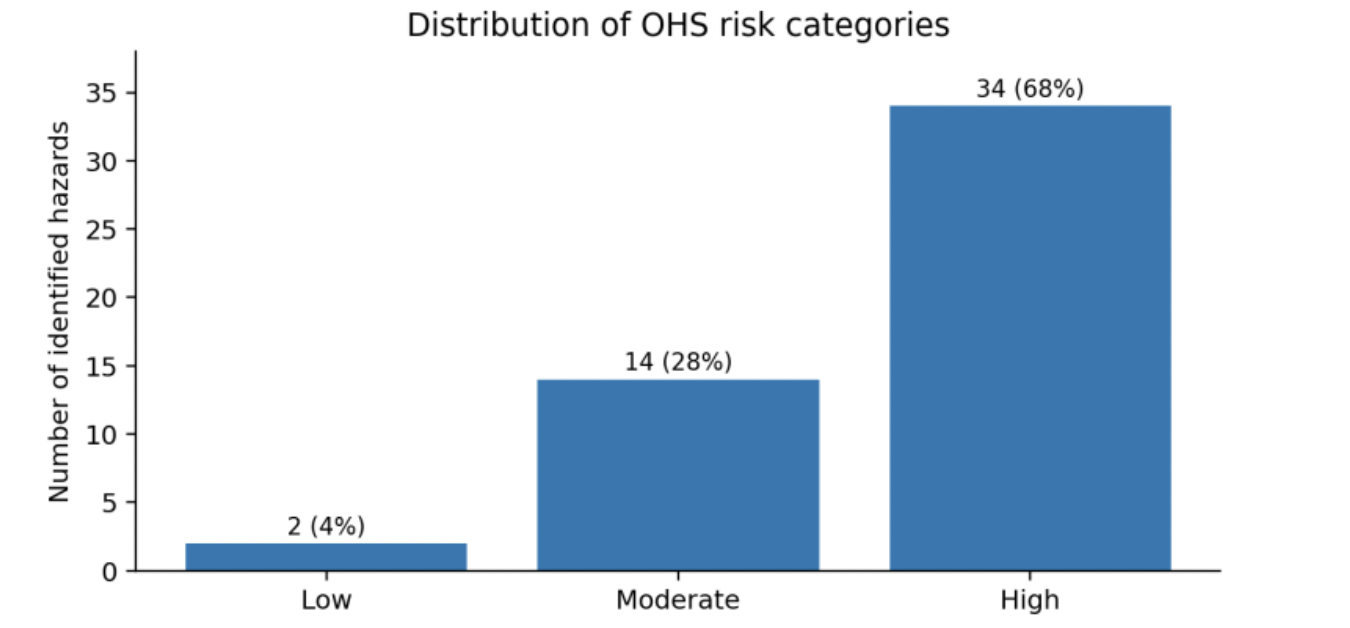
Construction workers are frequently exposed to falls, struck-by hazards, manual material handling, awkward postures, repetitive movements, and environmental stressors that may affect occupational safety, health, and productivity. This study integrates occupational safety and health (OSH) risk assessment with ergonomic risk factor evaluation to identify priority controls for building construction work. A descriptive cross-sectional design was applied to selected building projects in Badung, Denpasar, and Tabanan, Bali. Fifty workers and construction personnel were selected using purposive sampling because of their direct involvement in the observed activities. Primary data were collected through field observations, structured interviews, and closed questionnaires, while project records and relevant standards were used as secondary data. Fifty hazards associated with 18 work activities were assessed using modal likelihood and consequence scores. Ergonomic exposures were evaluated using the components of SNI 9011:2021 covering the upper body, back and lower body, and manual load handling. The risk assessment identified 2 low-risk hazards (4%), 14 moderate-risk hazards (28%), and 34 high-risk hazards (68%). The average ergonomic risk factor score by district was 44.89, while the average score by job type was 38.31; all assessed groups exceeded the hazardous threshold. Upper-body exposure was the largest contributor, followed by back/lower-body exposure and manual load handling. Existing controls were dominated by personal protective equipment and were insufficient to address the sources of ergonomic risk. An improvement framework is therefore proposed that prioritizes elimination or substitution, engineering controls, administrative controls, task-specific PPE, and periodic reassessment. The findings provide a structured basis for contractors to prioritize ergonomic and OSH interventions, although the proposed controls require post-implementation evaluation in future research.
Article Details

This work is licensed under a Creative Commons Attribution-ShareAlike 4.0 International License.
References
Ministry of Manpower of the Republic of Indonesia, Regulation of the Minister of Manpower No. 5 of 2018 concerning Occupational Safety and Health in the Work Environment, Jakarta, Indonesia, 2018.
National Standardization Agency of Indonesia, SNI 9011:2021, Measurement and Evaluation of Potential Ergonomic Hazards in the Workplace, Jakarta, Indonesia, 2021.
R. Vijayakumar and J.-H. Choi, “Emerging trends of ergonomic risk assessment in construction safety management: A scientometric visualization analysis,” International Journal of Environmental Research and Public Health, vol. 19, no. 23, Art. no. 16120, 2022, doi: 10.3390/ijerph192316120.
S. Anwer, H. Li, M. F. Antwi-Afari, and A. Y. L. Wong, “Associations between physical or psychosocial risk factors and work-related musculoskeletal disorders in construction workers based on literature in the last 20 years: A systematic review,” International Journal of Industrial Ergonomics, vol. 83, Art. no. 103113, 2021, doi: 10.1016/j.ergon.2021.103113.
C. Greggi, V. V. Visconti, M. Albanese, B. Gasperini, A. Chiavoghilefu, C. Prezioso, B. Persechino, S. Iavicoli, E. Gasbarra, R. Iundusi, and U. Tarantino, “Work-related musculoskeletal disorders: A systematic review and meta-analysis,” Journal of Clinical Medicine, vol. 13, no. 13, Art. no. 3964, 2024, doi: 10.3390/jcm13133964.
A. Kusumawardhani, H. Djamalus, and K. D. Lestari, “Ergonomic risk assessment and MSDs symptoms among laboratory workers using SNI 9011-2021,” The Indonesian Journal of Occupational Safety and Health, vol. 12, no. 1SI, pp. 35–41, 2023, doi: 10.20473/ijosh.v12i1SI.2023.35-41.
L. Sudiajeng, M. Yusuf, M. A. Santiana, I. K. Sutapa, and B. Martin, “Ergonomics risk factors analysis of building construction work in SARBAGITA Region Bali Indonesia,” International Research Journal of Engineering, IT and Scientific Research, vol. 11, no. 4, pp. 88–97, 2025, doi: 10.21744/irjeis.v11n4.2535.
Amalia, M. D. Kurniatie, D. S. Nugroho, and D. K. Wijaya, “Ergonomic assessment of manual material handling workers in the Semarang tofu industry utilizing SNI 9011:2021,” Jurnal Ergonomi Indonesia, vol. 10, no. 1, pp. 23–32, 2024, doi: 10.24843/JEI.2024.v10.i01.p03.
A. Susanto, Y. I. Komara, N. E. Mauliku, A. M. Khaliwa, A. D. Abdilah, A. D. Syuhada, and E. K. Putro, “Pengukuran dan evaluasi potensi bahaya ergonomi di laboratorium analisis dan assay Divisi Concentrating PT Freeport Indonesia,” Journal of Industrial Hygiene and Occupational Health, vol. 7, no. 1, 2022, doi: 10.21111/jihoh.v7i1.7996.
R. W. Safitri, M. N. Rhomadhoni, M. Sahri, and F. Ayu, “Evaluation of potential ergonomic hazards using the SNI 9011:2021 method for labeling unit workers in an East Java agro-industrial company,” Medical Technology and Public Health Journal, vol. 7, no. 2, pp. 166–170, 2023.
D. W. Napitupulu and H. Irwan, “Occupational safety and health evaluation using the Hazard Identification Risk Assessment and Risk Control (HIRARC) method based on ergonomics,” ASTONJADRO, vol. 15, no. 1, pp. 264–283, 2026, doi: 10.32832/astonjadro.v15i1.21231.
I. N. I. Kumara, D. Prayoga, I. B. Jnana, L. P. Putri, D. C. Indrashwara, and I. G. F. Tapa, "Balancing energy efficiency carbon reduction and cultural integrity through Tri Hita Karana guided envelope design in commercial buildings," in IET Conference Proceedings CP960, vol. 2025, no. 59, Dec. 2025, pp. 242–247, doi: 10.1049/icp.2026.2072.
K. H. E. Kroemer and E. Grandjean, Fitting the Task to the Human: A Textbook of Occupational Ergonomics, 5th ed. London, U.K.: CRC Press, 2009.
International Organization for Standardization, ISO 45001:2018, Occupational Health and Safety Management Systems—Requirements with Guidance for Use, Geneva, Switzerland, 2018.
International Labour Organization, Safety and Health in Construction: ILO Code of Practice, revised ed. Geneva, Switzerland: ILO, 2022.
Ministry of Public Works and Housing of the Republic of Indonesia, Regulation No. 10 of 2021 concerning Construction Safety Management System Guidelines, Jakarta, Indonesia, 2021.
A. R. K. Nasution, L. Ramadhanti, A. Fauziah, and H. D. Puspita, “Integrasi evaluasi ergonomi dan perancangan teknik dalam pengendalian risiko manual material handling: Studi kasus pada industri manufaktur,” Jurnal Penelitian Inovatif, 2026, doi: 10.54082/jupin.2269.
Y. A. N. Aziza and D. Erwandi, “Analisis penilaian dan rekomendasi desain ergonomi pada pekerja laboratorium menggunakan SNI 9011-2021,” Media Publikasi Promosi Kesehatan Indonesia, vol. 7, no. 2, pp. 433–441, 2024, doi: 10.56338/mppki.v7i2.4639.
H. N. Amrullah and M. Pristiwanti, “Penilaian risiko postur kerja dan perancangan ulang stasiun kerja pada pekerjaan marking sesuai SNI 9011:2021 di workshop fabrikasi baja,” Jurnal Keselamatan Kesehatan Kerja dan Lingkungan, vol. 5, no. 2, pp. 122–130, 2024, doi: 10.25077/jk3l.5.2.122-130.2024.
M. Pristiwanti, H. N. Amrullah, and F. Resmi, “Penilaian risiko ergonomi menggunakan SNI 9011:2021 dan perancangan ulang stasiun kerja pada pekerjaan pemotongan plat baja menggunakan mesin CNC di perusahaan fabrikasi baja,” Journal of Safety, Health, and Environmental Engineering, vol. 2, no. 2, pp. 18–26, 2024, doi: 10.35991/jshee.v2i2.42.