Performance of RAP-Based HRS-WC Mixtures Using Natural Rubber as Rejuvenator
Article Sidebar
Main Article Content
Abstract
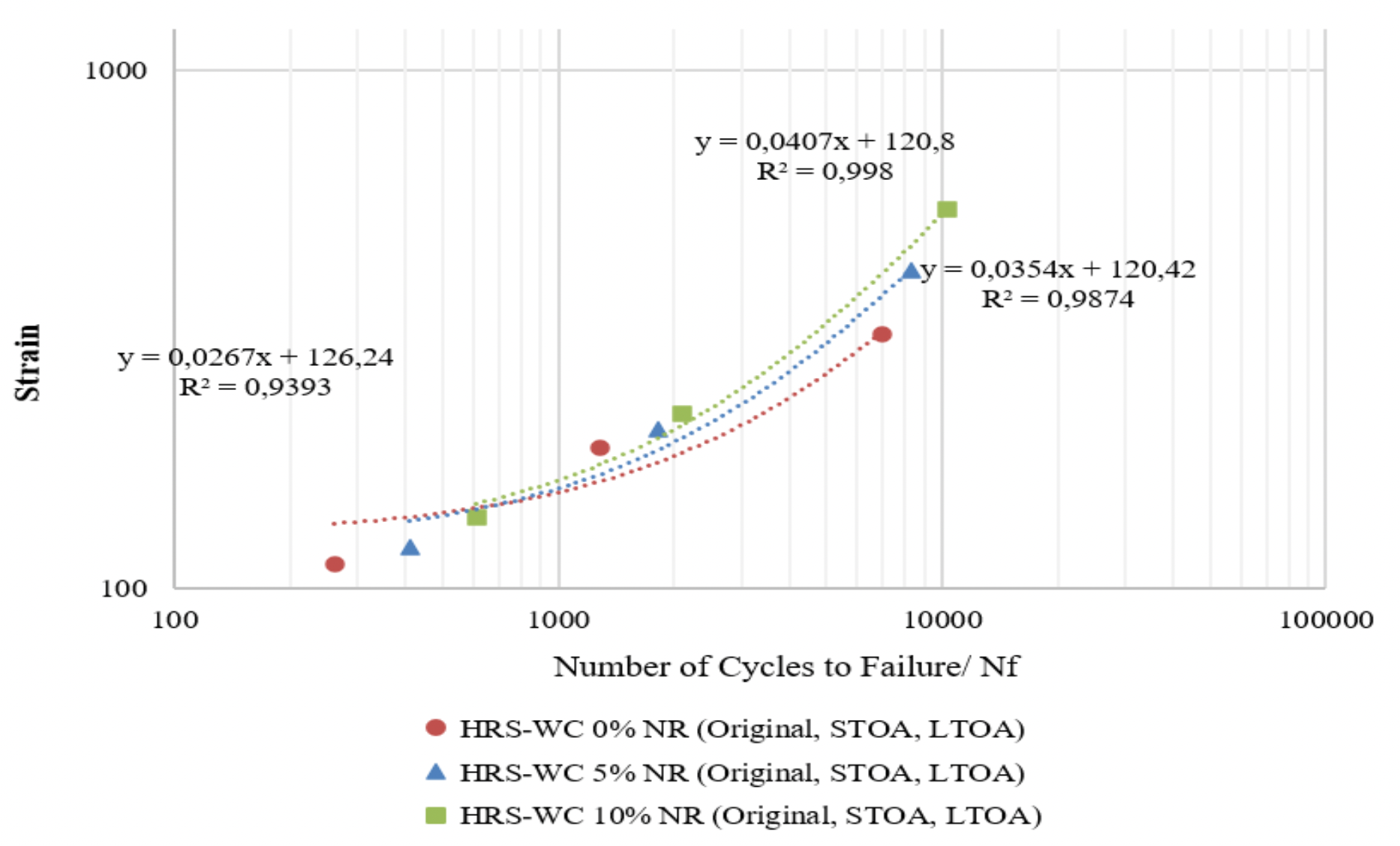
The growing demand for road pavement materials has encouraged the use of Reclaimed Asphalt Pavement (RAP) as a sustainable alternative. However, binder aging in RAP increases mixture stiffness, requiring rejuvenating agents to restore asphalt properties. This study aims to analyze the effect of Natural Rubber (NR) as a rejuvenating agent in RAP-based Hot Rolled Sheet-Wearing Course (HRS-WC) mixtures under unaged, Short-Term Oven Aging (STOA), and Long-Term Oven Aging (LTOA) conditions. The mixtures were designed using the Marshall method in accordance with RSNI M-01-2003, with NR contents of 0%, 5%, and 10% by weight of RAP asphalt. Performance evaluation included stiffness, deformation resistance, and fatigue resistance tests. The results indicate that NR affects the characteristics of RAP-based HRS-WC mixtures. The Indirect Tensile Stiffness Modulus (ITSM) decreases with increasing NR content, indicating improved flexibility and elasticity. However, stiffness increases after STOA and LTOA due to binder aging. The 10% NR mixture showed the best deformation resistance, with the lowest creep slope of 0.1284 under STOA. It demonstrated the highest fatigue resistance, achieving 10,311, 2,111, and 611 cycles to failure under unaged, STOA, and LTOA conditions, respectively. These findings demonstrate NR's potential as a rejuvenating agent for improving RAP-based HRS-WC performance and durability.
Article Details

This work is licensed under a Creative Commons Attribution-ShareAlike 4.0 International License.
References
W. Ervianto, “Kajian green construction infrastruktur jalan dalam aspek konservasi sumberdaya alam,” in Proc. Konferensi Nasional Teknik Sipil 7 (KoNTekS 7), 2013.
G. M. Lawalata et al., Jalan Hijau Indonesia: Naskah Ilmiah. Jakarta, Indonesia, 2013. [3] Jahanbakhsh, H., Karimi, M.M., Naseri, H., Nejad, F.M. 2020. Sustainable Asphalt Concrete Containing High Reclaimed Asphalt Pavements and Recycling Agents: Performance Assessment, Cost Analysis, and Environmental Impact. Journal of Cleaner Production, 244.
L. Noferini, A. Simone, C. Sangiorgi, and F. Mazzotta, “Investigation on performances of asphalt mixtures made with reclaimed asphalt pavement: Effects of interaction between virgin and RAP bitumen,” International Journal of Pavement Research and Technology, vol. 10, no. 4, pp. 322–332, 2017, doi: 10.1016/j.ijprt.2017.03.011.
X. Chen and H. Wang, “Life cycle assessment of asphalt pavement recycling for greenhouse gas emission with temporal aspect,” Journal of Cleaner Production, vol. 187, pp. 148–157, 2018, doi: 10.1016/j.jclepro.2018.03.207.
H. Jahanbakhsh, M. M. Karimi, H. Naseri, and F. M. Nejad, “Sustainable asphalt concrete containing high reclaimed asphalt pavements and recycling agents: Performance assessment, cost analysis, and environmental impact,” Journal of Cleaner Production, vol. 244, Art. no. 118837, 2020, doi: 10.1016/j.jclepro.2019.118837.
Y. Wang, Z. Leng, X. Li, and C. Hu, “Cold recycling of reclaimed asphalt pavement towards improved engineering performance,” Journal of Cleaner Production, vol. 171, pp. 1031–1038, 2018, doi: 10.1016/j.jclepro.2017.10.132.
M. Y. El-Hakim and S. L. Tighe, “Sustainability of perpetual pavement designs: Canadian perspective,” Transportation Research Record, vol. 2304, no. 1, pp. 10–16, 2012, doi: 10.3141/2304-02.
N. Nono, Campuran Beraspal Panas Daur Ulang dengan Proporsi RAP Tinggi. Bandung, Indonesia: Pusat Penelitian dan Pengembangan Jalan dan Jembatan, 2018.Pusat Penelitian Dan Pengembangan Jalan Dan Jembatan, .
J. Qiu, E. Schlangen, M. F. C. van de Ven, and M. Shirazi, “Reintroducing the intrinsic self-healing properties in reclaimed asphalt by rejuvenation,” in Proc. 4th International Conference on Self-Healing Materials, 2013.
R. B. Ahmed and K. Hossain, “Waste cooking oil as an asphalt rejuvenator: A state-of-the-art review,” Construction and Building Materials, vol. 230, Art. no. 116985, 2020, doi: 10.1016/j.conbuildmat.2019.116985
A. Dony, R. Colin, D. Bruneau, I. Drouaine, and J. Navarro, “Rejuvenation of asphalt concrete with high recycling rates: Changes in reclaimed binder properties according to rejuvenating agent,” Construction and Building Materials, vol. 41, pp. 175–181, 2013.
I. N. A. Thanaya, I. M. A. Ariawan, and I. P. C. Wibawa, “Analisis karakteristik campuran Laston menggunakan material perkerasan jalan lama dengan peremaja limbah minyak goreng,” Media Komunikasi Teknik Sipil, vol. 28, no. 2, pp. 230–240, 2022, doi: 10.14710/mkts.v28i2.48137.
A. R. Sulaiman, G. B. G. G., and B. B. Bustamin, “Penambahan latek alam campuran Laston bongkaran sebagai polimer untuk peremajaan lapisan AC-WC,” Teknik Sipil Politeknik Negeri Samarinda, 2022.
E. Shaffie, A. K. Arshad, A. Alisibramulis, J. Ahmad, W. Hashim, Z. Abd Rahman, and R. P. Jaya, “Effect of mixing variables on physical properties of modified bitumen using natural rubber latex,” International Journal of Civil Engineering and Technology, vol. 9, no. 7, pp. 1812–1821, 2018.
H. Liu, Z. Zhang, et al., “Effects of polyphosphoric acid (PPA), styrene-butadiene-styrene (SBS), or rock asphalt on the performance of desulfurized rubber modified asphalt,” Journal of Applied Polymer Science, 2021, doi: 10.1002/app.50621.
M. Jasso, R. Hampl, O. Vacin, D. Bakos, J. Stastna, and L. Zanzotto, “Rheology of conventional asphalt modified with SBS, Elvaloy and polyphosphoric acid,” Fuel Processing Technology, vol. 140, pp. 172–179, 2015, doi: 10.1016/j.fuproc.2015.09.002.
J. Wititanapanit, J. S. Carvajal-Munoz, and G. Airey, “Performance-related and rheological characterisation of natural rubber modified bitumen,” Construction and Building Materials, vol. 268, Art. no. 121058, 2021, doi: 10.1016/j.conbuildmat.2020.121058.
N. M. Azahar, N. A. Hassan, R. Putrajaya, M. R. Hainin, O. C. Puan, N. A. M. Shukry, and M. A. Hezmi, “Engineering properties of asphalt binder modified with cup lump rubber,” IOP Conference Series: Earth and Environmental Science, vol. 220, Art. no. 012014, 2019, doi: 10.1088/1755-1315/220/1/012014.
N. Pradani, B. S. Subagio, H. Rahman, and H. C. H. “Kinerja kelelahan campuran beton aspal lapisan aus menggunakan material hasil daur ulang dan polimer styrene-butadiene-styrene,” Jurnal Transportasi, vol. 11, no. 1, 2011.
I. N. A. Thanaya, I. G. R. Puranto, and I. N. S. Nugraha, “Studi karakteristik campuran aspal beton lapis aus (AC-WC) menggunakan aspal penetrasi 60/70 dengan penambahan lateks,” Media Komunikasi Teknik Sipil, vol. 22, no. 2, pp. 77–86, 2016, doi: 10.14710/mkts.v22i2.12875.
F. L. Roberts, P. S. Kandhal, E. R. Brown, D.-Y. Lee, and T. W. Kennedy, Hot Mix Asphalt Materials, Mixture Design, and Construction, 2nd ed. Lanham, MD, USA: NAPA Education Foundation, 1996.
H. Saodang, Konstruksi Jalan Raya, Buku 2: Perancangan Perkerasan Jalan Raya. Bandung, Indonesia: Nova, 2005.
R. Taufik, “Evaluasi kinerja campuran Laston lapis aus (AC-WC) menggunakan RAP dengan peremaja bioetanol dan kelapa sawit,” Institut Teknologi Bandung, 2023.
B. Sumantri, H. Santiko, L. Djakfar, and H. Bowoputro, “Pengaruh peremaja oli bekas dan solar terhadap karakteristik Marshall perkerasan daur ulang dengan Asbuton,” 2014.
X. Yu, Z. Ma, M. Dos Santos, S. Poulakidas, L. D. Poulikakos, and others, “Rheological, microscopic, and chemical characterization of the rejuvenating effect on asphalt binders,” Fuel, vol. 135, pp. 162–171, 2014, doi: 10.1016/j.fuel.2014.06.038.