The Badung River Level Capacity Due to Probable Maximum Flood in Denpasar City
Article Sidebar
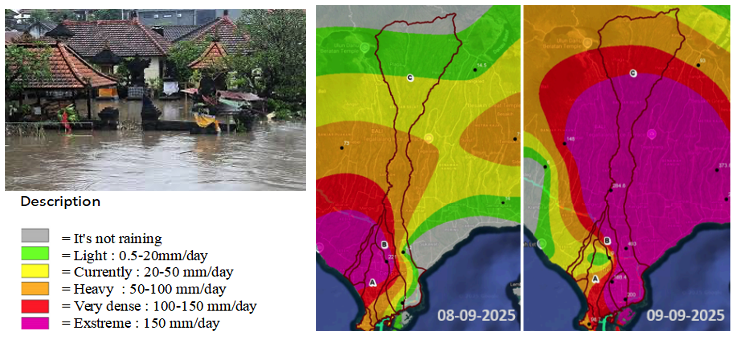
Main Article Content
Abstract
The runoff coefficient in the Badung river basin changes from 0.57 to 0.71 in 2026, especially due to the conversion of rice fields into residential and commercial areas, as well as the reduction of mangrove forests and green open spaces. These changes have resulted in a significant increase in runoff and flooding in the Badung River. The Probable Maximum Flood calculated in 2000 was 485.82 m3/s, in 2026 it was 764.91 m3/s. Over the past 26 years, the Badung River has experienced a 57.45% increase in the Maximum Probable Flood. The embankment capacity upstream of Hasanuddin Bridge is 503.579 m3/s, while downstream of Hasanuddin Bridge the capacity of the Badung River embankment is 482.174 m3/s. This analysis concludes that flood conditions around Hasanuddin Street are 0.80 m above the average height of the Badung River embankment. Necessary measures in the study area include raising the Badung River embankment by 1.6 meters in flood-affected areas, normalizing the channel slope to 0.009, maintaining the area's flow coefficient at 0.71, and managing and controlling waste in the area. This treatment will increase the capacity of the Badung River in flood-affected areas to 886.360 m3/sec.
Article Details

This work is licensed under a Creative Commons Attribution-ShareAlike 4.0 International License.
References
M. H. E. S. Harahap, “Causes & impacts of extreme flooding in Denpasar Bali 10 September 2025,” Antara News, Sep. 2025.
F. Ramadhan, “Walhi: Poor Spatial Planning and Land Conversion Cause Bali Floods,” Media Indonesia, Denpasar City, Sep. 2025.
Y. C. A. Sanjaya, “Foreign Media Says about Bali Floods: 9 People Died, Called an Unusual Disaster,” Kompas.com, Sep. 2025.
D. Ayu and C. Angelina, “Spatial Analysis of Priority Factors for Flood-Prone Areas in Denpasar City, Bali Province,” vol. 11, no. 2, pp. 145–152, 2022.
I. A. D. Giriantari and A. G. U. Sistem, “Flood Potential Analysis in Denpasar City Using the Analytical Hierarchy Process Method,” Maj. Ilm. Technol. Elektro, vol. 17, no. 2, pp. XX–XX, 2018, doi: 10.24843/mite.2018.v17i02.p10.
R. Vichotama, R. Haribowo, and T. B. Prayogo, “Water Quality Analysis of Tukad Badung, Denpasar, Bali Using the QUAL2Kw Program,” Jurnal Teknologi dan Rekayasa Sumber Daya Air, vol. 1, no. 1, pp. 40–51, 2021, doi: 10.21776/ub.jtresda.2021.001.01.04.
M. Witari, “Management of Badung River as a City Tour Attraction Using a Participatory Development Model,” Jurnal Kepariwisataan, vol. 6, no. 1, pp. 146–152, 2007, doi: 10.52352/jpar.v6i1.20.
M. F. J. et al., “Spatiotemporal Variability of Channel Roughness and its Substantial Influence on Flood Propagation,” Earth's Future, vol. 12, no. 7, Jul. 2024, doi: 10.1029/2023EF004257.
C. D. Sumarto, Engineering Hydrology, 2nd ed. Malang, Indonesia: Erlangga, 1999.
Y. Harjono and Widhiastuti, “Hydrology and Hydraulic Analysis of the Kali Pacal River Basin, Bojonegoro,” Civil Engineering, vol. 13, no. 1, pp. 16–23, 2019, doi: 10.21776/ub.tekniksipil.2019.013.01.3.
B. R. Sri Harto, Hydrological Analysis. Jakarta, Indonesia: Gramedia Pustaka Utama, 1993.
V. T. Chow, D. R. Maidment, and L. W. Mays, Applied Hydrology. New York, NY, USA: McGraw-Hill, 1988.
Region III Denpasar Meteorology, Climatology, and Geophysics Agency, “Daily weather forecast and climate analysis for Denpasar City,” BMKG Region III Denpasar, Denpasar, Indonesia, Tech. Rep., 2026. Available: https://balai3.bmkg.go.id/ [Accessed: Aug. 26, 2026]
BPS-Statistics of Denpasar City, “Denpasar Municipality in Figures 2026,” BPS-Statistics of Denpasar City, Denpasar, Indonesia, vol. 34, Feb. 2026. Available: https://denpasarkota.bps.go.id/ [Accessed: Aug. 26, 2026].
Denpasar City Regional Government, “Regional Regulation of Denpasar City Number 8 of 2021 concerning Denpasar City Spatial Plan for 2021–2041,” Regional Gazette of Denpasar City, Denpasar, Indonesia, No. 8, Dec. 2021. Available: https://jdih.denpasarkota.go.id/ [Accessed: Aug. 26, 2026].
Ministry of Public Works, “Drainage system assessment and flood control in Denpasar City 2025,” Ministry of Public Works, Tech. Rep., 2025. [Online]. Available: https://www.pu.go.id. [Accessed: Aug. 09, 2026].
K. K. Khatua and B. Mahakul, “Flood in Mahanadi delta stage II area - A case study,” in Proc. Nat. Sem. on Disaster Management, UCE, Burla, Orissa, 1999.
Paimin, I. B. Pramono, Purwanto, and D. R. Indrawati, Watershed Management Planning System. Bogor, Indonesia: Center for Conservation and Rehabilitation Research and Development, Ministry of Forestry, 2012.
I. B. P. Adnyana and I. W. G. E. Triswandana, "Analisis debit banjir dan kapasitas tanggul Tukad Badung di Kota Denpasar," Jurnal Ilmiah Teknik Sipil, vol. 24, no. 2, pp. 112–119, Jul. 2020. Available: Jurnal Ilmiah Teknik Sipil Unud. doi: 10.24843/JITS.2020.v24.i02.p03
S. Sosrodarsono and K. Takeda, Hydrology for Irrigation. Jakarta, Indonesia: PT Pradnya Paramita, 1985.
C. A. Siwi, A. Binilang, and F. Halim, “Capacity analysis of the Makalu River in Southeast Minahasa Regency against flood discharge for specified return periods” (in Indonesian), Jurnal Sipil Statik, vol. 6, no. 4, pp. 199–210, 2011.
P. D. H. Ardana et al., “Design flood discharge analysis in the Tukad Mati watershed” (in Indonesian), Jurnal Teknik Gradien, vol. 14, no. 2, pp. 58–70, Oct. 2021, doi: 10.47329/ teknikgradien.v13i2.761
H. Nugroho, Aplikasi Hidrologi (Hydrology Applications). Jogjakarta, Indonesia: Jogja Global Media, 2008.
Soewarno, Hydrology: Application of Statistical Methods for Data Analysis. Bandung, Indonesia: Nova, 1995.
S. A. Brown, S. M. Stein, and J. C. Warner, Urban Drainage Design Manual, Hydraulic Engineering Circular No. 22, 3rd ed., Publication No. FHWA-NHI-10-009, Federal Highway Administration (FHWA), Washington, DC, USA, 2009.
S. Javadinejad, R. Dara, and N. Dolatabadi, “Runoff coefficient estimation for various catchment surfaces,” Resour. Environ. Inf. Eng., vol. 3, no. 1, pp. 145–155, 2022, doi: 10.25082/REIE.2021.01.005.