Selection of Scaffolding Materials Using AHP: Case Study of Puspem Gianyar
Article Sidebar
Main Article Content
Abstract
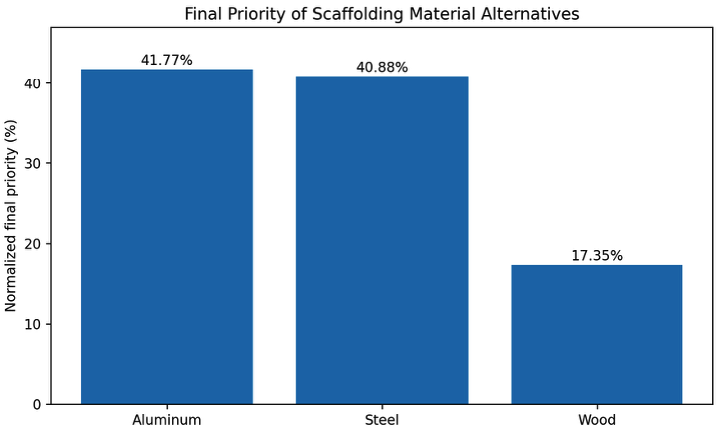
The selection of scaffolding materials is a multi-criteria decision problem because safety, technical performance, cost, time, and operational considerations may lead to different preferences. This study evaluates wood, steel, and aluminum scaffolding for reinforced-concrete works in Building A of the Gianyar Government Center (Puspem Gianyar). A mixed-method design was applied using field observation, structured interviews, project documents, and pairwise-comparison questionnaires completed by 30 construction practitioners and experts. Respondents were selected purposively, and individual judgments were aggregated using the geometric mean before being processed with the Analytical Hierarchy Process (AHP). The revised reciprocal criteria matrix produced occupational safety as the highest-priority criterion (35.86%), followed by technical performance (27.09%), time (17.22%), cost (11.30%), and operational convenience (8.53%). The criteria matrix had a consistency ratio of 2.90%, while the sub-criteria matrices had a consistency ratio of 0.79%, both below the 10% acceptance threshold. After synthesizing criterion, sub-criterion, and alternative priorities, aluminum achieved the highest normalized final priority (41.77%), narrowly exceeding steel (40.88%), while wood obtained 17.35%. Aluminum performed strongly in durability, reuse, maintenance, installation efficiency, dismantling, and transportation, whereas steel remained superior in material strength, rigidity, and structural safety. The narrow difference between aluminum and steel indicates that the final decision remains sensitive to project-specific safety and technical requirements. The model offers a transparent decision-support framework rather than a universal material prescription.
Article Details

This work is licensed under a Creative Commons Attribution-ShareAlike 4.0 International License.
References
Occupational Safety and Health Administration, 1926.451 General requirements, Safety and Health Regulations for Construction, Subpart L Scaffolds. [Online]. Available: https://www.osha.gov/laws-regs/regulations/standardnumber/1926/1926.451. Accessed: Aug. 4, 2026.
D. Fang, Q. Shen, S. Wu, and G. Liu, A comprehensive framework for assessing and selecting appropriate scaffolding based on analytic hierarchy process, Journal of Safety Research, vol. 34, no. 5, pp. 589596, 2003, doi: 10.1016/j.jsr.2003.05.008.
T. L. Saaty, Decision making with the analytic hierarchy process, International Journal of Services Sciences, vol. 1, no. 1, pp. 8398, 2008, doi: 10.1504/IJSSCI.2008.017590.
S. Aminbakhsh, M. Gunduz, and R. Sonmez, Safety risk assessment using analytic hierarchy process (AHP) during planning and budgeting of construction projects, Journal of Safety Research, vol. 46, pp. 99105, 2013, doi: 10.1016/j.jsr.2013.05.003.
J. C. Rubio-Romero, M. C. Rubio Gmez, and J. A. Carrillo-Castrillo, Analysis of the safety conditions of scaffolding on construction sites, Safety Science, vol. 55, pp. 160164, 2013, doi: 10.1016/j.ssci.2013.01.006.
R. G. Beale, Scaffold research A review, Journal of Constructional Steel Research, vol. 98, pp. 188200, 2014, doi: 10.1016/j.jcsr.2014.01.016.
E. Bazik-Borowa and J. Szer, The analysis of the stages of scaffolding life with regard to the decrease in the hazard at building works, Archives of Civil and Mechanical Engineering, vol. 15, no. 2, pp. 516524, 2015, doi: 10.1016/j.acme.2014.09.009.
E. Bazik-Borowa and J. Bc, Influence of dynamic properties on scaffoldings safety, Archives of Civil and Mechanical Engineering, vol. 21, Art. no. 144, 2021, doi: 10.1007/s43452-021-00295-3.
T. Terzioglu, G. Polat, and H. Turkoglu, Analysis of formwork system selection criteria for building construction projects: A comparative study, Buildings, vol. 11, no. 12, Art. no. 618, 2021, doi: 10.3390/buildings11120618.
I. N. I. Kumara, D. Prayoga, I. B. Jnana, L. P. Putri, D. C. Indrashwara, and I. G. F. Tapa, "Balancing energy efficiency carbon reduction and cultural integrity through Tri Hita Karana guided envelope design in commercial buildings," in IET Conference Proceedings CP960, vol. 2025, no. 59, Dec. 2025, pp. 242247, doi: 10.1049/icp.2026.2072.
T. T. Worku, Formwork material selection and optimization by a comprehensive integrated subjectiveobjective criteria weighting MCDM model, Discover Materials, vol. 5, Art. no. 2, 2025, doi: 10.1007/s43939-024-00162-x.
G. Raviv, A. Shapira, and B. Fishbain, AHP-based analysis of the risk potential of safety incidents: Case study of cranes in the construction industry, Safety Science, vol. 91, pp. 298309, 2017, doi: 10.1016/j.ssci.2016.08.027.
E. Ilbahar, A. Karaan, S. Cebi, and C. Kahraman, A novel approach to risk assessment for occupational health and safety using Pythagorean fuzzy AHP and fuzzy inference system, Safety Science, vol. 103, pp. 124136, 2018, doi: 10.1016/j.ssci.2017.10.025.
A. Mohammadi, M. Tavakolan, and Y. Khosravi, Factors influencing safety performance on construction projects: A review, Safety Science, vol. 109, pp. 382397, 2018, doi: 10.1016/j.ssci.2018.06.017.
A. Bavafa, A. Mahdiyar, and A. K. Marsono, Identifying and assessing the critical factors for effective implementation of safety programs in construction projects, Safety Science, vol. 106, pp. 4756, 2018, doi: 10.1016/j.ssci.2018.02.025.
International Organization for Standardization, ISO 45001:2018 Occupational Health and Safety Management Systems Requirements with Guidance for Use. Geneva, Switzerland: ISO, 2018.
European Committee for Standardization, EN 12811-1:2003 Temporary Works Equipment Part 1: Scaffolds Performance Requirements and General Design. Brussels, Belgium: CEN, 2003.
Ministry of Public Works and Housing of the Republic of Indonesia, Regulation No. 10 of 2021 concerning Guidelines for the Construction Safety Management System. Jakarta, Indonesia, 2021.