Aggregate Gradation Influence on Marshall and Stiffness of AC-WC Mixtures
Article Sidebar
Main Article Content
Abstract
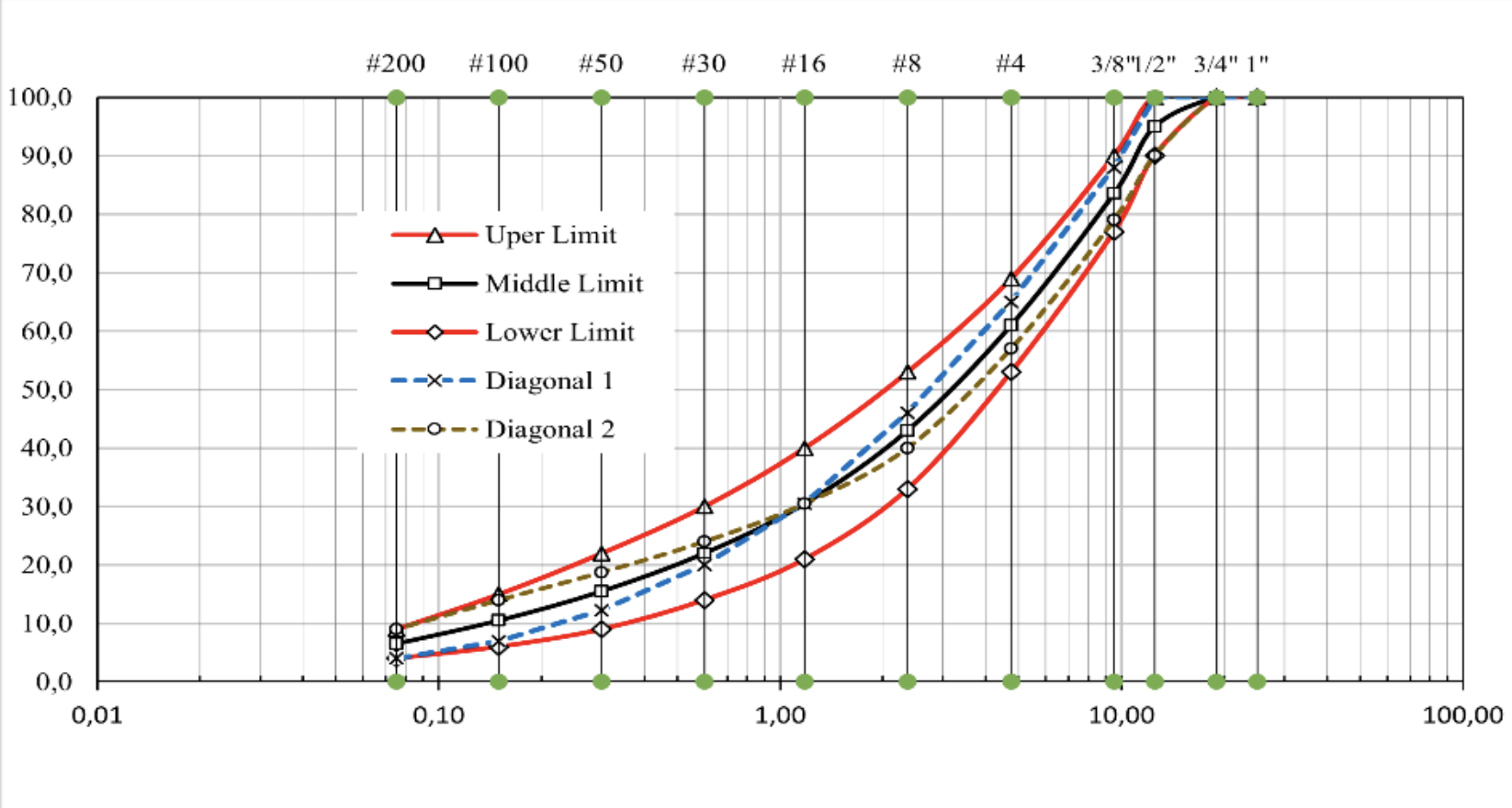
Aggregate gradation plays an important role in determining the performance of asphalt mixtures used in road pavement structures. Numerous studies have investigated the influence of aggregate gradation on Marshall characteristics and volumetric properties of asphalt mixtures. However, limited studies have examined the combined effect of aggregate gradation variations within the specification limits on both Marshall characteristics and stiffness performance of AC-WC mixtures. In addition, the influence of proportional gradation variations across the specification envelope has not been widely discussed. Therefore, this study aims to investigate the influence of aggregate gradation variations within the specification limits of Asphalt Concrete Wearing Course (AC-WC) on optimum asphalt content, Marshall characteristics, and mixture stiffness. Five aggregate gradation variations were prepared using the proportional method based on gradation limits. Laboratory tests were conducted using Marshall testing and Indirect Tensile Stiffness Modulus (ITSM) to evaluate mixture performance. The results show that aggregate gradation significantly affects the optimum asphalt content and mechanical characteristics of the mixture. Finer aggregate gradation increases the aggregate surface area and requires higher asphalt content. The optimum asphalt content for different gradation variations ranged from 5.7% to 6.3%. In addition, finer gradation produced lower air voids (VIM) and resulted in higher Marshall stability and mixture stiffness. These findings indicate that aggregate gradation has a significant influence on the volumetric and mechanical properties of AC-WC mixtures.
Article Details

This work is licensed under a Creative Commons Attribution-ShareAlike 4.0 International License.
References
S. Jain and B. Singh, “Cold mix asphalt: An overview,” J. Clean. Prod., vol. 280, p. 124378, Jan. 2021, doi: 10.1016/j.jclepro.2020.124378.
M. Amoori Kadhim, M. H. Al-Tameemi, M. F. M. Zain, and A. N. Baharom, “Developing a sustainable, post treated, half warm mix asphalt for structural surface layer,” Constr. Build. Mater., vol. 342, p. 127926, Aug. 2022, doi: 10.1016/j.conbuildmat.2022.127926.
P. Deb and K. L. Singh, “Mix design, durability and strength enhancement of cold mix asphalt: A state-of-the-art review,” Innov. Infrastruct. Solut., vol. 7, no. 1, p. 61, Feb. 2022, doi: 10.1007/s41062-021-00600-2.
S. Dash, A. Chandrappa, and U. C. Sahoo, “Design and performance of cold mix asphalt – A review,” Constr. Build. Mater., vol. 315, p. 125687, Jan. 2022, doi: 10.1016/j.conbuildmat.2021.125687.
W. Li, Y. Tian, R. Ma, Z. Leng, and J. Zhong, “Study on the early cement hydration process in the presence of cationic asphalt emulsion,” Constr. Build. Mater., vol. 261, p. 120025, Nov. 2020, doi: 10.1016/j.conbuildmat.2020.120025.
W. Li, W. Cao, X. Ren, S. Lou, S. Liu, and J. Zhang, “Impacts of aggregate gradation on the volumetric parameters and rutting performance of asphalt concrete mixtures,” Materials, vol. 15, no. 14, p. 4866, Jul. 2022, doi: 10.3390/ma15144866.
Y. Yue, M. Abdelsalam, and M. S. Eisa, “Aggregate gradation variation on the properties of asphalt mixtures,” Coatings, vol. 12, no. 11, p. 1608, Oct. 2022, doi: 10.3390/coatings12111608.
Ministry of Public Works and Housing of Indonesia, General Specifications for Highway Construction (Bina Marga 2018 Revision 2). Jakarta, Indonesia, 2020.
V. S. Arrieta and J. E. C. Maquilón, “Resistance to degradation or cohesion loss in Cantabro test on specimens of porous asphalt friction courses,” Procedia Soc. Behav. Sci., vol. 162, pp. 290–299, 2014, doi: 10.1016/j.sbspro.2014.12.210.
N. Saboo, D. Mehta, A. Sharma, and R. Kumar, “Development of aggregate gradation based on asphalt film thickness and aggregate structure,” Constr. Build. Mater., vol. 440, p. 137424, Aug. 2024, doi: 10.1016/j.conbuildmat.2024.137424.
M. Anggraini, “Perbandingan gradasi agregat gabungan campuran AC-WC sebelum dan setelah penghamparan dengan job mix formula,” 2017.
I. B. Wirahaji, “Analisis gradasi agregat gabungan laston binder pada ruas jalan Simpang Tohpati–Simpang Sakah,” J. Ilm. Tek. Sipil, vol. 16, no. 2, pp. 198–207, 2012.
Directorate General of Highways, Highway Engineering Guidelines. Jakarta, Indonesia, 2014.
H. Yu, M. Yang, G. Qian, J. Cai, H. Zhou, and X. Fu, “Gradation segregation characteristic and its impact on performance of asphalt mixture,” J. Mater. Civ. Eng., vol. 33, no. 3, 2021, doi: 10.1061/(ASCE)MT.1943-5533.0003535.
Asphalt Institute, Asphalt Cold Mix Manual, Manual Series No. 14 (MS-14), 3rd ed., Lexington, KY, USA, 1989.
British Standards Institution, BS EN 12697-26 Bituminous Mixtures – Test Methods for Hot Mix Asphalt – Part 26: Stiffness, London, UK, 2012.
AASHTO, AASHTO T245 Standard Method of Test for Resistance to Plastic Flow of Asphalt Mixtures Using Marshall Apparatus, Washington DC, USA, 2022.
H. Al-Mosawe, N. Thom, G. Airey, and A. Al-Bayati, “Effect of aggregate gradation on the stiffness of asphalt mixtures,” Int. J. Pavement Eng. Asphalt Technol., vol. 16, no. 2, pp. 39–49, 2015.
X. Zhou et al., “Property improvement of epoxy emulsified asphalt modified by waterborne polyurethane in consideration of environmental benefits,” Case Stud. Constr. Mater., vol. 21, 2024, doi: 10.1016/j.cscm.2024.e03559.
L. Devulapalli, G. Sarang, and S. Kothandaraman, “Characteristics of aggregate gradation, drain down and stabilizing agents in stone matrix asphalt mixtures: A state of art review,” J. Traffic Transp. Eng., vol. 9, no. 2, pp. 167–179, 2022.
J. L. S. Ferreira, L. F. A. L. Babadopulos, J. B. S. Bastos, and J. B. Soares, “A tool to design rutting resistant asphalt mixes through aggregate gradation selection,” Constr. Build. Mater., vol. 236, p. 117531, 2020.
Z. Li, W. Liu, C. Zhang, Y. Zhao, and H. Liu, “Effect of fine aggregate gradation on macro and micro properties of cold recycling mixture using emulsified asphalt,” Coatings, vol. 12, no. 5, p. 674, 2022.
M. A. Alsheyab and M. A. Khasawneh, “Statistical modeling of asphalt pavement surface friction based on aggregate fineness modulus and asphalt mix volumetrics,” Int. J. Pavement Res. Technol., vol. 17, no. 5, pp. 1093–1111, 2024.
P. Budiarnaya, “Analisis kerusakan jalan menggunakan metode Bina Marga 1990 (Studi kasus Jalan Kapten Agung, Denpasar),” J. Ilm. TELSINAS, vol. 6, no. 1, pp. 46–59, Apr. 2023, doi: 10.38043/telsinas.v6i1.4324.
R. I. Dayanti, Irwansyah, and W. Alamsyah, “Abu batu kapur sebagai alternatif filler dalam campuran aspal beton untuk lapisan aus,” J. Ilm. TELSINAS, vol. 7, no. 1, pp. 65–72, Apr. 2024, doi: 10.38043/telsinas.v6i2.5096.