Sedimentation Dynamics and Sustainable Lake Management: Integrating Bathymetric Analysis and Tri Hita Karana in Lake Tamblingan
Article Sidebar
Main Article Content
Abstract
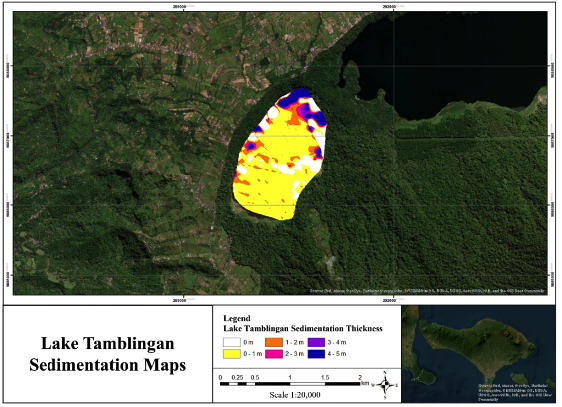
Lakes play an important role in supporting freshwater resources, ecosystems, and socio-cultural activities. However, increasing sedimentation has become a major environmental issue that can affect lake morphology and ecological functions. This study aims to analyze sediment accumulation in Lake Tamblingan and interpret its implications using the Tri Hita Karana framework. Bathymetric surveys were conducted using a Midas Valeport single-beam echosounder with 200 m transect spacing. The data were processed using Civil 3D and ArcGIS to generate bathymetric maps for 2023 and 2024, and sediment thickness was estimated through depth comparison. The results show that Lake Tamblingan experienced sediment accumulation reaching approximately 1,56 m, indicating a significant lake shallowing process. This condition may reduce lake storage capacity, increase turbidity, and potentially affect ecological stability as well as socio-cultural activities surrounding the lake. Integrating bathymetric analysis with the Tri Hita Karana perspective highlights the importance of holistic lake management that considers environmental, social, and spiritual dimensions.
Article Details

This work is licensed under a Creative Commons Attribution-ShareAlike 4.0 International License.
References
V. Yapiyev, K. Samarkhanov, N. Tulegenova, and S. Jumassultanova, “Estimation of Water Storage Changes in Small Endorheic Lakes in Northern,” J. Arid Environ., vol. 160, pp. 42–55, 2019, doi: 10.1016/j.jaridenv.2018.09.008.
I. M. Nada, I. W. Redana, I. G. B. S. Dharma, and A. A. G. A. Yana, “Community-Based Erosion Control Model in Batur Lake Zone,” in MATEC Web of Conferences, 2019. doi: https://doi.org/10.1051/matecconf /201927604008.
I. M. Nada, I. B. Suryatmaja, and I. G. N. A. Wiswasta, “Model Penanggulangan Sedimentasi Danau berbasis Masyarakat di Pulau Bali,” J. Bumi Lestari, vol. 17, no. 2, pp. 100–117, 2017.
L. G. Rodriguez, A. McCallum, D. Kent, C. Rathnayaka, and H. Fairweather, “A Review of Sedimentation Rates in Freshwater Reservoirs: Recent Changes and Causative Factors,” Aquat. Sci., vol. 85, no. 60, pp. 1–19, 2023, doi: 10.1007/s00027-023-00960-0.
E. L. Lo et al., “Sediment Infill of Tropical Floodplain Lakes: Rates, Controls, and Implications for Ecosystem Services,” Front. Earth Sci., vol. 10, no. May, pp. 1–14, 2022, doi: 10.3389/feart.2022.875919.
A. K. Sumaamijaya, F. Karly, N. R. Ar, and H. M. Ihsan, “Pemetaan Batimetri dan Pemodelan Morfologi Dasar Danau serta Analisa Daya Tampung Genangan Danau Patenggang,” Paduraksa, vol. 14, no. 1, pp. 76–86, 2025, doi: https://doi.org/10.22225/pd.14.1.10176.76-86.
A. T. Moningkey, M. M. F. Rampengan, A. A. Tumengkol, and J. C. Kumaat, “Study of Bathymetry and Sedimentation in Tondano Lake,” Int. Conf. Disaster Manag. Clim. Chang., 2022, doi: 10.1088/1755-1315/986/1/012038.
L. A. P. W. Pulasari, I. D. A. M. Damayanthi, and N. L. P. Prabandari, “Bathymetric-Based Sedimentation Assessment in Bali ’ s Volcanic Lakes,” J. Ilm. Tek. Sipil, vol. 29, no. 2, pp. 149–158, 2025, doi: https://doi.org/10.24843/JITS.2025.V29.i02.p05.
N. K. Surpi, S. L. N. Seriade, and N. W. J. Jero, “Integrating Traditional Ecological Knowledge and Environmental Science for Sustainable Lake Conservation: Danu Kerthi in Bali,” J. Environ. Sci. Sustain. Dev., vol. 8, no. 2, pp. 467–489, 2025, doi: 10.7454/jessd.v8i2.1369.
R. F. A. D. Presilia, F. A. Syaviar, N. Ubadati, and S. Sumarmi, “Kearifan Lokal Trihitakarana Suku Tengger dalam Kelangsungan Konservasi Ranu Pani,” J. Teor. dan Praksis Pembelajaran IPS, vol. 3, no. 2, pp. 76–80, 2018, doi: http://dx.doi.org/10.17977/um022v3i22018p076.
D. Hidayati, “Memudarnya Nilai Kearifan Lokal Masyarakat dalam Pengelolaan Sumber Daya Air,” J. Kependud. Indones., vol. 11, no. 1, pp. 39–48, 2016.
K. T. Suandayani et al., “Religious Activities and Their Impacts on The Surface Sediments of Two Lakes in Bali, Indonesia: A Case Study from Lake Buyan and Lake Tamblingan,” Elementa, vol. 11, no. 1, pp. 105–122, 2023, doi: 10.1525/elementa.2022.00140.
I. M. A. Kapela, “Tamblingan to be A Spiritual Tourism Destination,” Bali Tour. J., vol. 4, no. 2, pp. 31–34, 2020, doi: 10.36675/btj.v4i2.45.
I. M. Andhika and I. D. G. A. D. Putra, “Reinvigorating Cultural Landscapes for Planning Cultural Tourism in Bali,” Geoj. Tour. Geosites, vol. 33, no. 4, 2020, doi: 10.30892/gtg.3.
Z. Menberu, B. Mogesse, and D. Reddythota, “Regional Studies Assessment of Morphometric Changes in Lake Hawassa by Using Surface and Bathymetric Maps,” J. Hydrol. Reg. Stud., vol. 36, no. May, 2021, doi: 10.1016/j.ejrh.2021.100852.
A. Maxim, V. Mirela, P. G. Lucian, I. Catalina, and R. Adrian, “Testing Different Interpolation Methods Based on Single Beam Echosounder River Surveying. Case Study: Siret River,” ISPRS Int. J. Geo-Information, vol. 8, no. 11, p. 21, 2019.
N. Tuno et al., “Analyzing Depth Uncertainty of Near-Shore Bathymetric Survey Conducted by Single-Beam Echo Sounder,” Teh. Glas., vol. 18, pp. 84–91, 2024, doi: 10.31803/tg-20241008141610.
W. S. Kristinayanti, Y. Zaika, Y. P. Devia, S. Solimun, and M. A. Wibowo, “Insights into Local Wisdom of Tri Hita Karana Concept for Improving Sustainability: A Literature Review and Opportunities for Future Study,” in E3S Web of Conferences 622, INTERCONNECTS 2024, EDP Sciences, 2025, pp. 1–9. doi: https://doi.org/10.1051/e3sconf/202562204013.
T. L. B. Guruge, B. Palugaswewa, and S. Egashira, “Controlling Sedimentation through Regulating the River by Thalpitigala Reservoir Project,” in Proceedings of the International Association of Hydrological Sciences, 2024, pp. 1–6. doi: 10.5194/piahs-386-1-2024.
J. A. A. Simanjuntak, I. W. Restu, and I. W. D. Kartika, “Primary Productivity Levels and About Phythoplankton In Tamblingan Lake,” Adv. Trop. Biodivers. Environ. Sci., vol. 6, no. 2, p. 39, 2022, doi: 10.24843/atbes.2022.v06.i02.p02.
A. D. Pranta, M. T. Rahaman, M. S. Ahmed, and M. S. A. Rafi, “Navigating Eutrophication in Aquatic Environments: Understanding Impacts and Unveiling Solutions for Effective Wastewater Management,” Res. Ecol., vol. 5, no. 3, pp. 11–18, 2023, doi: 10.30564/re.v5i3.5908.
I. G. B. R. Utama and C. P. Trimurti, “Buyan Tamblingan Agro Tourism Ethical Planning in Forest Conservation Border Areas,” in ICOGESS, 2019, pp. 4–8. doi: 10.4108/eai.14-3-2019.2291999.
X. Ye, Q. Guo, Z. Zhang, and C. Xu, “Assessing Hydrological and Sedimentation Effects from Bottom Topography Change in a Complex River-Lake System of Poyang Lake, China,” Water, vol. 11, 2019, doi: 10.3390/w11071489.
R. C. Begy, C. F. Savin, J. Korponai, E. Magyari, and T. Kovács, “Investigation of The Last Two Centuries Sedimentation Dynamics in High-Altitude Lakes of Southern Carpathians, Romania,” Sci. Rep., vol. 14, no. 1, 2024, doi: 10.1038/s41598-024-51812-2.
M. K. Leta, M. Waseem, K. Rehman, and J. Tränckner, “Sediment Yield Estimation and Evaluating the Best Management Practices in Nashe Watershed, Blue Nile Basin, Ethiopia,” Environ. Monit. Assess., vol. 195, no. 6, 2023, doi: 10.1007/s10661-023-11337-z.