Artificial Intelligence Integration and Employee Turnover Intention: The Roles of Technostress and Reskilling Training
DOI:
https://doi.org/10.38043/jimb.v10i2.8034Keywords:
artificial intelligence, technostress, turnover intention, reskilling trainingAbstract
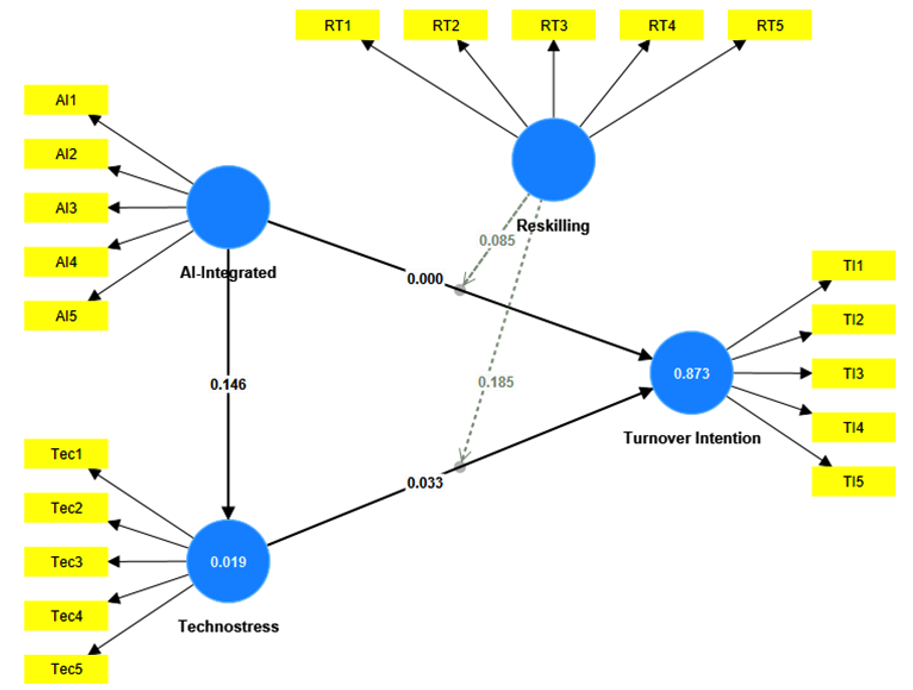
The adoption of artificial intelligence and automation in the workplace has the potential to improve efficiency while also influencing employees’ psychological and behavioral responses. Although reskilling training is expected to support employee adaptation to technological change, its effectiveness in shaping employee responses toward AI-driven transformation remains unclear. This study examines the direct effect of artificial intelligence integration on turnover intention, the mediating role of technostress, and the moderating role of reskilling training. A quantitative approach was employed using Structural Equation Modeling with SmartPLS 4. Data were collected through an online survey involving 265 employees working in organizations that had adopted artificial intelligence and automation technologies. The results showed that artificial intelligence integration had a significant positive effect on turnover intention, while its effect on technostress was positive but statistically insignificant. Furthermore, technostress did not significantly mediate the relationship between artificial intelligence integration and turnover intention. Reskilling training also did not significantly moderate the relationship between artificial intelligence integration and turnover intention or between technostress and turnover intention. These findings indicate that AI integration may influence turnover intention through mechanisms beyond technological strain, while reskilling training alone was not empirically confirmed as a significant buffering resource in this research context. This study contributes to the AI and employee management literature by highlighting the complexity of employee responses to AI-integrated workplaces and emphasizing the importance of broader organizational support strategies in managing technological transformation.
Downloads
References
Agarwal, P., Swami, S., & Malhotra, S. K. (2024). Artificial Intelligence Adoption in the Post COVID-19 New-Normal and Role of Smart Technologies in Transforming Business: a Review. In Journal of Science and Technology Policy Management. https://doi.org/10.1108/JSTPM-08-2021-0122
Al-Surmi, A., Bashiri, M., & Koliousis, I. (2022). AI based decision making: combining strategies to improve operational performance. International Journal of Production Research. https://doi.org/10.1080/00207543.2021.1966540
Arnold, M., Goldschmitt, M., & Rigotti, T. (2023). Dealing with information overload: a comprehensive review. In Frontiers in Psychology. https://doi.org/10.3389/fpsyg.2023.1122200
Asfahani, A. M. (2022). The Impact of Artificial Intelligence on Industrial-Organizational Psychology: A Systematic Review. Journal of Behavioral Science.
Bakker, A. B., & de Vries, J. D. (2021). Job DemandsResources theory and self-regulation: new explanations and remedies for job burnout. Anxiety, Stress and Coping, 34(1), 121. https://doi.org/10.1080/10615806.2020.1797695
Bankins, S., Ocampo, A. C., Marrone, M., Restubog, S. L. D., & Woo, S. E. (2024). A multilevel review of artificial intelligence in organizations: Implications for organizational behavior research and practice. In Journal of Organizational Behavior. https://doi.org/10.1002/job.2735
Bojic, L. (2022). Metaverse through the prism of power and addiction: what will happen when the virtual world becomes more attractive than reality? In European Journal of Futures Research. https://doi.org/10.1186/s40309-022-00208-4
Bris, A., Wang, T. Y. H., Zatzick, C. D., Miller, D. J. P., Fern, M. J., Cardinal, L. B., Gregoire, D. A., Shepherd, D. A., Westphal, J. D., Shani, G., Troster, C., Van Quaquebeke, N., Lanaj, K., Hollenbeck, J. R., Ilgen, D. R., Barnes, C. M., Harmon, S. J., Feldman, E. R., DesJardine, M. R., Sangiorgi, F. (2021). KNIGHTS, RAIDERS, AND TARGETS - THE IMPACT OF THE HOSTILE TAKEOVER - COFFEE,JC, LOWENSTEIN,L, ROSEACKERMAN,S. JOURNAL OF BANKING & FINANCE.
Budhwar, P., Malik, A., De Silva, M. T. T., & Thevisuthan, P. (2022). Artificial intelligencechallenges and opportunities for international HRM: a review and research agenda. In International Journal of Human Resource Management. https://doi.org/10.1080/09585192.2022.2035161
Cheung, G. W., Cooper-Thomas, H. D., Lau, R. S., & Wang, L. C. (2024). Reporting reliability, convergent and discriminant validity with structural equation modeling: A review and best-practice recommendations. Asia Pacific Journal of Management. https://doi.org/10.1007/s10490-023-09871-y
Chilunjika, A., Intauno, K., & Chilunjika, S. R. (2022). Artificial intelligence and public sector human resource management in South Africa: Opportunities, challenges and prospects. SA Journal of Human Resource Management. https://doi.org/10.4102/sajhrm.v20i0.1972
Cramarenco, R. E., Burc-Voicu, M. I., & Dabija, D. C. (2023). The impact of artificial intelligence (AI) on employees skills and well-being in global labor markets: A systematic review. In Oeconomia Copernicana. https://doi.org/10.24136/oc.2023.022
Dash, G., & Paul, J. (2021). CB-SEM vs PLS-SEM methods for research in social sciences and technology forecasting. Technological Forecasting and Social Change. https://doi.org/10.1016/j.techfore.2021.121092
Dawson F, J. (2014). Moderation in Management Research: What, Why, When, and How. Journal of Business and Psychology, 29, 119. https://doi.org/https://doi.org/10.1007/s10869-013-9308-7
Ekuma, K. (2024). Artificial Intelligence and Automation in Human Resource Development: A Systematic Review. In Human Resource Development Review. https://doi.org/10.1177/15344843231224009
Hair, J. F., & Sarstedt, M. (2021). Data, measurement, and causal inferences in machine learning: opportunities and challenges for marketing. Journal of Marketing Theory and Practice. https://doi.org/10.1080/10696679.2020.1860683
Hauk, N., Gritz, A. S., & Krumm, S. (2019). The mediating role of coping behavior on the age-technostress relationship: A longitudinal multilevel mediation model. PLoS ONE. https://doi.org/10.1371/journal.pone.0213349
Henderson, J., & Corry, M. (2021). Teacher anxiety and technology change: a review of the literature. Technology, Pedagogy and Education. https://doi.org/10.1080/1475939X.2021.1931426
Jabeen, Q., Nadeem, M. S., Raziq, M. M., & Sajjad, A. (2022). Linking individuals resources with (perceived) sustainable employability: Perspectives from conservation of resources and social information processing theory. International Journal of Management Reviews. https://doi.org/10.1111/ijmr.12276
John-Mathews, J. M., Cardon, D., & Balagu, C. (2022). From Reality to World. A Critical Perspective on AI Fairness. In Journal of Business Ethics. https://doi.org/10.1007/s10551-022-05055-8
Khammissa, R. A. G., Nemutandani, S., Feller, G., Lemmer, J., & Feller, L. (2022). Burnout phenomenon: neurophysiological factors, clinical features, and aspects of management. In Journal of International Medical Research. https://doi.org/10.1177/03000605221106428
Kiran, M. B. (2021). Application of artificial intelligence in additive manufacturing- a review. Proceedings of the International Conference on Industrial Engineering and Operations Management. https://doi.org/10.46254/an11.20210476
Lainjo, B. (2021). The enigmatic covid-19 vulnerabilities and the invaluable artificial intelligence (ai). In Journal of Multidisciplinary Healthcare. https://doi.org/10.2147/JMDH.S321751
Lee, A. (2021). In the Shadow of Platforms. M/C Journal. https://doi.org/10.5204/mcj.2750
Liu-Lastres, B., Karatepe, O. M., & Okumus, F. (2024). Combating quiet quitting: implications for future research and practices for talent management. International Journal of Contemporary Hospitality Management. https://doi.org/10.1108/IJCHM-08-2023-1317
Liu-Lastres, B., Wen, H., & Huang, W. J. (2023). A reflection on the Great Resignation in the hospitality and tourism industry. International Journal of Contemporary Hospitality Management. https://doi.org/10.1108/IJCHM-05-2022-0551
Mad Yusoh, S. S., Abd Wahab, D., Habeeb, H. A., & Azman, A. H. (2021). Intelligent systems for additive manufacturing-based repair in remanufacturing: a systematic review of its potential. PeerJ Computer Science. https://doi.org/10.7717/peerj-cs.808
Mezhoudi, N., Alghamdi, R., Aljunaid, R., Krichna, G., & Dtegr, D. (2023). Employability prediction: a survey of current approaches, research challenges and applications. Journal of Ambient Intelligence and Humanized Computing. https://doi.org/10.1007/s12652-021-03276-9
Namin, B. H., gaard, T., & Rislien, J. (2022). Workplace incivility and turnover intention in organizations: A meta-analytic review. In International Journal of Environmental Research and Public Health. https://doi.org/10.3390/ijerph19010025
Nguyen, C. N., Hoang, G., & Luu, T. T. (2023). Frontline employees turnover intentions in tourism and hospitality sectors: A systematic literature review and research agenda. Tourism Management Perspectives. https://doi.org/10.1016/j.tmp.2023.101197
Omamode Henry Orieno, Ndubuisi Leonard Ndubuisi, Valentine Ikenna Ilojianya, Preye Winston Biu, & Beryl Odonkor. (2024). THE FUTURE OF AUTONOMOUS VEHICLES IN THE U.S. URBAN LANDSCAPE: A REVIEW: ANALYZING IMPLICATIONS FOR TRAFFIC, URBAN PLANNING, AND THE ENVIRONMENT. Engineering Science & Technology Journal. https://doi.org/10.51594/estj.v5i1.721
Passalacqua, M., Pellerin, R., Doyon-Poulin, P., Del-Aguila, L., Boasen, J., & Lger, P. M. (2022). Human-Centred AI in the Age of Industry 5.0: A Systematic Review Protocol. Lecture Notes in Computer Science (Including Subseries Lecture Notes in Artificial Intelligence and Lecture Notes in Bioinformatics). https://doi.org/10.1007/978-3-031-21707-4_34
Poon, Y. S. R., Lin, Y. P., Griffiths, P., Yong, K. K., Seah, B., & Liaw, S. Y. (2022). A global overview of healthcare workers turnover intention amid COVID-19 pandemic: a systematic review with future directions. In Human Resources for Health. https://doi.org/10.1186/s12960-022-00764-7
Pressley, C., & Garside, J. (2023). Safeguarding the retention of nurses: A systematic review on determinants of nurses intentions to stay. In Nursing Open. https://doi.org/10.1002/nop2.1588
Psarommatis, F., May, G., & Azamfirei, V. (2023). Envisioning maintenance 5.0: Insights from a systematic literature review of Industry 4.0 and a proposed framework. In Journal of Manufacturing Systems. https://doi.org/10.1016/j.jmsy.2023.04.009
Rasool, T., Warraich, N. F., & Sajid, M. (2022). Examining the Impact of Technology Overload at the Workplace: A Systematic Review. SAGE Open. https://doi.org/10.1177/21582440221114320
Rudiyanto, T., Kunda, H., Dunn, A., Shenderovskiy, S., & Gibson, R. (2023). Ethical and Legal Concerns of Artificial Intelligence in the Workplace: Examining Current Legislations in the United States. Lex Publica. https://doi.org/10.58829/lp.10.1.2023.84-100
Sarath Kumar Boddu, R., Santoki, A. A., Khurana, S., Vitthal Koli, P., Rai, R., & Agrawal, A. (2022). An analysis to understand the role of machine learning, robotics and artificial intelligence in digital marketing. Materials Today: Proceedings. https://doi.org/10.1016/j.matpr.2021.11.637
Shiau, W. L., Wang, X., Zheng, F., & Tsang, Y. P. (2022). Cognition and emotion in the information systems field: a review of twenty-four years of literature. In Enterprise Information Systems. https://doi.org/10.1080/17517575.2021.1992675
Tummers, L., & Bakker, A. B. (2021). Leadership and Job Demands-Resources Theory: a Systematic Review. https://doi.org/10.31234/osf.io/52bjz
Vallas, S., Schor, J. B. J. B. B., Umar, M., Xu, Y., Mirza, S. S. S. S., Kelly, J. M., Pangrazio, L., Bishop, C., Lee, F., Munoz, K. M., Martinez, A. D., Lin, Z. J., Zhang, Y. W., Van den Abbeele, G., Georgiou, D., Lehdonvirta, V., Kassi, O., Hjorth, I., Barnard, H., Pal, A. (2022). The Creativity Hoax: Precarious Work and the Gig Economy. NEW TECHNOLOGY WORK AND EMPLOYMENT.
Westphal, A., Kalinowski, E., Hoferichter, C. J., & Vock, M. (2022). K12 teachers stress and burnout during the COVID-19 pandemic: A systematic review. In Frontiers in Psychology. https://doi.org/10.3389/fpsyg.2022.920326
Yu, Z., Guindani, M., Grieco, S. F., Chen, L., Holmes, T. C., & Xu, X. (2022). Beyond t test and ANOVA: applications of mixed-effects models for more rigorous statistical analysis in neuroscience research. In Neuron. https://doi.org/10.1016/j.neuron.2021.10.030
Zidaru, T., Morrow, E. M., & Stockley, R. (2021). Ensuring patient and public involvement in the transition to AI-assisted mental health care: A systematic scoping review and agenda for design justice. In Health Expectations. https://doi.org/10.1111/hex.13299
Downloads
Published
How to Cite
Issue
Section
License
Copyright (c) 2025 Bayu Wijaya

This work is licensed under a Creative Commons Attribution-ShareAlike 4.0 International License.