Green Marketing for Millennial Consumer Purchasing Decisions Through Brand Perception
DOI:
https://doi.org/10.38043/jimb.v11i1.7659Keywords:
Green Marketing, Brand Perception, Purchasing Decision, Consumers, MillennialsAbstract
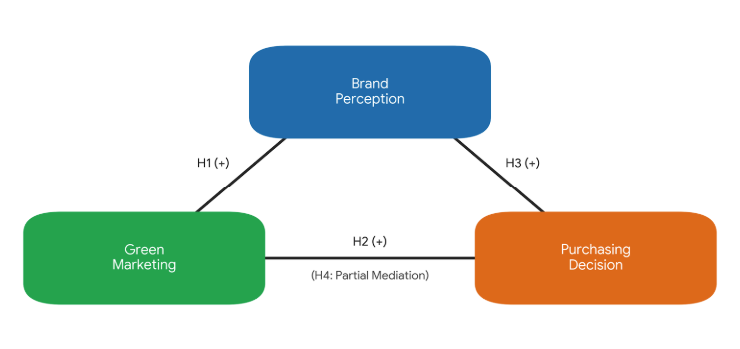
There is a lack of public awareness regarding the purchase of eco-friendly products. Understanding pro-environmental attitudes and purchasing behaviours related to green marketing is crucial for shaping brand perception and consumer decisions. Therefore, this study aims to analyse the impact of green marketing on brand perception and purchasing decisions, the impact of brand perception on purchasing decisions, and the role of brand perception as a mediating variable. The research employs a quantitative causal approach. The sample consisted of 350 millennial consumers selected through purposive sampling. Data were collected over four months using an online questionnaire with a 1-to-5 point Likert scale. Data were analysed using SEM-PLS, involving evaluations of both the outer and inner models. The questionnaire was confirmed to be reliable, with loading factor values ranging from 0.79 to 0.87, Cronbach's Alpha values ranging from 0.918 to 0.927, and Composite Reliability values ranging from 0.932 to 0.941. The R-squared values were 0.468 for brand perception and 0.602 for purchasing decisions, indicating moderate to strong explanatory power. The results demonstrate that green marketing has a positive and significant effect on brand perception (beta = 0.684, t = 13.221, p < 0.001) and purchasing decisions (beta = 0.372, t = 6.145, p < 0.001), while brand perception also has a positive and significant effect on purchasing decisions (beta = 0.491, t = 7.842, p < 0.001). Furthermore, brand perception was found to mediate the effect of green marketing on purchasing decisions (beta = 0.336, t = 6.589, p < 0.001). This mediation is classified as partial because both the direct and indirect effects were significant. In conclusion, the effectiveness of green marketing is determined by strategic implementation and the ability to shape a credible brand perception. The findings imply that companies need to integrate eco-friendly innovation, transparent communication, product quality, and brand reputation strengthening to enhance consumer trust.
Downloads
References
Agarwal, S., Long, Q., Wen, K., & Wider, W. (2025). Redefining marketing strategies through sustainability: Influencing consumer behavior in the circular economy: A systematic review and future research roadmap. Cleaner and Responsible Consumption, 18, 100298.1-14. https://doi.org/10.1016/j.clrc.2025.100298
Amiri, B., Jafarian, A., & Abdi, Z. (2024). Nudging towards sustainability: a comprehensive review of behavioral approaches to eco-friendly choice. Discover Sustainability, 5(1). https://doi.org/10.1007/s43621-024-00618-3
Asa, A. R., Nautwima, J. P. (2026). Corporate digital responsibility and consumer trust: a signaling theory perspective. Cogent Business & Management, 13(1), 1-28. https://doi.org/10.1080/23311975.2025.2607753
Baltaci, D. ., Durmaz, Y., & Baltaci, F. (2024). The relationships between the multidimensional planned behavior model, green brand awareness, green marketing activities, and purchase intention. Brain and Behavior, 14(6), e3584. https://doi.org/10.1002/brb3.3584.
Baskoro, M. L., Tjahjono, B., Beltran, M., Bogush, A., & Wang, Y. (2024). The imperative of communication signals in boosting business strategies of the bioplastic packaging industry. Business Strategy and The Environment, 33(2), 307334. https://doi.org/10.1002/bse.3490
Batbay & Kahramanolu. (2024). Using theory of planned behaviour to understand and manage the factors affecting farmers intention in pesticide use. Cleaner and Circular Bioeconomy, 9, 1-8. https://doi.org/10.1016/j.clcb.2024.100126
Cherono, V., Miah, M. T., Rudnk, I., & Csaba, S. (2025). Beyond the Hype: A Systematic Exploration of Emerging Thematic Trends and Persistent Challenges in Combating Greenwashing Across Global Supply Chains. Administrative Sciences, 15(5), 127. https://doi.org/10.3390/admsci15050173
Chotisarn, N., & Phuthong, T. (2025). Green production processes and consumer behaviour: a theory-context-characteristics- methodology framework-based systematic review and future research agenda. International Journal of Sustainable Engineering, 18(1), 1-34. https://doi.org/10.1080/19397038.2025.2480100
Dwivedi, S., Gupta, A., & Sayal, A. (2025). Evolution of consumer perceptions and intentions in the green cosmetics market: a thematic and trend analysis. Frontiers in Sustainability, 6, 1-13. https://doi.org/10.3389/frsus.2025.1617779
Ebrahimzadeh, S. M., Labafi, S., Khajeheian, D., & Arbatani, T. R. (2026). Sustainable Development and Innovation as Drivers of Brand Equity Enhancement in Knowledge-Based Enterprises: Empirical Evidence from Science Parks. Sustainability, 18(6), 143. https://doi.org/10.3390/su18063115
Elmadani, M., Kasmai Kiptulon, E., Klra, S., & Orsolya, M. (2024). Systematic Review of the Impact of Natural Resource Management on Public Health Outcomes: Focus on Water Quality. Resources, 13(9), 121. https://doi.org/10.3390/resources13090122
Garg, V., Bohara, S., & Srivastav, A. (2025). AI-driven sustainability marketing transforming consumers perception toward eco-friendly brands. Discover Sustainability, 6, 1-20. https://doi.org/10.1007/s43621-025-01934-y
Gupta, R., Kapoor, A. P., & Verma, H. V. (2025). Neuro-insights: a systematic review of neuromarketing perspectives across consumer buying stages. Frontiers in Neuroergonomics, 6, 1-31. https://doi.org/10.3389/fnrgo.2025.1542847
Hair, J., & Alamer, A. (2022). Partial Least Squares Structural Equation Modeling ( PLS-SEM ) in second language and education research: Guidelines using an applied example. Research Methods in Applied Linguistics, 1(3), 100027, 1-16. https://doi.org/10.1016/j.rmal.2022.100027
Halibas, A., Akram, U., Hoang, A., Do, M., & Hoang, T. (2025). Unveiling the future of responsible, sustainable, and ethical consumption: a bibliometric study on Gen Z and young consumers. Young Consumers: Insight and Ideas for Responsible Marketers, 26(7), 142171. https://doi.org/10.1108/YC-11-2024-2327
Handoyo, S. (2024). Purchasing in the digital age: A meta-analytical perspective on trust, risk, security, and e-WOM in e-commerce. Heliyon, 10(8), e29714.1-23. https://doi.org/10.1016/j.heliyon.2024.e29714
Hasan, M. A., Talukder, S. C., Lakner, Z., & Temesi, . (2025). Clothing Brands Sustainability Practices: A Bibliometric Approach. Administrative Sciences, 15(6), 122. https://doi.org/10.3390/admsci15060221
Kesa, D., (2025). Evaluating the Effectiveness of Green Marketing Campaigns on Consumer Behavior in Eco-Friendly Product Markets. The Journal of Academic Science, 2(5), 15381549.
Klabi, F. (2025). Social Sciences & Humanities Open Factors affecting green product purchase intention in an emerging country: An empirical investigation. Social Sciences & Humanities Open, 11. https://doi.org/10.1016/j.ssaho.2025.101570
Kumar, S., Sharma, C., Mishra, M. K., Sharma, S., & Bhardwaj, V. (2025). Smart, sustainable, and green: the digital transformation of greenmarketing. Discover Sustainability, 6(388), 1-25. https://doi.org/10.1007/s43621-025-01242-5
Li, F., & Xiong, H. (2025). Green supply chain decision-making considering fair concerns and consumer environmental mindset. Heliyon, 11(5), e42916. https://doi.org/10.1016/j.heliyon.2025.e42916
Maduwinarti, A., Maruta, I. A., & Mahendra, I. A. (2025). The intersection of green marketing and social media in Southeast Asia: a bibliometric analysis and research agenda. Cogent Business & Management, 12(1), 1-26. https://doi.org/10.1080/23311975.2025.2525499
Mukwarami, S., van der Poll, H.M. (2024). Critical environmental management accounting practices influencing service delivery of growing cities in a developing economy: a review and conceptual framework. Environment Systems and Decisions, 44, 710739. https://doi.org/10.1007/s10669-023-09960-9
Nguyen, N. V., & Nguyen, A. N. N. (2025). Bibliometric analysis of the theory of planned behavior and its role in agritourism. Cogent Social Sciences, 11(1), 1-29. https://doi.org/10.1080/23311886.2025.2573158
Ong, A. K. S., Diaz, J. F. T., Abella, J. K. A. L., Alayra, R. J. N., Calimag, B. C. R., Callo, B. C. B., Tee, Z. A. K., & Delos Reyes, C. R. V. (2025). Translating sustainable purchase intention to actual action through the incorporation of affecting design factors among products. Cogent Business & Management, 12(1), 1-28. https://doi.org/10.1080/23311975.2025.2583272
Samoggia, A., Rossi, G., Fantini, A., Mouchtaropoulou, E., & Argiriou, N. (2025). What drives consumers intention towards fairness-oriented products purchasing? An emotion-extended model of theory of planned behaviour. Heliyon, 11(1), e41285.1-14. https://doi.org/10.1016/j.heliyon.2024.e41285
Suvarna, R. J., Kavitha, T. C., Shanbhag, P., & Santekellur, V. J. R.. (2026). Greenwashing uncovered: mapping consumer behavioural outcomes through TCCM and bibliometric insights. Cogent Business & Management, 13(1), 1-24. https://doi.org/10.1080/23311975.2026.2632731
Tan, Q. L., Hashim, S., Abdullah, N. L., Zaki, H. O., & Zheng, Z. (2025). a bibliometric analysis and systematic review. Humanities And Social Sciences Communications, 12(1243), 116. https://doi.org/10.1057/s41599-025-05613-1
Tanzares, J., Rahmiati, F., Jokhu, J. R., & Mangkurat, R. S. B. (2024). The impact of willingness to pay, environmental awareness, consumer behavior, consumer attitudes toward purchase decisions on sustainable packaging in Indonesia. Journal of Character and Environment, 2(1), 1535. https://doi.org/10.61511/jocae.v2i1.2024.878
Trinh, H. T. T., Hue, T. T., Luu, T.-M.-N., Nghiem, X.-H., Pham, H.-H., & Hai, L. D. (2025). A literature review on green brand equity and future research directions. Discover Sustainability, 6(1), 1338, 1-27. https://doi.org/10.1007/s43621-025-02237-y
Verma, R., Dvorsky, J., Tewari, A., Shrivastava, A. K., Kumar, M., Singh, M., & Sharif, T. (2025). Do Gen Y and Gen Z differ in their purchase intention towards recycled products? A moderation study. Cogent Business & Management, 12(1), 1-23. https://doi.org/10.1080/23311975.2025.2534852
Zheng, C., Sun, D., Khamarudin, M., Ahmad, A., Wei, H., Xu, J. (2025). Integrating customer-based brand equity and the theory of planned behavior to predict electric vehicle adoption in China: The moderating role of perceived price. Plos One, 20(7): e0329224, 124. https://doi.org/10.1371/journal.pone.0329224
Downloads
Published
How to Cite
Issue
Section
License
Copyright (c) 2026 Doddy Adhimursandi, Hairul Anwar, Hidayani

This work is licensed under a Creative Commons Attribution-ShareAlike 4.0 International License.