Beyond Quiet Quitting: Community Pressure and Adaptive Work Behaviors Explaining Family Hope Facilitators’ Task Performance
DOI:
https://doi.org/10.38043/jimb.v11i1.7641Keywords:
Quiet Quitting, Community Preseure, Task Performance, Digital Fatuge, Job Hopping, Job HuggingAbstract
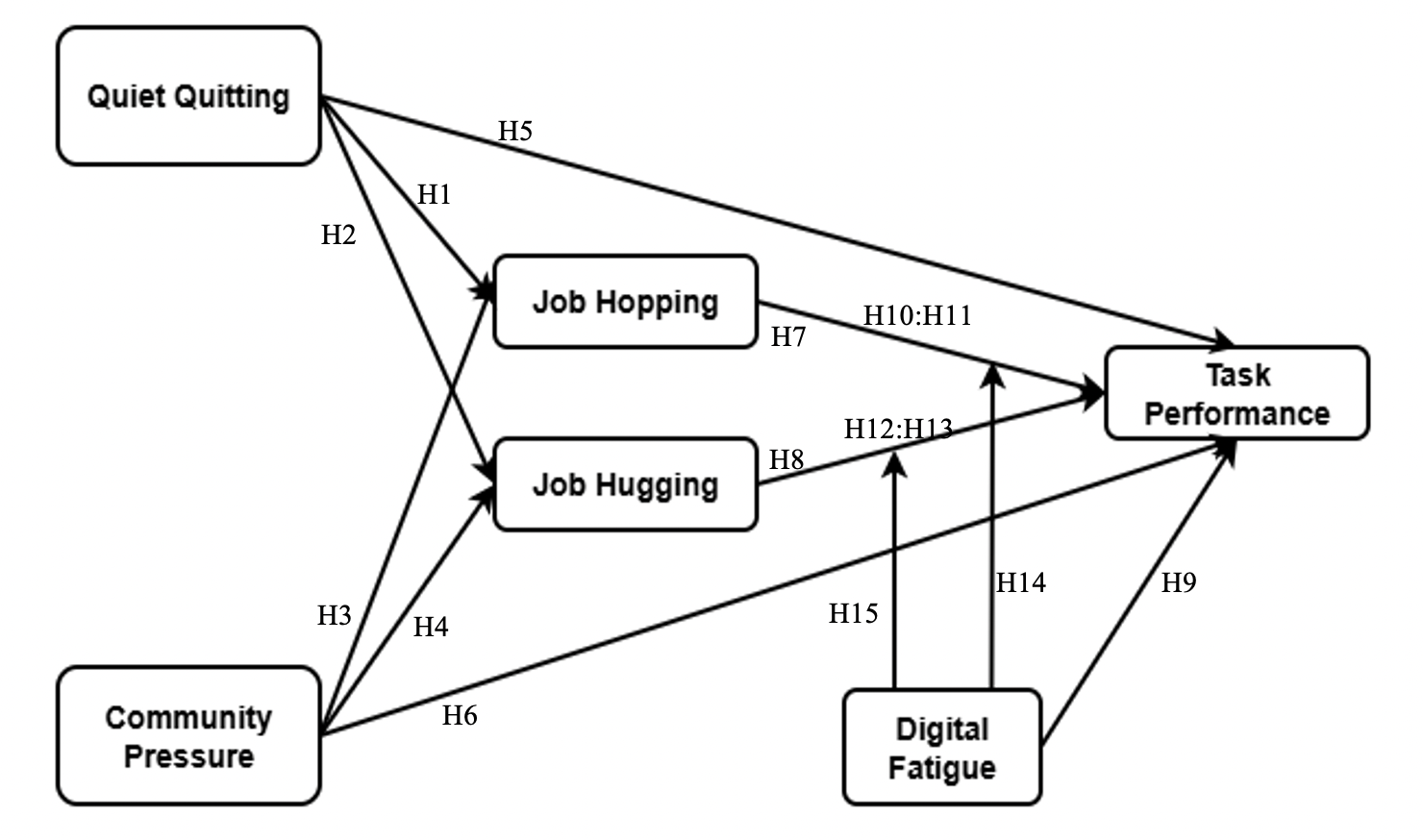
This study examines the effects of quiet quitting and community pressure on the task performance of Family Hope Program facilitators’, incorporating the mediating roles of job hopping and job hugging, as well as the moderating role of digital fatigue. A quantitative, explanatory, and cross-sectional research design was employed. Data were collected from 203 PKH facilitators in Tulungagung, Indonesia selected through purposive sampling, with criteria including a minimum of five years of work experience and active involvement in program implementation. Data collection was conducted a survey method using a structured online questionnaire, and analyzed using Partial Least Squares Structural Equation Modeling. The findings reveal that quiet quitting significantly influences both job hopping and job hugging, while also negatively affecting task performance. Community pressure significantly affects job hopping and job hugging, but does not directly impact task performance. Further results indicate that job hopping reduces task performance, whereas job hugging enhances it. Mediation analysis shows that job hopping partially mediates the relationship between quiet quitting and task performance, and fully mediates the relationship between community pressure and task performance. Similarly, job hugging serves as a partial mediator in the relationship between quiet quitting and task performance, and as a full mediator in its relationship with community pressure. Additionally, digital fatigue does not significantly affect task performance nor moderate the relationships examined, indicating moderate its a rejected. The findings contribute to the literature by extending the understanding of task performance beyond digital fatigue and suggest that organizations should pay greater attention to employees’ behavioral work responses when designing strategies to support performance and adaptation to workplace demands.
Downloads
References
Abbasi, S. G., Abbas, M., & Ilyas, M. A. (2024). Enhancing Organizational Learning Capabilities through Digital Transformation: Role of Perceived Organizational Support and Knowledge Oriented Leadership. Pakistan Journal of Commerce and Social Sciences, 18(3), 703728. https://doi.org/10.64534/commer.2024.035
Adha, M. A., Musyaffi, A. M., Ariyanti, N. S., Maulida, E., Sumardi, N. A., & Maisyaroh, M. (2026). Technostress measurement scale among Indonesian young entrepreneurs: A psychometric study. Social Sciences and Humanities Open, 13(December 2025). https://doi.org/10.1016/j.ssaho.2025.102373
Admiraal, W. (2025). Attrition risk profiles of novice teachers based on their job demands, individual and school resources, and well-being. Teaching and Teacher Education, 162(May), 105070. https://doi.org/10.1016/j.tate.2025.105070
Ahmed, K., Shahzad, F., Fareed, Z., Zulfiqar, B., & Naveed, T. (2014). Impact of Relationship, Task & Role Conflict on Teaching Performance in Educational Institutes. International Journal of Management, Accounting & Economics, 1(2), 101112. https://doi.org/https://dor.isc.ac/dor/20.1001.1.23832126.2014.1.2.1.3
Alkhayyal, S., & Bajaba, S. (2024). Countering technostress in virtual work environments: The role of work-based learning and digital leadership in enhancing employee well-being. Acta Psychologica, 248(May). https://doi.org/10.1016/j.actpsy.2024.104377
Aman, A., Rafiq, M., & Dastane, O. (2023). A cross-cultural comparison of work engagement in the relationships between trust climate Job performance and turnover intention: Focusing China and Pakistan. Heliyon, 9(9). https://doi.org/10.1016/j.heliyon.2023.e19534
Atatsi, E. A., Azila-Gbettor, E. M., & Mensah, C. (2021). Predicting task performance from psychological ownership and innovative work behaviour: A cross sectional study. Cogent Business and Management, 8(1). https://doi.org/10.1080/23311975.2021.1917483
Atiq, A., Sullman, M., & Apostolou, M. (2025). The silent shift: exploring the phenomenon of quiet quitting in modern workplaces. Personnel Review, 123. https://doi.org/10.1108/PR-12-2024-1059
Baik, J. H. (2020). Stress and the dopaminergic reward system. In Experimental and Molecular Medicine (Vol. 52, Nomor 12). https://doi.org/10.1038/s12276-020-00532-4
Bakker, A. B. (2018). Job crafting among health care professionals: The role of work engagement. Journal of Nursing Management, 26(3), 321331. https://doi.org/10.1111/jonm.12551
Bakker, A. B., & Demerouti, E. (2014). Work and Wellbeing: A Complete Reference Guide Job Demands-Resources Theory. In John Wiley & Sons,Inc.: Vol. III. John Wiley & Sons. https://doi.org/10.1002/9781118539415.wbwell019
Ben Ghrbeia, S., & Alzubi, A. (2024). Building Micro-Foundations for Digital Transformation: A Moderated Mediation Model of the Interplay between Digital Literacy and Digital Transformation. Sustainability (Switzerland) , 16(9). https://doi.org/10.3390/su16093749
Berger, M., Sajko, T., & Zunk, B. M. (2026). The Demanded Skill Set of European B2B Salespeople: A Job Advertisement Analysis. Procedia Computer Science, 277(2026), 33073317. https://doi.org/10.1016/j.procs.2026.02.367
Bernard, M., Bernela, B., & Ferru, M. (2021). Does the geographical mobility of scientists shape their collaboration network? A panel approach of chemists careers. Papers in Regional Science, 100(1), 7999. https://doi.org/10.1111/pirs.12563
Bhardwaj, B., & Kalia, N. (2021). Contextual and task performance: role of employee engagement and organizational culture in hospitality industry. Vilakshan - XIMB Journal of Management, 18(2), 187201. https://doi.org/10.1108/xjm-08-2020-0089
Blumer, H. (1954). What is Wrong with Social Theory? American Sociological Review, 19(Kolisch 1954), 310.
Boehnlein, P., & Baum, M. (2022). Does job crafting always lead to employee well-being and performance? Meta-analytical evidence on the moderating role of societal culture. International Journal of Human Resource Management, 33(4), 647685. https://doi.org/10.1080/09585192.2020.1737177
Breni, V., & McGee, A. (2026). Measuring employers demand for personality traits in job ads. Journal of Economic Psychology, 113(June 2025), 102887. https://doi.org/10.1016/j.joep.2026.102887
Brewster, C., Fontinha, R., Haak-Saheem, W., Lamperti, F., & Walker, J. (2023). Linking embeddedness to physical career mobility: How Brexit affected the preference of business, economics and management academics for leaving the UK. Research Policy, 52(9), 104855. https://doi.org/10.1016/j.respol.2023.104855
Brya, P. (2015). The Impact of International Student Mobility on Subsequent Employment and Professional Career: A Large-scale Survey among Polish Former Erasmus Students. Procedia - Social and Behavioral Sciences, 176, 633641. https://doi.org/10.1016/j.sbspro.2015.01.521
Can, H. C., & Alas, D. K. (2025). The silent scream of digital future: Exploring AI awareness and quiet quitting in Turkish teachers. Acta Psychologica, 260(July). https://doi.org/10.1016/j.actpsy.2025.105589
Cangi, F., Davoine, E., & Tashtish, S. (2021). (Im)mobilities, waiting and professional aspirations: The career lives of highly skilled Syrian refugees in Switzerland. Geoforum, 125, 5765. https://doi.org/10.1016/j.geoforum.2021.06.015
Carter, M. J. (2014). Gender socialization and identity theory. Social Sciences, 3(2). https://doi.org/10.3390/socsci3020242
Cho, J., Schilpzand, P., Huang, L., & Paterson, T. (2021). How and When Humble Leadership Facilitates Employee Job Performance: The Roles of Feeling Trusted and Job Autonomy. Journal of Leadership and Organizational Studies, 28(2), 169184. https://doi.org/10.1177/1548051820979634
Cochran, W.G. (1977) Sampling Techniques. 3rd Edition, John Wiley & Sons, New York.
Czaller, L., Eriksson, R. H., & Lengyel, B. (2021). Reducing automation risk through career mobility: Where and for whom? Papers in Regional Science, 100(6), 15451569. https://doi.org/10.1111/pirs.12635
Dangi, M. R. M., & Shuhidan, S. M. (2025). Interaction Influence of Organisational Support on the Educators Acceptance, Personality Traits, and Technological Competence towards Intention to Adopt the Virtual Learning Environment. International Journal of Research and Innovation in Social Science (IJRISS), VII(2454), 11751189. https://doi.org/10.47772/IJRISS
Demerouti, E. (2025). Job demands-resources and conservation of resources theories: How do they help to explain employee well-being and future job design? Journal of Business Research, 192(March), 115296. https://doi.org/10.1016/j.jbusres.2025.115296
Depari, R. P. B. D., Riasih, T., & Rosilawati, R. (2023). Kinerja Pendamping Program Keluarga Harapan (Pkh) Dalam Pertemuan Peningkatan Kemampuan Keluarga (P2K2) Di Kecamatan Bojongsoang Kabupaten Bandung. Jurnal Ilmiah Perlindungan dan Pemberdayaan Sosial (Lindayasos), 5(1). https://doi.org/10.31595/lindayasos.v5i1.676
Dileki, ., Kaya, A., & iek, . (2025). Occupational stress, burnout, and change fatigue as predictors of quiet quitting among teachers. Acta Psychologica, 254(February). https://doi.org/10.1016/j.actpsy.2025.104812
Dixit, A., & Upadhyay, Y. (2021). Role of JD-R model in upticking innovative work behaviour among higher education faculty. RAUSP Management Journal, 56(2), 156169. https://doi.org/10.1108/RAUSP-03-2020-0060
Dogbey, G., Hiller, A.-M., Zinale, A., Baiden, S. A., & Kisiel, M. A. (2026). Job Strain Profiles in Pharmacy Workforce: Evidence from the Job Demand, Control, and Support Model in Ghana. Safety and Health at Work, 46(1), 122. https://doi.org/https://doi.org/10.1016/j.shaw.2026.03.007
Dreisoerner, A., Junker, N. M., Schlotz, W., Heimrich, J., Bloemeke, S., Ditzen, B., & van Dick, R. (2021). Self-soothing touch and being hugged reduce cortisol responses to stress: A randomized controlled trial on stress, physical touch, and social identity. Comprehensive Psychoneuroendocrinology, 8, 100091. https://doi.org/10.1016/j.cpnec.2021.100091
Du, S., Tan, H., & Fan, H. (2026). Social capital and career choices among rural Chinese youth: The mediating role of social mobility perception. Acta Psychologica, 262(May 2025), 106149. https://doi.org/10.1016/j.actpsy.2025.106149
Duran, R., & Doan, H. (2026). Social Workers Perception of Social Assistance: A Perspective on Empathy, Personal and Professional Power. Human Service Organizations: Management, Leadership & Governance, 33(1), 122. https://doi.org/10.1080/23303131.2026.2622384
Feng, Y., Feng, Y., & Liu, Z. (2025). The Influence of Perceived Organizational Support on Sustainable AI Adoption in Digital Transformation: An Integrated SEMANNNCA Model. Sustainability (Switzerland), 17(24), 139. https://doi.org/10.3390/su172411373
Fitrinitia, I. S., & Matsuyuki, M. (2023). Social protection for climate-disasters: A case study of the program Keluarga Harapan cash transfer program for smallholder farm household in Indonesia. Progress in Disaster Science, 17, 100278. https://doi.org/10.1016/j.pdisas.2023.100278
Ghosh, D., & Gurunathan, L. (2015). Do commitment based human resource practices influence job embeddedness and intention to quit? IIMB Management Review, 27(4), 240251. https://doi.org/10.1016/j.iimb.2015.09.003
Giacomucci, S. (2021). Sociometry and Social Work Theory. In Social Work, Sociometry, and Psychodrama: Experiential Approaches for Group Therapists, Community Leaders, and Social Workers (hal. 83100). Springer Singapore. https://doi.org/10.1007/978-981-33-6342-7_5
Gordon, H. J., Demerouti, E., Le Blanc, P. M., Bakker, A. B., Bipp, T., & Verhagen, M. A. M. T. (2018). Individual job redesign: Job crafting interventions in healthcare. Journal of Vocational Behavior, 104, 98114. https://doi.org/10.1016/j.jvb.2017.07.002
Hair, J. F. J., Sarstedt, M., Hopkins, L., & G. Kuppelwieser, V. (2014). Partial least squares structural equation modeling (PLS-SEM). European Business Review, 26(2), 106121. https://doi.org/10.1108/EBR-10-2013-0128
Hair, J. F., Matthews, L. M., Matthews, R. L., & Sarstedt, M. (2017). PLS-SEM or CB-SEM: updated guidelines on which method to use. International Journal of Multivariate Data Analysis, 1(2), 107. https://doi.org/10.1504/IJMDA.2017.087624
He, Z., Chen, L., & Shafait, Z. (2023). How psychological contract violation impacts turnover intentions of knowledge workers? The moderating effect of job embeddedness. Heliyon, 9(3), e14409. https://doi.org/10.1016/j.heliyon.2023.e14409
Holmgreen, L., Tirone, V., Gerhart, J., & Hobfoll, S. E. (2024). The Handbook of Stress and Health: A Guide to Research and Practice, Conservation of resources theory. In Encyclopedia of Technological Hazards and Disasters in the Social Sciences. John Wiley & Sons. https://doi.org/10.4337/9781800882201.ch25
Inoue, A., Eguchi, H., Kachi, Y., & Tsutsumi, A. (2025). Moderating Effect of Psychosocial Safety Climate on the Association of Job Demands and Job Resources With Psychological Distress Among Japanese Employees: A Cross-sectional Study. Safety and Health at Work, 16(2), 213219. https://doi.org/10.1016/j.shaw.2025.02.001
Jain, S., Varma, V., Vijay, T. S., & Cabral, C. (2025). Technostress influence on innovative work behaviour and the mitigating effect of leader-member exchange: A moderated mediation study in the Indian banking industry. Acta Psychologica, 255(March). https://doi.org/10.1016/j.actpsy.2025.104875
Jatmiko, U., Pribadiyono, & Suhermin. (2025). Determinants of Individual Performance of Professional Village Facilitators: The Mediation of Innovative Work Behavior and Moderation of Work-Life Balance in Kediri Regency, Indonesia. ECONOMICS - Innovative and Economics Research Journal, 13(2), 179201. https://doi.org/10.2478/eoik-2025-0036
Jooss, S., Carbery, R., & Kuosa, M. (2025). Inter-brand career mobility: a study of general manager perceptions and implications for talent management. International Journal of Contemporary Hospitality Management, 37(13), 3963. https://doi.org/10.1108/IJCHM-08-2024-1240
Kalia, N., & Bhardwaj, B. (2019). Contextual and Task Performance: Do Demographic and Organizational variables matter? Rajagiri Management Journal, 13(2), 3042. https://doi.org/10.1108/ramj-09-2019-0017
Kanten, P., Kanten, S., & Gurlek, M. (2015). The Effects of Organizational Structures and Learning Organization on Job Embeddedness and Individual Adaptive Performance. Procedia Economics and Finance, 23(October 2014), 13581366. https://doi.org/10.1016/s2212-5671(15)00523-7
Karppi, M., Hyrkknen, U., & Jokisaari, M. (2025). The consequences of shared leadership on job demands and job resources in project teams. Project Leadership and Society, 6(May). https://doi.org/10.1016/j.plas.2025.100203
Khalequzzaman, M., Wang, S., Zhang, N., & Wang, L. (2025). Digital transformation stressors in banking: Technostress as a mediator and organizational support as a moderator of job performance. Acta Psychologica, 260(July). https://doi.org/10.1016/j.actpsy.2025.105612
Khalil, S., Di Paola, N., Samhan, B., Midha, V., Davila Valdiviezo, A., & Kraus, S. (2026). Technological readiness during different stages of the pandemic: A qualitative comparative analysis approach. Technological Forecasting and Social Change, 222(August 2025). https://doi.org/10.1016/j.techfore.2025.124397
Kiazad, K., Hom, P., Schwarz, G., Newman, A., & Holtom, B. (2024). High-performance work practices and job embeddedness: A comprehensive test. Journal of Vocational Behavior, 155(October 2023), 104066. https://doi.org/10.1016/j.jvb.2024.104066
Kim, D., Shin, J., Seo, M. G., & Sung, M. J. (2021). Enjoy the pain that you cannot avoid: Investigation on the relationship between developmental job experience and employees innovative behavior. Journal of Business Research, 126(December 2020), 363375. https://doi.org/10.1016/j.jbusres.2020.12.064
Kreuter, M. W., Garg, R., Fu, Q., Caburnay, C., Thompson, T., Roberts, C., Sandheinrich, D., Javed, I., Wolff, J. M., Butler, T., Grimes, L. M., Carpenter, K. M., Pokojski, R., Engelbrecht, K., Howard, V., & McQueen, A. (2023). Helping low-income smokers quit: findings from a randomized controlled trial comparing specialized quitline services with and without social needs navigation. The Lancet Regional Health - Americas, 23, 113. https://doi.org/10.1016/j.lana.2023.100529
Le Blanc, P. M., Demerouti, E., & Bakker, A. B. (2017). How can i shape my job to suit me better? Job crafting for sustainable employees and organizations. In An Introduction to Work and Organizational Psychology: An International Perspective. https://doi.org/10.1002/9781119168058.ch3
Liu, C., Lin, T., & Ko, Y. (2025). Exploring the impact of AI technostress on physicians job insecurity and performance from an empirical multi-hospital study. iScience CelPress, January(16), 115. https://doi.org/https://doi.org/10.1016/j.isci.2025.114394
Liu, C., & Sun, Z. (2026). Buffering the harmful effects of technostress on innovation in physical education: The roles of perceived innovation importance and creative self-efficacy. Acta Psychologica, 265(March). https://doi.org/10.1016/j.actpsy.2026.106653
Mahand, T., & Caldwell, C. (2023). Quiet Quitting Causes and Opportunities. Business and Management Research, 12(1), 9. https://doi.org/10.5430/bmr.v12n1p9
Mkikangas, A., & Schaufeli, W. (2021). A person-centered investigation of two dominant job crafting theoretical frameworks and their work-related implications. Journal of Vocational Behavior, 131(March), 113. https://doi.org/10.1016/j.jvb.2021.103658
Mansurolu, E., & Smith, A. P. (2026). Technostress and employee well-being: A systematic review of empirical evidence. Computers in Human Behavior Reports, 21(July 2025). https://doi.org/10.1016/j.chbr.2026.100941
Manurung, D. H., Pertiwi, P., & Setiawan, B. (2026). Gender minority in disasters: social practice and role of Indonesian waria community in COVID-19 pandemic preparedness and response. Disaster Prevention and Management: An International Journal, 35(2), 161174. https://doi.org/10.1108/DPM-12-2025-0433
Medici, G., Tschopp, C., Grote, G., & Hirschi, A. (2020). Grass roots of occupational change: Understanding mobility in vocational careers. Journal of Vocational Behavior, 122(August), 103480. https://doi.org/10.1016/j.jvb.2020.103480
Medina, E., & Prieto, L. (2022). Moderating Effects of Work-Life Balance Programs Perceived Value on Relationships between Organizational Support and Employee Outcomes. Journal of Managerial Issues, 34(1), 6181. https://www.jstor.org/stable/48658987
Meng, Y., Wang, Y., & Tian, X. (2021). Job Crafting Paths for Job Engagement: An Empirical Study among Chinese Social Workers. Human Service Organizations Management, Leadership and Governance, 45(2). https://doi.org/10.1080/23303131.2021.1873213
Mobley, W. H., Horner, S. O., & Hollingsworth, A. T. (1978). An evaluation of precursors of hospital employee turnover. Journal of Applied Psychology, 63(4), 408414. https://doi.org/10.1037/0021-9010.63.4.408
Motowidlo, S. J., Borman, W. C., & Schmit, M. J. (1997). A theory of individual differences in task and contextual performance. Human Performance, 10(2), 7183. https://doi.org/10.1207/s15327043hup1002_1
Motowidlo, S. J., Borman, W. C., & Schmit, M. J. (2014). A theory of individual differences in task and contextual performance. In Oraganizational Citizenship Behavior and Contextual Performance (hal. 7183). Psychology Press.
Mtsweni, E. S. (2025). Quiet Quitting Effects on Members of Software Project Team Knowledge Hiding Behaviour in Software Project Teams. International Journal of Knowledge and Systems Science, 16(1), 119. https://doi.org/10.4018/IJKSS.393061
Murray, K., McGregor, A., Jin, R., Xu, F., & Leach, L. (2025). Body appreciation at work: Examining indirect effects in the relationship between job demands, job resources, and workplace well-being. Body Image, 54(July), 101948. https://doi.org/10.1016/j.bodyim.2025.101948
Nair, R. K., Rixon, A., King, R., Robertson, H., & Hinchcliff, R. (2026). Hospital-in-the-Home nursing work design: A scoping review using the Job DemandsResources Framework. Collegian, 33(2), 7786. https://doi.org/10.1016/j.colegn.2025.12.002
Nayak, A., & Pandey, M. (2022). A Study on Moderating Role of Family-Friendly Policies in WorkLife Balance. Journal of Family Issues, 43(8), 20872110. https://doi.org/10.1177/0192513X211030037
Nimmi, P. M., Syed, F., Manjaly, N. B., & Harsha, G. (2024). Employees narrative on quiet quitting a qualitative analysis. Employee Relations, 46(7), 14061421. https://doi.org/10.1108/ER-10-2023-0538
Ochoa Pacheco, P., Coello-Montecel, D., & Tello, M. (2023). Psychological Empowerment and Job Performance: Examining Serial Mediation Effects of Self-Efficacy and Affective Commitment. Administrative Sciences, 13(3), 76. https://doi.org/10.3390/admsci13030076
zelik, G., & Cenkci, T. (2014). Moderating Effects of Job Embeddedness on the Relationship between Paternalistic Leadership and In-role Job Performance. Procedia - Social and Behavioral Sciences, 150, 872880. https://doi.org/10.1016/j.sbspro.2014.09.096
zkan, O. S., Huertas-Valdivia, I., & zm, B. (2023). Fostering employee promotive voice in hospitality: The impact of responsible leadership. Tourism Management Perspectives, 49(January). https://doi.org/10.1016/j.tmp.2023.101186
zkan, O. S., Huertas-Valdivia, I., zm, B., & Contreras-Gordo, I. (2025). Responsible leadership and job embeddedness in hospitality: The role of managers light-triad personality and employees prosocial identity. International Journal of Hospitality Management, 131(June). https://doi.org/10.1016/j.ijhm.2025.104351
Prez, E. J., Carabali, M., Mercille, G., Sylvestre, M. P., Blanchet, R., Roncarolo, F., Schnitzer, M., & Potvin, L. (2025). Community-based social assistance programs and household food insecurity among de novo food-aid seekers in Quebec, Canada. SSM - Population Health, 31, 101859. https://doi.org/10.1016/j.ssmph.2025.101859
Perry, J. L., & Wise, L. R. (1990). The Motivational Bases Of Public Service Theory (hal. 267373).
Pratiwi, P. E., Stanislaus, S., & Pratiwi, P. C. (2023). The Tendency of Quiet Quitting Workers in Terms of Engagement and Well-Being at Work. Philanthropy: Journal of Psychology, 7(2), 132. https://doi.org/10.26623/philanthropy.v7i2.7905
Preacher, K. J., & Hayes, A. F. (2008). Asymptotic and resampling strategies for assessing and comparing indirect effects in multiple mediator models. Behavior Research Methods, 40(3), 879891. https://doi.org/10.3758/BRM.40.3.879
Rahman, H., Singh, T., & Mandal, M. (2025). The dark silence: Dark triad personality traits as predictors of quiet quitting intention. Acta Psychologica, 261(November). https://doi.org/10.1016/j.actpsy.2025.105860
Rasool, S. F., Wang, M., Tang, M., Saeed, A., & Iqbal, J. (2021). How toxic workplace environment effects the employee engagement: The mediating role of organizational support and employee wellbeing. International Journal of Environmental Research and Public Health, 18(5). https://doi.org/10.3390/ijerph18052294
Riekhoff, A. J. (2022). Good or bad (in)stability? A cross-cohort study of the relation between career stability and earnings mobility in Finland. Research in Social Stratification and Mobility, 77, 100674. https://doi.org/10.1016/j.rssm.2022.100674
Roczniewska, M., & Bakker, A. B. (2021). Burnout and self- regulation failure: A diary study of self- undermining and job crafting among nurses. Journal of Advanced Nursing, 77(3), 34243435. https://doi.org/DOI: 10.1111/jan.14872
Samnani, A.-K., & Robertson, K. (2025). More Than a Personal Decision: A Relational Theory of Quiet Quitting. Human Resource Management, 64(5), 13211335. https://doi.org/https://doi.org/10.1002/hrm.22314
Sarfika, R., Putri, D. E., Sabri, R., Kustanti, C. Y., Efendi, F., Sulistiowati, N. M. D., Indarwati, R., Sawitri, N. K. A., Saifudin, I. M. M. Y., & Abdullah, K. L. (2026). Unseen struggles: exploring social, economic, and emotional challenges among adolescents in coastal Indonesia. Children and Youth Services Review, 187, 109083. https://doi.org/10.1016/j.childyouth.2026.109083
Sarkar, K., & Badir, Y. F. (2026). Preference for online social interaction and its psychological costs: Examining technostress and computer anxiety among middle-aged adults. Telematics and Informatics Reports, 21(June 2025). https://doi.org/10.1016/j.teler.2026.100297
Sarling, A., Leineweber, C., & Peristera, P. (2026). Option better than action? Autonomy over remote work, technostress, and mental health disparities in Sweden during the COVID-19 pandemic. Acta Psychologica, 262(July 2025). https://doi.org/10.1016/j.actpsy.2025.106185
Sekaran, & Bougie, R. (2023). Research Methods For Business A Skill Building Approach. In John Wiley & Sons: Vol. Vol.3 (8th Edition). John Wiley & Sons.
Sharif, M. N., Zhang, L., Asif, M., Alshdaifat, S. M., & Hanaysha, J. R. (2025). Artificial intelligence and employee outcomes: Investigating the role of job insecurity and technostress in the hospitality industry. Acta Psychologica, 253(September 2024). https://doi.org/10.1016/j.actpsy.2025.104733
Siddiqi, K. O., Rahman, M. H., Rahman, J., & Radulescu, M. (2025). Effect of perceived supervisor support, technological self-efficacy and technostress on nurses turnover intention: A moderated mediation model. Acta Psychologica, 260(January). https://doi.org/10.1016/j.actpsy.2025.105631
Sitorus, M. G., & Rachmawati, R. (2024). Analysis of the Quiet Quitting Phenomenon with Work Engagement and Job Satisfaction as mediators, Study of Employees in Indonesia Banking Industry. Eduvest - Journal of Universal Studies, 4(11 SE-Articles), 1067110793. https://doi.org/10.59188/eduvest.v4i11.44765
Siyal, S., Liu, J., Ma, L., Kumari, K., Saeed, M., Xin, C., & Hussain, S. N. (2023). Does inclusive leadership influence task performance of hospitality industry employees? Role of psychological empowerment and trust in leader. Heliyon, 9(5), e15507. https://doi.org/10.1016/j.heliyon.2023.e15507
Sonker, K., Tewari, V., & Tiwari, V. (2025). From traits to triumph: Exploring the impact of job embeddedness in linking the big five personality traits to career satisfaction among IT sector employees - A combined use of cIPMA and PLS-SEM. Acta Psychologica, 260(May), 105623. https://doi.org/10.1016/j.actpsy.2025.105623
Sterud, T., & sthus, S. (2026). Emotional demands at work measured via a job exposure matrix and sickness absence from common mental disorders: a population-based study of sex differences. Social Science and Medicine, 399(March). https://doi.org/10.1016/j.socscimed.2026.119231
Supriyadi, T., Sulistiasih, S., Rahmi, K. H., Pramono, B., & Fahrudin, A. (2025). The impact of digital fatigue on employee productivity and well-being: A scoping literature review. Environment and Social Psychology, 10(2), 113. https://doi.org/10.59429/esp.v10i2.3420
Tangkudung, S. N., & Nasrudin, R. (2025). The purchasing power of Non-cash food Program and household food security in Indonesia. World Development Perspectives, 40, 100748. https://doi.org/10.1016/j.wdp.2025.100748
van Oudenhoven, B., Demerouti, E., Basten, R., & Van de Calseyde, P. (2025). Preparing for predictive maintenance: Employee perspectives on job demands and resources before and after its implementation. Applied Ergonomics, 129(June), 104561. https://doi.org/10.1016/j.apergo.2025.104561
Veerkov, D., Gilchrist, A., Riad, A., & Pokorn, A. (2025). Examining work ability in nursing students: The role of job demand, control, and social support. Nurse Education in Practice, 86(May). https://doi.org/10.1016/j.nepr.2025.104404
Wang, X., Lin, M., Wang, Y., Qiu, L., Zhou, H., Hu, H., & Hu, F. (2025). Do Digital Technology-Related Demands Facilitate Employees Innovative Behavior? The Effects of Career Resilience and Perceived Organizational Support. SAGE Open, 15(4), 116. https://doi.org/10.1177/21582440251393866
Wang, X., Liu, M., Leung, A. Y. M., Jin, X., Dai, H., & Shang, S. (2024). Nurses job embeddedness and turnover intention: A systematic review and meta-analysis. International Journal of Nursing Sciences, 11(5), 563570. https://doi.org/10.1016/j.ijnss.2024.10.003
Weinert, C., Maier, C., Laumer, S., & Weitzel, T. (2024). How Embeddedness Influences IT-Induced WorkHome Boundary Reduction, WorkHome Conflict, and Job Outcomes. Information and Management, 61(3), 103929. https://doi.org/10.1016/j.im.2024.103929
Wingerden, J. Van, Derks, D., & Bakker, A. B. (2017). The Impact of Personal Resources and Job Crafting Interventions on Work Engagement and Performance. Human Resource Management, 56(1), 5167. https://doi.org/10.1002/hrm.21758
Xie, W., & Yang, R. (2025). Exploring the influence of individual digitalization on technostress in Chinese IT remote workers: The mediating role of Information Processing demands and the Job Complexity. Acta Psychologica, 255(September 2024). https://doi.org/10.1016/j.actpsy.2025.104882
Yang, Y., Shamim, S., De Massis, A., & Gao, D. (2025). Defensive routines as coping mechanisms against technostress: roles of digital leadership and employee goal orientation. Technological Forecasting and Social Change, 216(March). https://doi.org/10.1016/j.techfore.2025.124143
Yu, Y., & Jiao, X. (2026). Social interactions in organisations: Investigating employee quiet quitting using spatial econometric methods. Tourism Management, 115(May 2025). https://doi.org/10.1016/j.tourman.2026.105396
Zabetta, M. C., & Geuna, A. (2026). Postdoctoral mobility and returnees careers in Italian academia. Research Policy, 55(4), 105456. https://doi.org/10.1016/j.respol.2026.105456
Zhang, X., & Deng, G. (2025). Protecting work engagement from digital fatigue: the contingent roles of leadership style and network ties. Frontiers in Psychology, 16(November), 116. https://doi.org/10.3389/fpsyg.2025.1645057
Zhang, Y., Chen, H., & Ju, K. (2023). Research on enterprise digital agility based on machine learning: An evaluation of green financial technology. Journal of Global Information Management, 31(9), 113. https://doi.org/10.4018/JGIM.327006
Zhao, G., Li, M., Long, Z., & Fan, H. (2025). Unlocking AI potential in primary mathematics: Teachers technological pedagogical readiness in China. Acta Psychologica, 260(August), 105558. https://doi.org/10.1016/j.actpsy.2025.105558
Downloads
Published
How to Cite
Issue
Section
License
Copyright (c) 2026 Udik Jatmiko, Suhermin, Putra Budi Ansori

This work is licensed under a Creative Commons Attribution-ShareAlike 4.0 International License.