Analysis of Distribution Network Disruptions Using Fault Tree Analysis: A Case Study of the Bandung Feeder at PT. PLN Bengkalis
Article Sidebar
Main Article Content
Abstract
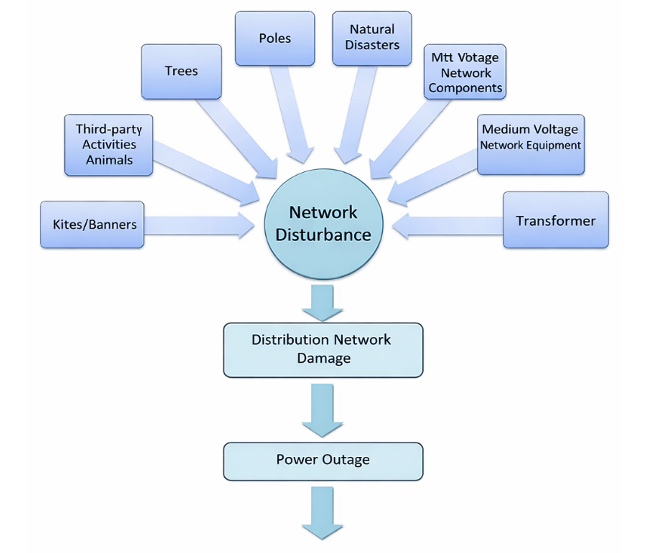
The electricity distribution network plays an important role in distributing electrical energy from substations to customers. At the Bandung PT. PLN (Persero) ULP Bengkalis feeder, there are still disruptions that cause blackouts and reduce service quality. This study aims to analyze the causes of disruptions using the Fault Tree Analysis (FTA) method to identify the dominant factors and root causes. The methods used include literature studies, observations, interviews, and data collection on disruptions from January 2025 to Desember 2025 This study was motivated by the limitations of previous studies, which generally used Fault Tree Analysis (FTA) only in a descriptive manner without a quantitative approach and did not consider the influence of local factors on power distribution network outages. Therefore, this study aims to develop a semi-quantitative, probability-based FTA approach and to examine the characteristics of outages in the Bengkalis region. The scientific contribution of this study lies in the integration of probabilistic analysis into FTA and the strengthening of risk-based recommendations to improve the reliability of the electrical distribution system. Animals such as birds, squirrels, or other creatures can cause disruptions by coming into contact with or bridging conductors, which can potentially cause short circuits. The high frequency of interactions between electrical networks and their surroundings, combined with a lack of monitoring and protection of the networks, makes these two factors more significant than other causes. When comparing internal and external disruptions, it is evident that external disruptions account for a larger proportion—approximately 59% of total disruptions—while internal disruptions account for about 41%. This confirms that the reliability of the distribution system in the study area is more heavily influenced by external factors than by the technical condition of the equipment itself.
Article Details

This work is licensed under a Creative Commons Attribution-ShareAlike 4.0 International License.
References
A. R. Bergen and V. Vittal, Power Systems Analysis, 2nd ed. New York: Pearson, 2019.
J. J. Grainger and W. D. Stevenson, Power System Analysis, New York: McGraw-Hill, 2017.
M. Kezunovic, “Smart Fault Location for Smart Grids,” IEEE Trans. Smart Grid, vol. 11, no. 2, pp. 123–130, 2020.
S. M. Muyeen et al., “Reliability Assessment of Distribution System,” Electric Power Systems Research, vol. 189, 2020.
A. R. Duyo et al., “Analisis Gangguan Jaringan Distribusi Menggunakan FTA,” Jurnal Teknik Elektro, vol. 10, no. 2, 2019..
S. Wasahua et al., “Analisis Penyebab Gangguan Distribusi Listrik dengan FTA,” Jurnal Energi dan Kelistrikan, vol. 12, no. 1, 2021.
E. Zio, The Monte Carlo Simulation Method for System Reliability, Springer, 2016.
R. E. Barlow and F. Proschan, Statistical Theory of Reliability, SIAM, 2017.
H. Wang et al., “Fault Tree Analysis in Power Systems,” IEEE Access, vol. 8, 2020.
Y. Liu et al., “Reliability Evaluation Using FTA,” International Journal of Electrical Power, vol. 117, 2020.
M. I. Ramadhan, “Analisis Gangguan Jaringan PLN Menggunakan FTA,” Jurnal Sains dan Teknologi, vol. 9, no. 2, 2022.
R. Saputra et al., “Evaluasi Keandalan Jaringan Distribusi,” Jurnal Teknik Elektro Indonesia, vol. 11, no. 1, 2023.
R. Billinton and R. N. Allan, Reliability Evaluation of Power Systems, 2nd ed. New York: Springer, 2017.
M. Kezunovic, “Monitoring, Control, and Protection of the Smart Grid,” IEEE Trans. Smart Grid, vol. 11, no. 1, pp. 1–9, 2020.
E. Zio, An Introduction to the Basics of Reliability and Risk Analysis, Singapore: World Scientific, 2018.
P. Kundur, Power System Stability and Control. New York, NY, USA: McGraw-Hill, 2017.
IEEE Power & Energy Society, “IEEE Guide for Electric Power Distribution Reliability Indices,” IEEE Std 1366-2012, 2019.
S. M. Amin and B. F. Wollenberg, “Toward a smart grid: Power delivery for the 21st century,” IEEE Power and Energy Magazine, vol. 3, no. 5, pp. 34–41, 2018.
T. Gönen, Electric Power Distribution Engineering, 3rd ed. Boca Raton, FL, USA: CRC Press, 2016.
M. Kezunovic, “Smart fault location for smart grids,” IEEE Transactions on Smart Grid, vol. 11, no. 1, pp. 11–22, 2020.
PLN (Persero), Statistik Ketenagalistrikan Indonesia. Jakarta, Indonesia, 2022.
S. S. Venkata, “Vegetation management for power system reliability,” IEEE Industry Applications Magazine, vol. 22, no. 6, pp. 45–52, 2017.
H. Saadat, Power System Analysis, 3rd ed. New York, NY, USA: PSA Publishing, 2018.
R. Adawiyah and H. Amri, “Analisa Indeks Keandalan Pelayanan Sistem Distribusi Tenaga Listrik 20 kV Berdasarkan SAIFI pada PT PLN (Persero) ULP Bengkalis,” INOVTEK Seri Elektro, 2025.
R. A. Duyo, “Analisis Penyebab Gangguan Jaringan pada Distribusi Listrik Menggunakan Metode Fault Tree Analysis,” Vertex Elektro, 2020.