Contact Angle Based Dielectric Strength Enhancement of Contaminated Ceramic Insulators Using Epoxy-SiO2 Coating
Article Sidebar
Main Article Content
Abstract
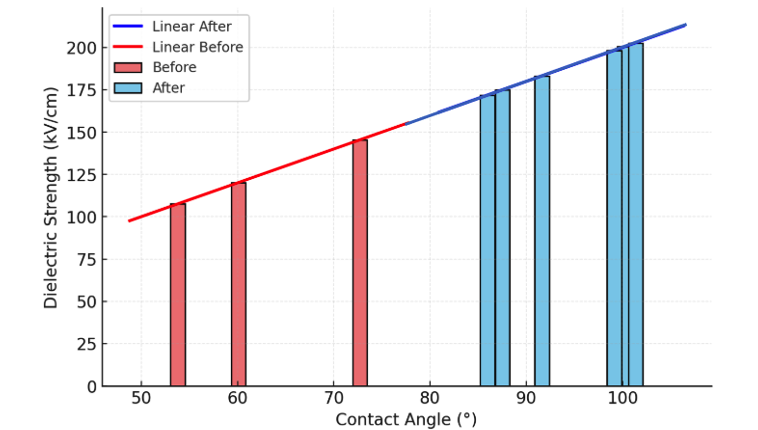
This study evaluates the effectiveness of epoxy-SiO2 coatings in enhancing the dielectric strength of contaminated ceramic insulators through contact angle analysis. Insulators in tropical regions, such as the 150 kV Koto Panjang-Payakumbuh line, often suffer from performance degradation due to moss contamination and high humidity, leading to reduced hydrophobicity and an increased risk of flashover. Contact angles were measured using the sessile drop method before and after coating. Uncoated insulators exhibited hydrophilic behavior with contact angles below 90° (53.81°, 72.70°, and 60.14°). Pure epoxy improved the values to 87.52°, 91.62°, and 85.94°, indicating partial hydrophobicity. The addition of SiO2 nanoparticles further increased the values above 100° (100.26°, 99.33°, and 101.33°). Based on the empirical correlation between contact angle and dielectric strength, dielectric performance improved from 124.4 kV/cm (uncoated) to 176.7 kV/cm (epoxy) and 200.4 kV/cm (epoxy-SiO2). The novelty of this work lies in demonstrating, for the first time, the comparative effectiveness of epoxy and epoxy-SiO2 coatings under real tropical contamination conditions. These findings confirm that epoxy-SiO2 coatings not only improve hydrophobicity but also provide a homogeneous protective layer, thereby reducing leakage current and strengthening dielectric endurance. The results highlight a cost-effective preventive maintenance strategy with both scientific and practical contributions for high-voltage transmission systems in tropical environments.
Article Details

This work is licensed under a Creative Commons Attribution-ShareAlike 4.0 International License.
References
A. P. G. Scholar, "Performance in High Tension Ceramic Post Insulator with Epoxy Resin Coatings," pp. 1-5, 2017.
D. H. Santosa, "Analysis of Accelerated Lifespan of Ceramic Insulators on 20 kV Distribution Lines in Coastal Areas Due to Air Contaminants," pp. 1-39, 2017.
F. R. Yanti, "Analysis of the Effect of Insulator Contaminants on the Number of Flashovers on the 150 kV Koto Panjang-Payakumbuh Transmission Line," Pros. Sains Nas. dan Teknol., vol. 12, no. 1, p. 559, 2022, doi: 10.36499/psnst.v12i1.7212.
W. M. Putri and R. Nurdiansyah, "The Effect of Vehicle Smoke Pollutant Contamination on the Flashover Voltage of Porcelain Insulators Using the Slow Rate of Rise Test Method," vol. 02, no. 5, pp. 53-60, 2024.
A. Fatoni, "Reliability Analysis of the 20 kV Distribution System of PT.PLN Lumajang Rayon Using the FMEA (Failure Modes and Effects Analysis) Method," J. Tek. ITS, vol. 5, no. 2, pp. 462-467, 2017, doi: 10.12962/j23373539.v5i2.16150.
E. Darmawan, Hermawan, and A. Syakur, "Analysis of the Influence of Contaminant Types on Leakage Current," vol. 4, no. 3, pp. 532-541, 2015.
X. Wang et al., "Improved properties of epoxy composite coatings enabled by multi-dimension filler materials," Prog. Org. Coatings, vol. 197, no. August, p. 108800, 2024, doi: 10.1016/j.porgcoat.2024.108800.
J. Heri and A. Syakur, "Surface Leakage Current Study of Epoxy Silane Resin Insulation Materials With Various Silica Sand Fillers (With Beach Pollutants)," Transmisi, vol. 14, no. 1, pp. 20-37, 2012.
Y. Anugerah, M. Ambabunga, and H. Masiku, "Damage to High Voltage Transmission Line Insulators Due to the Influence of Pollutants (Dry and Wet Conditions)," vol. 6, no. 2, pp. 7-12, 2021.
S. Virtanen et al., "Dielectric breakdown strength of epoxy bimodal-polymer-brush-grafted core functionalized silica nanocomposites," IEEE Trans. Dielectr. Electr. Insul., vol. 21, no. 2, pp. 563-570, 2014, doi: 10.1109/TDEI.2014.004415.
A. Kusumaningrum, "Analysis of Accelerated Life of 20 Kv Polymer Insulator Due to the Influence of Contaminants Based on Leakage Current Measurements," J. ITS, p. 1, 2019.
J. Homepage et al., "Investigation of Insulating Material Application: Affordable and Optimal Use of Epoxy Resin Filler, Indonesian Journal of Electrical Engineering and Renewable Energy (IJEERE)," vol. 4, no. 2, pp. 56-61, 2024.
S. Baghshahi, M. Dashti, A. Sedghi, and H. N. Miankoshki, "Nano-Silica Coatings and their Effect on the Hydrophobicity and Electrical Properties of Power Line Porcelain Insulators," Iran. J. Mater. Sci. Eng., vol. 21, no. 3, pp. 1-14, 2024, doi: 10.22068/ijmse.3558.
I. H. Susanto, "Design and Construction of Statistical Data Processing Applications Using the Pearson Product Moment Correlation Method," Sekolah Tinggi Manajemen Informatika dan Teknik Komputer Surabaya, pp. 0-71, 2014.
A. I. Pratiwi and M. Asri, "Analysis of Breakdown Voltage and Hydrophobicity of Epoxy Resin and SiO2 Composite Nano Insulators," Jambura J. Electr. Electron. Eng., vol. 3, no. 2, pp. 89-93, 2021, doi: 10.37905/jjeee.v3i2.10763.
A. A. El-Hag, "Performance of nano-filled epoxy coatings for outdoor high-voltage insulation," IEEE Trans. Dielectr. Electr. Insul., vol. 28, no. 3, pp. 1021-1030, 2021.
M. Ponomar et al., "Sessile Drop Method: Critical Analysis and Optimization for Measuring the Contact Angle of an Ion-Exchange Membrane Surface," Membranes (Basel)., vol. 12, no. 8, 2022, doi: 10.3390/membranes12080765.
H. Hillborg et al, "Surface hydrophobicity recovery of silicone and epoxy-based nanocomposite insulators," IEEE Electr. Insul. Mag., vol. 36, no. 5, 2020.
N. Yuniarti and A. N. Afandi, "Review of the Hydrophobic Properties of Silicone Rubber Insulation Materials," Tekno, vol. 2, no. 19, pp. 1-11, 2020.
S. B. G. R. Damaru, A. Novaringga, and Darmansyah, "Resin Composite Synthesis Reinforced with Banana Tree Fiber with Carboxylic Silica (SiO2-COOH) Addition as a Nanofiller," Indonesian Journal of Chemical Science, vol. 10, no. 1, 2021.
E. Hasan Harun, R. Kurniawan Putra Otaya, and J. Ilham, "Comparison of Breakdown Voltage and Compressive Strength of Epoxy Resin Insulators Using Bolango Gorontalo River Sand and Silica Sand as Filler," J. Renew. Energy Eng., vol. 1, no. 1, pp. 1-5, 2023, doi: 10.56190/jree.v1i1.7.
J. S. Y. Xu and Q. Zhou, "Enhancement of surface hydrophobicity and dielectric strength of epoxy/SiO2 nanocomposites under multi-stress conditions," J. Appl. Polym. Sci., vol. 138, no. 14, 2021.
A. B. Bukit, A. Syakur, and J. Windarta, Comparative Analysis of Ceramic Insulator Performance with The Application of Silicone Rubber Coating and Nano-Ceramic Coating. Atlantis Press International BV, 2024. doi: 10.2991/978-94-6463-480-8_5.
J. Jumari, J. Sinaga, and S. Zega, "Study of the effect of air pollution contamination on 20 Kv medium voltage insulators at PT PLN (Persero) Medan Customer Service Implementation Unit (UP3)," J. Teknol. Energi Uda J. Tek. Elektro, vol. 9, no. 1, pp. 31-43, 2020.
Y. S. H, "The Effect of Artificial UV Radiation on Surface Damage of Epoxy Silane Resin Insulation Materials," vol. 2, no. 4, 2013.