Managing Image in the Midst of Uncertainty: A Systematic Analysis of Destination Communication Strategies Post-Security Crisis
DOI:
https://doi.org/10.38043/jimb.v11i1.7495Keywords:
post-security crisis, destination image, communication strategies, tourist loyalty, smart tourism technologies, community involvementAbstract
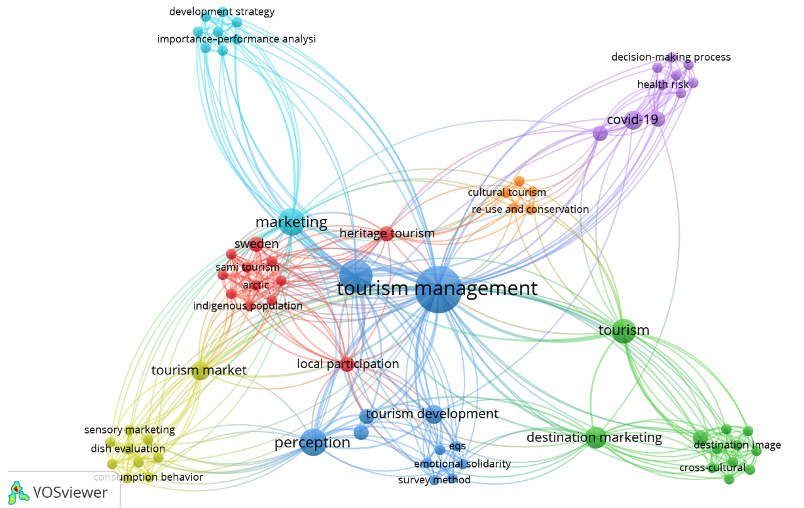
Post-security crises, particularly those arising from political instability or natural disasters, tourism destinations in Indonesia face challenges in managing their image and sustaining tourist visits. Effective crisis communication strategies, including transparent actions and engagement with tourists, play a crucial role in rebuilding trust and loyalty, essential for long-term tourism sustainability. These strategies, along with smart tourism technologies and community involvement, are vital for managing destination image during and after a crisis, ensuring recovery and maintaining tourist interest. This study explores key strategies destinations use to manage their image post-crisis, focusing on the role of smart tourism technologies (STT) and content marketing in fostering tourist loyalty, and investigates community involvement in building resilience. A systematic literature review using the PRISMA framework was conducted, supplemented by bibliometric analysis with VOSviewer, covering 18 articles published between 2020 and 2025. Adaptive crisis communication, STT (AI, VR), content marketing, and community engagement are essential in restoring destination image and sustaining tourist loyalty. Digital platforms and UGC play significant roles in shaping visitor perceptions and decisions. The integration of digital strategies, transparent communication, and community involvement are crucial for post-crisis recovery and long-term resilience. Emotional engagement and perceived safety significantly influence the effectiveness of these strategies. This study provides unique insights into strategies for managing tourism destinations' post-crisis recovery. It offers practical guidance for managers on how to integrate crisis communication strategies, community involvement, and digital innovations to enhance both tourist loyalty and destination resilience, ensuring long-term sustainability.
Downloads
References
Baalbaki, J. (2024). Egyptian crises and destination brand image: the resurrection of the mummy. Current Issues in Tourism, 27(6), 887905. https://doi.org/10.1080/13683500.2023.2187280
Baalbaki, J., & Zizka, L. (2024). Current Issues in Tourism Egyptian crises and destination brand image: the resurrection of the mummy. 3500. https://doi.org/10.1080/13683500.2023.2187280
Carvache-franco, M., Vquez-paniagua, A. G., Carvache-, O., Prez-orozco, A., Orden-meja, M., Carvache-franco, W., Vquez-paniagua, A. G., & Carvache-, O. (2024). Implications of destination marketing from the perspective of the perceived value of foreign tourists. Cogent Business & Management, 11(1). https://doi.org/10.1080/23311975.2024.2392258
Chemin, M., da Silva, C. P., & de Paul Vikou, S. V. (2025). User-generated content (UGC) in tourist attractions and destinations: systematic literature review and perspectives for management. PASOS Revista de Turismo y Patrimonio Cultural, 23(2), 539562. https://doi.org/10.25145/j.pasos.2025.23.036
Chen, Y. (2023). Comparing content marketing strategies of digital brands using machine learning. 2023, 118. https://doi.org/10.1057/s41599-023-01544-x
Clemens, K. (2021). Determinants of content marketing effectiveness: Conceptual framework and empirical findings from a managerial perspective. Cm, 125. https://doi.org/10.1371/journal.pone.0249457
Dilys, M., Sarlauskiene, L., & Smitas, A. (2022). Analysis of the concept of content marketing. 9(5), 4759. https://doi.org/10.21833/ijaas.2022.05.006
Ding, J., Syed, A., & Shamshudeen, R. I. (2024). Exploring the online destination image of an all-for-one tourism destination in China: a DMO perspective. Cogent Social Sciences, 10(1). https://doi.org/10.1080/23311886.2024.2447397
Gssling, S., & Reinhold, S. (2025). Accelerating small and medium sized tourism enterprises engagement with climate change. Journal of Sustainable Tourism, 33(5), 840857. https://doi.org/10.1080/09669582.2024.2350659
Harrill, R., Zuiga-collazos, A., Castillo-palacio, M., & Padilla-delgado, L. M. (2023). An Exploratory Attitude and Belief Analysis of Ecotourists Destination Image Assessments and Behavioral Intentions. 111. https://doi.org/10.3390/su151411349
Jara-am, C. (2023). The Impact of YouTube in Tourism Destinations: A Methodological Proposal to Qualitatively Measure Image Positioning Case: Saudi Arabia. https://doi.org/10.3390/su15139879
Jara-Amzaga, C. (2023). The Impact of YouTube in Tourism Destinations: A Methodological Proposal to Qualitatively Measure Image PositioningCase: Saudi Arabia. Sustainability (Switzerland), 15(13). https://doi.org/10.3390/su15139879
Latif, W. Bin, Islam, N., Ahammad, I., Forid, S., Dona, P. Das, & Hasan, M. (2024). DETERMINANTS OF CUSTOMER-BASED BRAND EQUITY ON BRAND IMAGE: THE MODERATING ROLE OF TOURISM MANAGEMENT AND ADVERTISEMENT. 8(1), 252263. https://doi.org/10.22495/cgobrv8i1p22
Li, S., Dou, Q., Chen, H., & Yu, Z. (2023). The Impact of Consumer s Adaptation to the Creative Culture of Theme Parks on Review Usefulness. https://doi.org/10.3390/su151712859
Liu, W., Xu, C., Peng, Y., & Xu, X. (2023). Evolution of Tourism Risk Communication: A Bibliometric Analysis and Meta-Analysis of the Antecedents of Communicating Risk to Tourists. https://doi.org/10.3390/su15129693
Lopes, A. R., & Porto, I. (2022). DIGITAL CONTENT MARKETING: CONCEPTUAL REVIEW AND RECOMMENDATIONS FOR PRACTITIONERS. 21(2), 117. https://doi.org/10.4236/ajibm.2024.144020
Mac, R., Bonal, J., Le, J., Fern, ., Arco, J., & Burillo, P. (2023). Golf Club Management Challenges towards Sustainability: Opportunities and Innovations during and after the COVID-19 Pandemic: A Qualitative Perspective. https://doi.org/10.3390/su151813657
Martins, A. F., Penela, D., & Cardoso, M. G. M. S. (2023). Understanding the personality of Europes only world surfing reserve. Consumer Behavior in Tourism and Hospitality, 18(2), 215227. https://doi.org/10.1108/CBTH-05-2022-0115
Martins, A. F., Penela, D., & Cardoso, M. G. M. S. (2025). Understanding the personality of Europe s only world sur fi ng reserve. 18(2), 215227. https://doi.org/10.1108/CBTH-05-2022-0115
Musa, H. G., Fatmawati, I., & Suyanto, M. (2025). What drives loyalty in sustainable tourism? Escapism and affordability at Central Java s heritage sites. Cogent Social Sciences, 11(1). https://doi.org/10.1080/23311886.2025.2482112
Nguyen, D., & Nguyen, T. (2023). BRAND PERSONALITY AND REVISIT INTENTION: THE MEDIATING ROLE OF TOURISTS SELF-IMAGE CONGRUITY. 29(2), 235248. https://doi.org/10.20867/thm.29.2.8
Nguyen, D. T., Nguyen, T. T. H., Nguyen, K. O., Pham, T. T. H., & Nguyen, T. H. (2023). Brand Personality and Revisit Intention: the Mediating Role of Tourists Self-Image Congruity. Tourism and Hospitality Management, 29(2), 235248. https://doi.org/10.20867/thm.29.2.8
Rethlefsen, M. L., & Page, M. J. (2022). PRISMA 2020 and PRISMA-S: common questions on tracking records and the flow diagram. 110(April), 253257. https://doi.org/10.31222/osf.io/439ju
Sardari, Z. A., Mohamadabadi, T. A., & Nazarian-jashnabadi, J. (2024). Smart Experience and Green Health Tourism: The Moderating Role of Content Marketing. 120. https://doi.org/10.3390/su16114546
Sekhniashvili, G. (2023). Developing a Wine Tourism Destination Image Measurement Scale. 113. https://doi.org/10.3390/su15118549
Sekhniashvili, G., & Bujdos, Z. (2023). Developing a Wine Tourism Destination Image Measurement Scale. Sustainability (Switzerland), 15(11), 113. https://doi.org/10.3390/su15118549
Singh, V. K., Singh, P., Karmakar, M., Leta, J., & Mayr, P. (2021). The journal coverage of Web of Science, Scopus and Dimensions: A comparative analysis. Scientometrics, 126(6), 51135142. https://doi.org/10.1007/s11192-021-03948-5
Suli, D., Boros, L., & PAL, V. (2024). THE ROLE OF MUSIC FESTIVALS IN SHAPING DESTINATION BRANDING AND IMAGE IN TWO HUNGARIAN REGIONAL CENTERS Dorottya SLI *. 53(2), 657667. https://doi.org/10.30892/gtg.53229-1241
Sli, D., Boros, L., & Pl, V. (2024). the Role of Music Festivals in Shaping Destination Branding and Image in Two Hungarian Regional Centers. Geojournal of Tourism and Geosites , 53(2), 657667. https://doi.org/10.30892/gtg.53229-1241
Tsai, P., Hsaio, C., Li, Y., & Lin, C. (2023). Clustering Travelers Lifestyle Destination Image from Five Asian Traveler-Generated Content. 118. https://doi.org/10.3390/su15075887
Wang, Q., Liao, J., Lapata, M., & Macleod, M. (2022). PICO entity extraction for preclinical animal literature. Systematic Reviews, 112. https://doi.org/10.1186/s13643-022-02074-4
Downloads
Published
How to Cite
Issue
Section
License
Copyright (c) 2026 Dedy Iswanto, Sulhan Hadi, Baiq Reinelda Tri Yunarni, Muhammad Fuzail

This work is licensed under a Creative Commons Attribution-ShareAlike 4.0 International License.