Psychological Well-Being at Hospitality: Configuring the Antecedents and Outcomes from Millennials Perspectives
DOI:
https://doi.org/10.38043/jimb.v10i2.6320Keywords:
Psychological well-being, Millennials, Ambidextrous , Leadership, Turnover Intention, Organizational engagementAbstract
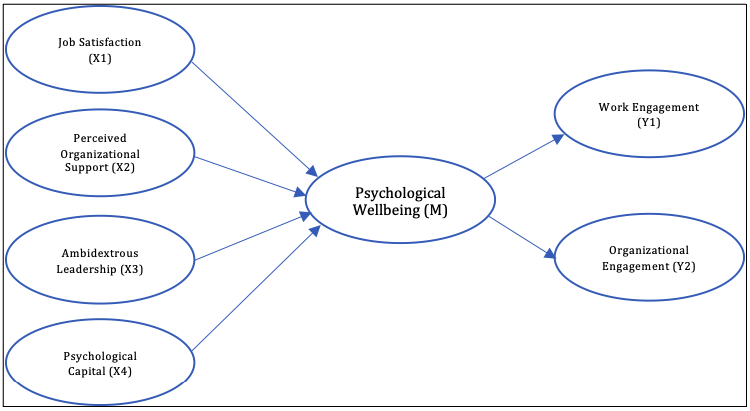
This study provides a new perspective on the psychological well-being of millennial employees in the Bali hospitality industry by identifying its key predictors and assessing its impact on work and organizational engagement. The study employed explanatory sequential analysis of 153 millennial workers working in various star-rated hotels in Bali. The quantitative analysis with SmartPLS revealed that ambidextrous leadership (beta = 0.578, p < 0.001) and psychological capital (beta = 0.346, p < 0.001) significantly enhanced psychological well-being, while job satisfaction showed a negative effect (beta = -0.186, p < 0.05) and perceived organizational support showed no significant impact (p = 0.160). Furthermore, psychological well-being strongly predicted organizational engagement (beta = 0.760, p < 0.001) and work engagement (beta = 0.705, p < 0.001), with a greater influence on organizational engagement. This study contributes to the literature by demonstrating that psychological well-being exerts a stronger influence on organizational engagement than on work engagement, highlighting millennials’ deeper commitment to their organizations when their well-being is supported. These findings underscore the importance of psychological capital in fostering resilience and offering fresh insights to enhance organizational engagement. Unlike previous research, this study uniquely integrates ambidextrous leadership and psychological capital as primary drivers of psychological well-being, revealing their significant positive influence.
Downloads
References
Abolnasser, M. S. A., Abdou, A. H., Hassan, T. H., & Salem, A. E. (2023). Transformational Leadership, Employee Engagement, Job Satisfaction, and Psychological Well-Being among Hotel Employees after the Height of the COVID-19 Pandemic: A Serial Mediation Model. International Journal of Environmental Research and Public Health, 20(4). https://doi.org/10.3390/ijerph20043609
Ajmal, M., Sareet, Z., & Islam, A. (2025). Unleashing innovation through employee voice behavior in the hotel industry: the impact of ambidextrous leadership on innovative work behavior. Journal of Hospitality and Tourism Insights, 8(2), 448-471. https://doi.org/10.1108/JHTI-08-2023-0564
Alatartseva, E., & Barysheva, G. (2015). Well-being: subjective and objective aspects. Procedia-Social and Behavioral Sciences. https://www.sciencedirect.com/science/article/pii/S1877042814066178
Ardelt, M. (2019). Wisdom and well-being. psycnet.apa.org. https://psycnet.apa.org/record/2018-33245-027
Bantha, T., Nayak, U., & Mishra, S. K. (2023). Engaging the disengaged: the role of workplace spirituality on millennials work engagement. International Journal of Organizational Analysis. https://doi.org/10.1108/IJOA-07-2023-3841
Barrington-Leigh, C., & Escande, A. (2018). Measuring progress and well-being: A comparative review of indicators. Social Indicators Research. https://doi.org/10.1007/s11205-016-1505-0
Chakravarty, S. R. (2017). Analyzing multidimensional well-being: A quantitative approach. books.google.com. https://books.google.com/books?hl=en&lr=&id=_IE5DwAAQBAJ&oi=fnd&pg=PA1&dq=%22well+being%22&ots=X8nnDCdkww&sig=Er1pkVLrC-tGhlq1P4xOK9R12Gc
Darvishmotevali, M., & Ali, F. (2020). Job insecurity, subjective well-being and job performance: The moderating role of psychological capital. International Journal of Hospitality Management, 87. https://doi.org/10.1016/j.ijhm.2020.102462
Day, A., & Nielsen, K. (2017). 16 What Does Our Organization Do to Help Our Well-Being? Creating. An Introduction to Work and Organizationalhttps://books.google.com/books?hl=en&lr=&id=bTpKDgAAQBAJ&oi=fnd&pg=PA295&dq=%22well+being%22&ots=9zDTgx53N_&sig=Pn0sYTh-No6xeZ-cpC61ZRSRhu4
Delina, G. (2020). A study on the interrelationships between employee engagement, employee engagement initiatives and job satisfaction. International Journal of Business Excellence. https://www.inderscienceonline.com/doi/abs/10.1504/IJBEX.2020.105355
Diener, E., Lucas, R. E., & Oishi, S. (2018). Advances and open questions in the science of subjective well-being. Collabra: Psychology. https://online.ucpress.edu/collabra/article-abstract/4/1/15/112974
Diener, E., Oishi, S., & Tay, L. (2018). Handbook of well-being. academia.edu. https://www.academia.edu/download/89829225/download.pdf
Disabato, D. J., Goodman, F. R., Kashdan, T. B. (2016). Different types of well-being? A cross-cultural examination of hedonic and eudaimonic well-being. Psychological https://psycnet.apa.org/journals/pas/28/5/471.html?uid=2015-40634-001
Dorina Racola-Paina, N., & Dan Irini, R. (2021). Generation Z in the Workplace through the Lenses of Human Resource Professionals-A Qualitative Study Young entrepreneurship View project Talent management View project. Quality Access to Success, 22(183), 7885. https://www.researchgate.net/publication/352374489
Erben, G. S. (2019). Mindfulness as an Antecedent of Work Engagement: Impact of Demographic Factors in the Relationship Between Mindfulness and Work Engagement. Management Techniques for Employee Engagement. https://www.igi-global.com/chapter/mindfulness-as-an-antecedent-of-work-engagement/221404
Fletcher, G. (2016). The philosophy of well-being: An introduction. taylorfrancis.com. https://doi.org/10.4324/9781315745329
Frye, W. D., Kang, S., Huh, C., & Lee, M. J. (MJ). (2020). What factors influence Generation Ys employee retention in the hospitality industry?: An internal marketing approach. International Journal of Hospitality Management, 85, 102352. https://doi.org/10.1016/j.ijhm.2019.102352
Gip, H., Guchait, P., Paamehmetolu, A., & Khoa, D. T. (2023). How organizational dehumanization impacts hospitality employees service recovery performance and sabotage behaviors: the role of psychological well-being and tenure. International Journal of Contemporary Hospitality Management, 35(1), 64-91.
Gouda, G. K., & Tiwari, B. (2022). Ambidextrous leadership: a distinct pathway to build talent agility and engagement. Human Resource Development International, 27(1), 133141. https://doi.org/10.1080/13678868.2022.2163101
Haworth, J., & Hart, G. (2007). Well-being: Individual, community and social perspectives. books.google.com. https://books.google.com/books?hl=en&lr=&id=LZwqDAAAQBAJ&oi=fnd&pg=PP1&dq=%22well+being%22&ots=c1sHLavxZm&sig=bIJfjXJ_XHO1cRF5hnbWt7nOFkU
Haybron, D. M., & Tiberius, V. (2015). Well-being policy: What standard of well-being? Journal of the American Philosophical . https://www.cambridge.org/core/journals/journal-of-the-american-philosophical-association/article/wellbeing-policy-what-standard-of-wellbeing/CAF9DFAB941647B16B4DE692497AB2EF
Howell, K. H., Coffey, J. K., Fosco, G. M., Kracke, K., & ... (2016). Seven reasons to invest in well-being. Psychology of . https://psycnet.apa.org/fulltext/2015-59081-002.html
Indrayani, I. G. A. P. W., & Sihombing, I. H. H. (2025). Exploring the Interplay between Ambidextrous Leadership and Organizational Engagement Among the Millennials: A Moderated Mediation Analysis. Global Business & Finance Review, 30(1), 13. DOI: https://doi.org/10.17549/gbfr.2025.30.1.13
Jang, J., Jo, W. M., & Kim, J. S. (2020). Can employee workplace mindfulness counteract the indirect effects of customer incivility on proactive service performance through work engagement? Journal of Hospitality Marketing https://www.tandfonline.com/doi/abs/10.1080/19368623.2020.1725954
Jeffrey, R. (2016). Politics, women and well-being: How Kerala becamea model. books.google.com. https://books.google.com/books?hl=en&lr=&id=ENC-DAAAQBAJ&oi=fnd&pg=PR11&dq=%22well+being%22&ots=WBg0Qoz7-Y&sig=mzmZOkKoP-Mp1Ed-XDQP5boxL1U
Johnson, S., Robertson, I., & Cooper, C. L. (2018). Well-being and employee engagement. WELL-BEING. https://link.springer.com/chapter/10.1007/978-3-319-62548-5_3
Khan, S. M., & Abbas, J. (2022). Mindfulness and happiness and their impact on employee creative performance: Mediating role of creative process engagement. Thinking Skills and Creativity, 44, 101027. https://doi.org/10.1016/j.tsc.2022.101027
Kokkoris, M. D. (2016). Revisiting the relationship between maximizing and well-being: An investigation of eudaimonic well-being. Personality and Individual Differences. https://www.sciencedirect.com/science/article/pii/S0191886916303592
Magyar, J. L., & Keyes, C. L. M. (2019). Defining, measuring, and applying subjective well-being. psycnet.apa.org. https://psycnet.apa.org/record/2019-20160-025
Mahmoud, A. B., Fuxman, L., Mohr, I., Reisel, W. D., & Grigoriou, N. (2021). We arent your reincarnation! workplace motivation across X, Y and Z generations. International Journal of Manpower, 42(1), 193209. https://doi.org/10.1108/IJM-09-2019-0448
Murphy, E. R. (2023). Hope and well-being. Current Opinion in Psychology. https://www.sciencedirect.com/science/article/pii/S2352250X23000039
Naim, M. F. (2022). What matters most for Indian Generation Y employees? An empirical study based on work-values. Global Business and Organizational Excellence, 41(3), 5568. https://doi.org/10.1002/joe.22134
Netemeyer, R. G., Warmath, D., & ... (2018). How am I doing? Perceived financial well-being, its potential antecedents, and its relation to overall well-being. Journal of Consumer https://academic.oup.com/jcr/article-abstract/45/1/68/4600084
Park, C. L., Kubzansky, L. D., Chafouleas, S. M., Davidson, R. J., & ... (2023). Emotional well-being: What it is and why it matters. Affective Science. https://doi.org/10.1007/s42761-022-00163-0
Pradhan, R. K., & Hati, L. (2022). The measurement of employee well-being: development and validation of a scale. Global Business Review. https://doi.org/10.1177/0972150919859101
Ryff, C. D. (2017). Eudaimonic well-being, inequality, and health: Recent findings and future directions. International Review of Economics. https://doi.org/10.1007/s12232-017-0277-4
Sahu, S., Pathardikar, A., & Kumar, A. (2018). Transformational leadership and turnover: Mediating effects of employee engagement, employer branding, and psychological attachment. Leadership & Organization. https://www.emerald.com/insight/content/doi/10.1108/LODJ-12-2014-0243/full/html?fbclid=IwAR3r7WGktYSmIpSZ0y7SjXUvXskq7egp7uwu96WXVz72svE8A_9VqdplzJ8
Verma, S., & Garg, N. (2024). Validation and Confirmation of the Equanimity Scale-16 in India and its Relationship with Well-Being. Mindfulness, 15(3), 689699. https://doi.org/10.1007/s12671-024-02318-5
Viac, C., & Fraser, P. (2020). Teachers well-being: A framework for data collection and analysis. oecd-ilibrary.org. https://www.oecd-ilibrary.org/content/paper/c36fc9d3-en
Downloads
Published
How to Cite
Issue
Section
License
Copyright (c) 2025 I Gusti Ayu Putu Wita Indrayani, Ni Luh Supartini

This work is licensed under a Creative Commons Attribution-ShareAlike 4.0 International License.