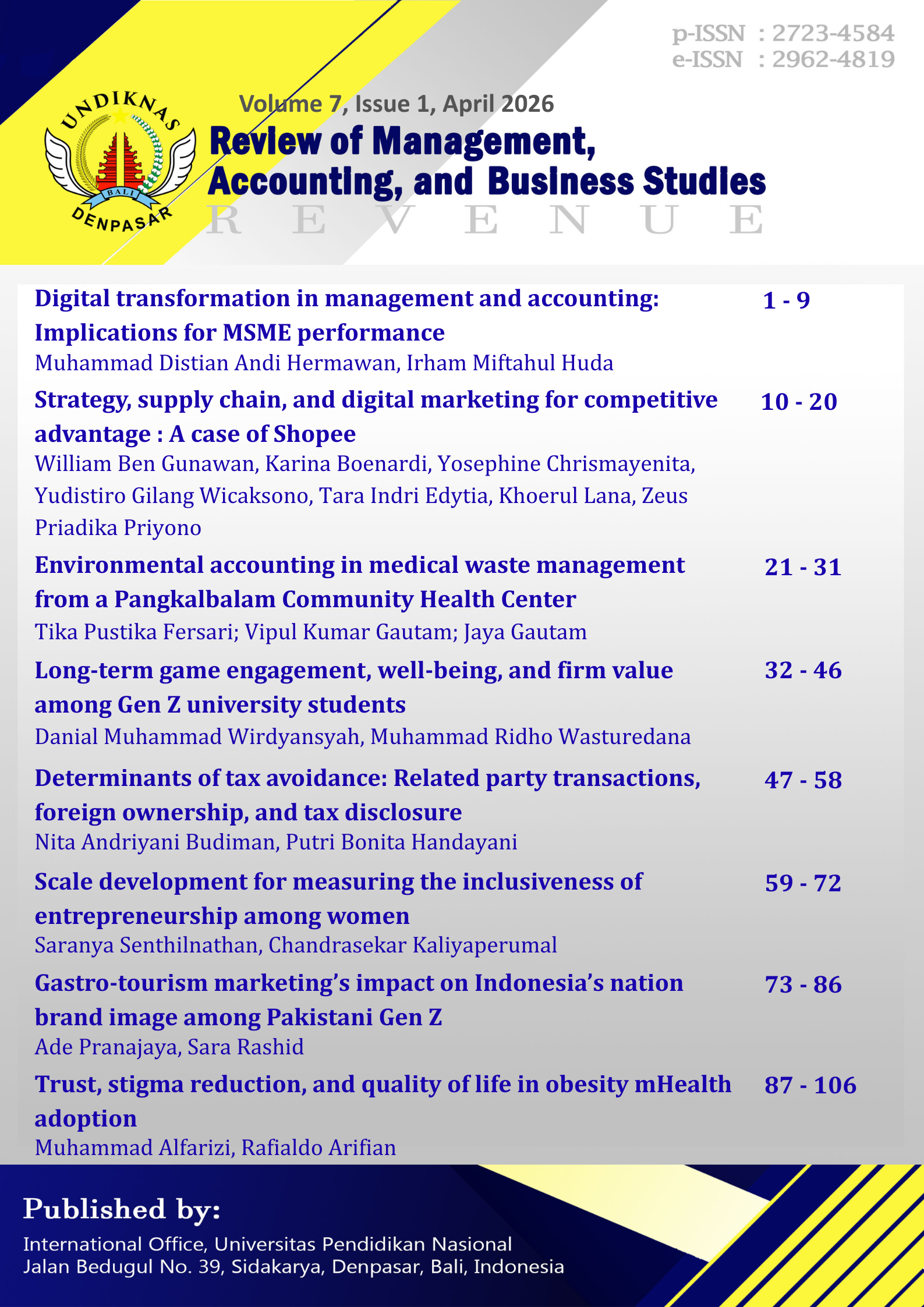
Scale development for measuring the inclusiveness of entrepreneurship among women
DOI:
https://doi.org/10.38043/revenue.v7i1.7502Keywords:
Entrepreneurial Development, Financial Inclusion, Government Schemes, Inclusiveness, Technological Empowerment, Women EntrepreneursAbstract
This study developed and validated a comprehensive measurement scale to assess inclusiveness in women’s entrepreneurship with a focus on marginalized and rural communities in Tamil Nadu. Drawing on the Capability Approach and Institutional Theory, it used a rigorous two-phase methodology involving extensive literature review and empirical validation with data from 376 women entrepreneurs. Exploratory and confirmatory factor analyses identified four core dimensions of inclusiveness: financial, technological, managerial, and marketing inclusion. The final measurement model demonstrated strong internal consistency, reliability, and construct validity across all dimensions. Notably, technological and marketing inclusion were the most influential factors, highlighting the pivotal roles of digital access and market connectivity in sustaining women-led enterprises. This validated scale serves as a diagnostic tool for researchers, policymakers, and practitioners to evaluate entrepreneurial programs and formulate targeted, inclusive interventions. By operationalizing inclusiveness comprehensively in the context of women’s entrepreneurship, the study fills a critical literature gap and provides an empirically sound instrument applicable in developing country contexts. It enhances understanding of the impact of government schemes on women entrepreneurs and supports the design of gender-responsive and regionally inclusive economic policies to foster entrepreneurship growth and socio-economic development in Tamil Nadu.
References
Agrawal, R., Chauhan, P., & Pandey, A. (2022). Inclusive growth through political action: Insights from post-2014 India. Journal of Public Policy and Administration, 37(2), 213–230.
Alagh, R., & Thapliyal, S. (2023). Government schemes and women entrepreneurship: A review of effectiveness and gaps. International Journal of Public Sector Management, 36(4), 487–505.
Anand, A., & Swaniti Initiative. (2021). Entrepreneurship and social equity: Financial sustainability among marginalized groups in India. Indian Journal of Economics and Development, 17(3), 112–124.
Ault, J. K. (2016). An institutional perspective on the social impact of inclusive business. Journal of International Business Studies, 47(6), 748–763.
Bacon, D. R., Sauer, P. L., & Young, M. (2016). Composite reliability in structural equation modeling. Journal of Modern Applied Statistical Methods, 11(1), 56–70.
Baskaran, A., Anantharaman, S., & Ramachandran, K. (2019). Inclusive innovation and incubators: A case study of academia-led initiatives in India. Science and Public Policy, 46(3), 435–446.
Bhatt, R., & Pant, C. (2015). Financial inclusion and regional development: A study of Uttarakhand. Economic and Political Weekly, 50(33), 79–85.
Brockhaus, R. H. (1980). Risk-taking propensity of entrepreneurs. Academy of Management Journal, 23(3), 509–520.
Busenitz, L. W., & Barney, J. B. (1997). Differences between entrepreneurs and managers in large organizations: Biases and heuristics in strategic decision-making. Journal of Business Venturing, 12(1), 9–30.
Camisón-Haba, S., Clemente-Almendros, J. A., & González-Cruz, T. F. (2019). Training programs and firm innovation: The moderating role of entrepreneurial orientation. Journal of Business Research, 101, 939–947.
Dolan, C., & Rajak, D. (2016). Remaking Africa’s informal economies: Youth, entrepreneurship and the promise of inclusion at the bottom of the pyramid. Journal of Development Studies, 52(4), 514–529.
Drori, I., Manos, R., & Santoro, M. D. (2018). Language and market entry: Cultural dynamics and gender inclusion in entrepreneurship. Journal of International Business Studies, 49(8), 919–941.
Fan, Z., & Zhang, R. (2017). Reducing credit constraints through financial inclusion: A signaling model for emerging markets. Journal of Economic Behavior and Organization, 137, 209–225.
Farrell, A. M., & Rudd, J. M. (2009). Factor analysis and discriminant validity: A brief review. Research Online. [No URL provided]
George, G., Howard-Grenville, J., Joshi, A., & Tihanyi, L. (2021). Understanding and advancing inclusiveness in innovation and entrepreneurship. Academy of Management Journal, 64(2), 511–521.
Goel, N., & Madan, P. (2019). Financial inclusion and women empowerment: An empirical study. Global Business Review, 20(2), 385–401.
Hakala, H. (2011). Strategic orientations in management literature: Three approaches to understanding the interaction between market, technology, entrepreneurial and learning orientations. International Journal of Management Reviews, 13(2), 199–217.
Hall, J., Matos, S., Sheehan, L., & Silvestre, B. (2012). Entrepreneurship and innovation at the base of the pyramid: A recipe for inclusive growth or social exclusion? Journal of Management Studies, 49(4), 785–812.
Hamburg, I., & Bucksch, S. (2017). Digital social innovation for inclusive entrepreneurship education. Journal of Innovation Management, 5(3), 52–71.
Holzmann, P., & Gregori, P. (2022). Digital transformation and sustainable entrepreneurship: A systematic literature review. Journal of Cleaner Production, 338, 130434.
Iddrisu, A. M., Danquah, B. A., & Kwaku, A. (2012). Entrepreneurial training and SME growth in developing countries: A Ghanaian case study. International Journal of Business and Social Research, 2(6), 1–9.
Jonathan, K., & Munoz, P. (2017). Financial inclusion and the capabilities approach: Reframing entrepreneurship for the poor. Journal of Business Venturing, 32(5), 476–497.
Kluve, J., Puerto, S., Robalino, D., Romero, J. M., Rother, F., & Stöterau, J. (2017). Interventions to improve the labor market outcomes of youth: A systematic review. Campbell Systematic Reviews, 13(1), 1–288.
Koloma, Y. (2021). Determinants of youth entrepreneurship in Mali: The role of financial inclusion. African Journal of Economic Policy, 28(1), 74–93.
Kulchina, E. (2017). Do managerial skills matter? Evidence from innovative startups. Strategic Management Journal, 38(9), 1760–1780.
Kummitha, R. K. R. (2019). Smart cities and entrepreneurial urbanism: Reconfiguration of governance, institutions and technology. Cities, 84, 100–109.
Ljubotina, P. (2020). Managerial decision-making and inclusive economic growth: Evidence from transition economies. Journal of East European Management Studies, 25(2), 198–214.
Lyngsie, J., & Foss, N. J. (2017). The more, the merrier? Women in top management teams and entrepreneurial orientation. Academy of Management Perspectives, 31(2), 218–229.
Marchese, M. (2014). Financial education and targeted microcredit schemes for inclusive entrepreneurship. OECD LEED Working Papers, (09).
Mathew, J., Singh, N., & Kaur, G. (2010). Social entrepreneurship: A tool for poverty eradication and employment generation. IUP Journal of Entrepreneurship Development, 7(2), 20–29.
Morrish, S. C., Miles, M. P., & Deacon, J. H. (2010). Entrepreneurial marketing: Acknowledging the entrepreneur and customer-centric interrelationship. Journal of Strategic Marketing, 18(4), 303–316.
Nwankwo, F., & Kanyangale, M. (2020). Entrepreneurial marketing as a strategic tool for survival of SMEs in a recession: A study of Nigerian entrepreneurs. Academy of Strategic Management Journal, 19(4), 1–12.
Orser, B. J., Riding, A. L., & Weeks, J. R. (2019). The gender gap in ICT usage and access among micro-entrepreneurs in developing economies. Gender in Management, 34(3), 194–209.
Osunmuyiwa, O., & Ahlborg, H. (2022). Gender inclusion in energy entrepreneurship: A critical analysis of renewable energy interventions in Sub-Saharan Africa. Energy Research & Social Science, 85, 102415.
Panakaje, N. (2023). Challenges in inclusive welfare distribution across India: Policy implications and regional disparities. Indian Journal of Social Development, 33(1), 59–75.
Qureshi, S. (2020). Micro-entrepreneurship and data justice: Financial inclusion through ICT in developing countries. Information Technology for Development, 26(4), 715–738.
Rashid, A. T. (2019). Information and communication technologies (ICTs) and economic development: A critical review of literature. Telematics and Informatics, 45, 101303.
Ratten, V. (2017). Gendered perspectives on global entrepreneurship. International Journal of Entrepreneurship and Small Business, 30(4), 409–438.
Reynaud, F., & Reynaud, M. (2017). Women’s entrepreneurship and financial inclusion in Mexico: The limits of informal sector growth. Latin American Business Review, 18(1), 51–72.
Sattar, A. (2018). Technological advancements and the role of digital finance in rural development. Asian Development Review, 35(1), 93–109.
Schaltegger, S., & Wagner, M. (2011). Business case for sustainability: The integration of sustainability into business strategy. Business Strategy and the Environment, 20(4), 205–213.
Singh, A., & Bansal, M. (2020). Government schemes for women entrepreneurs: An empirical evaluation. Indian Journal of Development Studies, 13(2), 151–165.
Silvestre, B. S., & Godinho, M. F. S. (2014). Understanding and advancing inclusive business models: A conceptual framework. Journal of Business Ethics, 114(3), 397–413.
Teixeira, A., & Sa, M. C. (2018). Digital transformation and inclusive innovation: Enabling female entrepreneurship in emerging markets. Technological Forecasting and Social Change, 131, 124–137.
Tobón, S., & González, C. P. (2018). Gender equality and sustainable development: The role of women in agriculture in rural Colombia. Journal of Agricultural Education and Extension, 24(3), 245–260.
Zhen, Z., & Zhang, D. (2018). Financial inclusion and rural women entrepreneurship: A case study from rural China. Development Studies Research, 5(1), 88–97.
Downloads
Published
How to Cite
Issue
Section
License
Copyright (c) 2026 Saranya Senthilnathan, Chandrasekar Kaliyaperumal

This work is licensed under a Creative Commons Attribution-ShareAlike 4.0 International License.