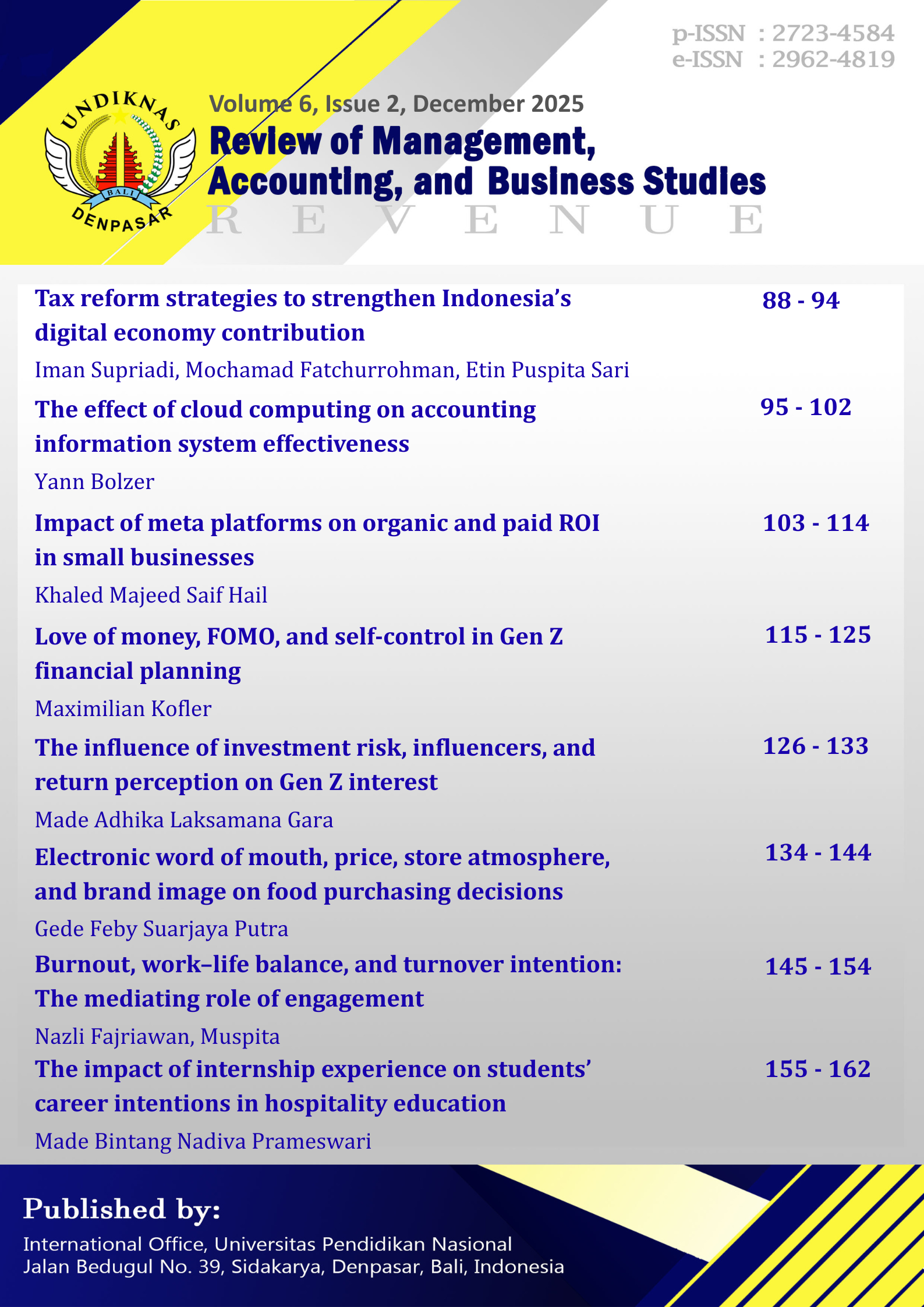
The impact of internship experience on students’ career intentions in hospitality education
DOI:
https://doi.org/10.38043/revenue.v6i2.7404Keywords:
Internship programs, career intention, human resource management, hospitality education, workforce developmentAbstract
Hospitality, as a major segment of the tourism industry, relies heavily on effective human resource management to deliver service quality and sustain organizational competitiveness. Consequently, workforce demand in the hospitality sector must be supported by a pipeline of skilled and job-ready graduates, which can be strengthened through vocational education and structured internship programs. Bali Tourism Polytechnic (Politeknik Pariwisata Bali) implements an internship program known as Praktek Kerja Nyata (PKN) across all study programs, including Hospitality Administration. Internship participation is expected to enhance students’ professional competencies and provide clearer insights into career options during and after their studies.This study examines the effect of internship experience on the career intention of Hospitality Administration students at Bali Tourism Polytechnic. Using a quantitative approach, data were collected through an online questionnaire measuring students’ satisfaction with their internship experience and their career intention. The survey targeted students in semesters 4, 6, and 8 who had completed at least one internship placement. A simple random sampling technique yielded 253 valid responses. Data were analyzed using simple linear regression, t-tests, and the coefficient of determination. From a management perspective, the findings underscore the role of internship programs as a strategic human resource practice for shaping early career intentions in the hospitality industry. The results indicate that internship experience has a positive and statistically significant effect on students’ career intention, explaining 45.8% of the variance. These findings highlight the managerial importance of well-designed internship programs for human resource development and workforce planning in the hospitality sector.
References
Badrolhisam, N. I., Achim, N., & Zulkipli, N. (2019). Employee career decision making: The influence of salary and benefits, work environment and job security. Journal of Academia, 7, 41–50.
Bhalla, A., & Dawra, S. (2019). Internship and self-efficacy: A literature review on career intentions of undergraduate hospitality students. Restaurant Business, 118(9), 467–486.
Cascio, W. F., & Aguinis, H. (2014). Applied psychology in human resource management (7th ed.). Prentice Hall.
Chang, W., & Busser, J. A. (2020). Hospitality career retention: The role of contextual factors and thriving at work. International Journal of Contemporary Hospitality Management, 32(1), 193–211.
Chen, T., & Shen, C. (2012). Today’s intern, tomorrow’s practitioner? The influence of internship programmes on students’ career development in the hospitality industry. Journal of Hospitality, Leisure, Sport & Tourism Education, 11(1), 29–40.
Chen, T. L., Shen, C. C., & Gosling, M. (2018). Does employability increase with internship satisfaction? Enhanced employability and internship satisfaction in a hospitality program. Journal of Hospitality, Leisure, Sport & Tourism Education, 22, 88–99.
Chrismardani, Y. (2016). Theory of planned behavior sebagai prediktor intensi berwirausaha. Competence: Journal of Management Studies, 10(1).
D’Abate, C. P., Youndt, M. A., & Wenzel, K. E. (2009). Making the most of an internship: An empirical study of internship satisfaction. Academy of Management Learning & Education, 8(4), 527–539. https://doi.org/10.5465/AMLE.2009.47785471
Dahanayake, S. N. S., Biyiri, E. W., & Dassanayake, D. M. C. (2019). Tourism and hospitality undergraduates’ internship experience, their satisfaction and impact on future career intention. Journal of Management Matters, 6(1), 33–44.
Darmanah, G. (2019). Metodologi penelitian. CV Hira Tech.
Effrisanti, Y. (2015). Pembelajaran berbasis proyek melalui program magang sebagai upaya peningkatan soft skills mahasiswa. Eksis: Jurnal Riset Ekonomi dan Bisnis, 10(1). https://doi.org/10.26533/eksis.v10i1.52
Ghozali, I. (2018). Aplikasi analisis multivariate dengan program IBM SPSS 25. Badan Penerbit Universitas Diponegoro.
Iswahyuni, Y. (2018). Analisis faktor-faktor yang mempengaruhi pemilihan karir menjadi akuntan publik oleh mahasiswa program studi akuntansi STIE AKA Semarang. JAK (Jurnal Akuntansi) Kajian Ilmiah Akuntansi, 5(1), 33–44.
Janna, N. M., & Herianto, H. (2021). Konsep uji validitas dan reliabilitas dengan menggunakan SPSS.
Jogiyanto, H. M. (2007). Sistem informasi keperilakuan. Andi.
Koo, G. Y., Diacin, M. J., Khojasteh, J., & Dixon, A. W. (2016). Effects of internship satisfaction on the pursuit of employment in sport management. Sport Management Education Journal, 10(1), 29–42.
Korir, J., & Wafula, W. (2012). Factors that influence career choice of hospitality students in Moi University, Kenya. Journal of Education and Practice, 3(14), 83–90.
Kusluvan, S., Kusluvan, Z., & Eren, D. (2003). Undergraduate tourism students’ satisfaction with student work experience and its impact on their career attitudes. In Managing employee attitudes and behaviors in the tourism and hospitality industry (p. 135).
Mellu, B., & Tokan, B. (2018). Analisis faktor penunjang dan penghambat pengembangan objek wisata. Journal of Management (SME’s), 7(2), 269–286.
Pratiwi, F., Syakurah, R. A., Yuliana, I., & Siburian, R. (2020). Relationships of self-efficacy, outcome expectation, career intention and career exploration in nutrition science student’s career choice. In 2nd Sriwijaya International Conference of Public Health (SICPH 2019) (pp. 302–309). Atlantis Press.
Qiu, S., Dooley, L., & Palkar, T. (2017). What factors influence the career choice of hotel management major students in Guangzhou? Independent Journal of Management & Production, 8(3), 1092–1115.
Qu, H., Leung, X. Y., Huang, S. S., & He, J. (2021). Factors affecting hotel interns’ satisfaction with internship experience and career intention in China. Journal of Hospitality, Leisure, Sport & Tourism Education, 28, 100311.
Rosyidah, R., Widiati, U., Sutrisno, A. A., Fauzi, A., Subagyo, K. P., & Nurhidayati, N. (2020). Job satisfaction and performance: A survey study on internship students of Universitas Negeri Malang. Jurnal Pendidikan Vokasi, 10(1), 93–102.
Self, T. T., Adler, H., & Sydnor, S. (2016). An exploratory study of hospitality internships: Student perceptions of orientation and training and their plans to seek permanent employment with the company. Journal of Human Resources in Hospitality & Tourism, 15(4), 485–497.
Sugiyono. (2018). Metode penelitian kuantitatif. Alfabeta.
Tse, T. S. (2010). What do hospitality students find important about internships. Journal of Teaching in Travel & Tourism, 10(3), 251–264.
Widjaja, S. D., & Santoso, R. W. (2016). Faktor-faktor yang mempengaruhi motivasi Generasi Y untuk berkarir di hospitality industry [Undergraduate thesis]. Universitas Kristen Petra.
World Travel & Tourism Council. (2022). Indonesia 2021 annual research: Key highlights.
Yiu, M., & Law, R. (2012). A review of hospitality internship: Different perspectives of students, employers, and educators. Journal of Teaching in Travel and Tourism, 12(4), 377–402.
Zopiatis, A., & Theocharous, A. L. (2013). Revisiting hospitality internship practices: A holistic investigation. Journal of Hospitality, Leisure, Sport & Tourism Education, 13, 33–46. https://doi.org/10.1016/j.jhlste.2013.04.002
Downloads
Published
How to Cite
Issue
Section
License
Copyright (c) 2025 Made Bintang Nadiva Prameswari

This work is licensed under a Creative Commons Attribution-ShareAlike 4.0 International License.