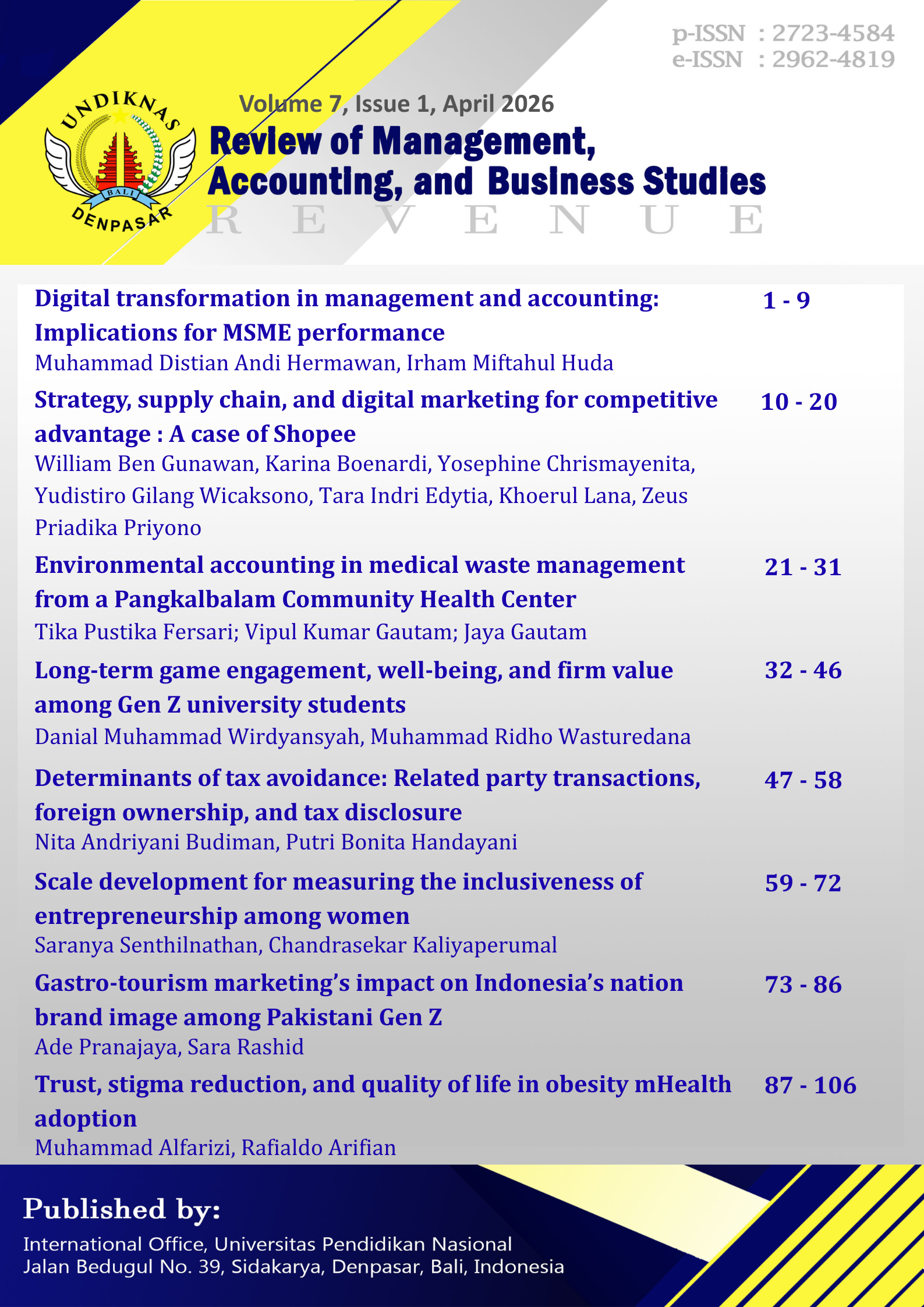
Determinants of tax avoidance: Related party transactions, foreign ownership, and tax disclosure
DOI:
https://doi.org/10.38043/revenue.v7i1.7412Keywords:
Foreign Ownership, Multinational Companies, Related Party Transactions, Tax Avoidance, Tax DisclosureAbstract
This study aims to examine the effect of related party transactions, foreign ownership, and tax disclosure on tax avoidance in multinational companies listed on the Indonesia Stock Exchange. The study employs a quantitative approach using secondary data obtained from corporate financial statements and sustainability reports for the period 2018–2024. The sample was selected using a purposive sampling method, resulting in 98 firm-year observations that met the research criteria. Panel data regression was applied as the analytical method. The results indicate that related party transactions have a positive effect on tax avoidance, suggesting that the higher the intensity of transactions with related parties, the greater the tendency of firms to engage in tax avoidance practices. Foreign ownership is also found to have a positive effect on tax avoidance, indicating that firms with higher foreign ownership tend to implement more aggressive tax planning strategies. Meanwhile, tax disclosure has a negative effect on tax avoidance, implying that higher levels of tax transparency are associated with lower levels of tax avoidance. These findings suggest that related party transactions and foreign ownership increase the risk of tax avoidance, while tax disclosure plays an important role in mitigating such practices. This study contributes to the literature on corporate taxation and provides insights for policymakers in formulating regulations that enhance transparency and improve tax compliance among multinational companies in Indonesia. This study is particularly relevant in the context of Indonesia’s recent tax reforms, including the Harmonization of Tax Regulations Law, which emphasizes improved tax compliance, transparency, and the prevention of tax avoidance practices among corporate taxpayers.
References
Afriani, C., & Utama, S. (2020). Determinants of disclosure level of related party transactions in Indonesia. International Journal of Disclosure and Governance, 17(4), 268–284.
Andrialdi, A., Nuryanah, S., & Islam, S. M. N. (2021). Foreign investor’s interests and tax avoidance. Universitas Indonesia. https://scholar.ui.ac.id/en/publications/foreign-investors-interests-and-tax-avoidance.
Aulia, R. (2024). The quality of tax disclosure in Indonesia based on GRI 207 standards. Sustainability Accounting Studies, 9(1), 54–70.
Beer, S., De Mooij, R., & Liu, L. (2020). International corporate tax avoidance: A review of the channels, magnitudes, and blind spots. Journal of Economic Surveys, 34(3), 660–688.
Beuselinck, C., & Pierk, J. (2022). The impact of transfer pricing regulations on multinational firms. European Accounting Review, 31(1), 1–27.
Budiman, N. A., Bandi, B., Widagdo, A. K., & Sudaryono, E. A. (2025). The evolution of tax strategies in multinational companies: A historical perspective. International Journal of Disclosure and Governance, 22(3), 745-758.
Budiono, S., & Purba, J. T. (2023). Factors of foreign direct investment flows to Indonesia in the era of COVID-19 pandemic. Heliyon, 9(4), e15429.
Cho, C. H., Laine, M., Roberts, R. W., & Rodrigue, M. (2020). Organized hypocrisy, organizational façades, and sustainability reporting. Accounting, Organizations and Society, 84, 101074.
Cobham, A., & Janský, P. (2020). Global distribution of revenue loss from corporate tax avoidance: Re-estimation and country results. Journal of International Development, 32(2), 206–232.
Cristea, A. D., & Nguyen, D. X. (2020). Transfer pricing by multinational firms: New evidence from foreign firm ownership. American Economic Journal: Economic Policy, 12(1), 170–202.
Deegan, C. (2002). Introduction: The legitimising effect of social and environmental disclosures – a theoretical foundation. Accounting, Auditing & Accountability Journal, 15(3), 282–311.
Desai, M. A., & Dharmapala, D. (2006). Corporate tax avoidance and high-powered incentives. Journal of Financial Economics, 79(1), 145–179.
Desai, M. A., & Dharmapala, D. (2009). Corporate tax avoidance and firm value. Review of Economics and Statistics, 91(3), 537–546.
De Simone, L., Lester, R., & Markle, K. (2020). Transparency and tax avoidance: Evidence from mandatory disclosure regimes. The Accounting Review, 95(5), 1–30.
Ekasari, J. C., Rahayu, Y. S., & Ratri, D. K. (2023). Foreign ownership and transfer pricing on tax avoidance with leverage as a moderation. Economics and Finance, 7(2), 112–124.
Eisenhardt, K. M. (1989). Agency theory: An assessment and review. Academy of Management Review, 14(1), 57–74.
Hanlon, M., & Heitzman, S. (2010). A review of tax research. Journal of Accounting and Economics, 50(2–3), 127–178.
Heckemeyer, J. H., & Overesch, M. (2021). Multinationals’ profit response to tax differentials: Effect size and shifting channels. Canadian Journal of Economics, 54(1), 1–28.
IMF. (2022). Fiscal Monitor: Managing Public Wealth. International Monetary Fund.
Jensen, M. C., & Meckling, W. H. (1976). Theory of the firm: Managerial behavior, agency costs and ownership structure. Journal of Financial Economics, 3(4), 305–360.
Joshi, P., Outslay, E., & Persson, A. (2020). Tax transparency and tax avoidance: Evidence from multinational banks in Europe. Journal of International Accounting Research, 19(3), 97–122.
Kerr, J. N., Brown, J. L., & Smith, K. J. (2024). Corporate governance and tax avoidance: Evidence from multinational firms. Journal of Accounting and Public Policy, 43, In press.
Kovermann, J., & Velte, P. (2020). The impact of corporate governance on corporate tax avoidance: A literature review. Journal of International Accounting, Auditing and Taxation, 39, 100270.
Laulita, N., & Yanni, S. (2022). Corporate governance, related party transactions, and tax avoidance: Evidence from Indonesia. Asian Journal of Business Ethics, 11(2), 85–99.
Le, M. D., Nguyen, T. T., & Pham, H. T. (2024). Tax-avoidance profit shifting by multinational firms: Evidence from Vietnam. Review of Development Economics. Advance online publication.
Martini, J. T., Niemann, R., Simons, D., & Voeller, D. (2025). Incentive effects of tax transparency: Evidence from country-by-country reporting. Journal of Accounting and Public Policy. Advance online publication.
Mashiri, E., Dzomira, S., & Canicio, D. (2021). Transfer pricing auditing and tax forestalling by multinational corporations: A game theoretic approach. Cogent Business & Management, 8(1), 1907012.
Meivitawanli, B. (2021). Determinants of foreign direct investment: Evidence from provincial level data in Indonesia. The Journal of Asian Finance, Economics and Business, 8(5), 53–60.
OECD. (2015). Base erosion and profit shifting (BEPS) action plan. OECD Publishing.
OECD. (2021). Country-by-Country Reporting: Handbook on Effective Tax Risk Assessment. OECD Publishing.
OECD. (2021). Corporate Tax Statistics 2021. OECD Publishing.
Ramadhani, D., Fauziah, F., & Sari, D. (2023). The effect of related party transactions and ownership structure on tax avoidance in Indonesia. Journal of International Trade Policy, 6(4), 211–227.
Richardson, G., Taylor, G., & Lanis, R. (2022). The impact of ownership structure on corporate tax avoidance: Evidence from international markets. Journal of Contemporary Accounting & Economics, 18(2), 100310.
Salihu, I. A., Annuar, H. A., & Obid, S. N. S. (2021). Corporate governance and tax avoidance: Evidence from emerging markets. International Journal of Managerial Finance, 17(5), 702–721.
Santana, S. L. L., & Rezende, A. J. (2022). Related party transactions and tax avoidance: Evidence from emerging markets. Journal of Accounting in Emerging Economies, 12(3), 562–583.
Suchman, M. C. (1995). Managing legitimacy: Strategic and institutional approaches. Academy of Management Review, 20(3), 571–610.
UNCTAD. (2023). World Investment Report 2023. United Nations.
Downloads
Published
How to Cite
Issue
Section
License
Copyright (c) 2026 Nita Andriyani Budiman, Putri Bonita Handayani

This work is licensed under a Creative Commons Attribution-ShareAlike 4.0 International License.