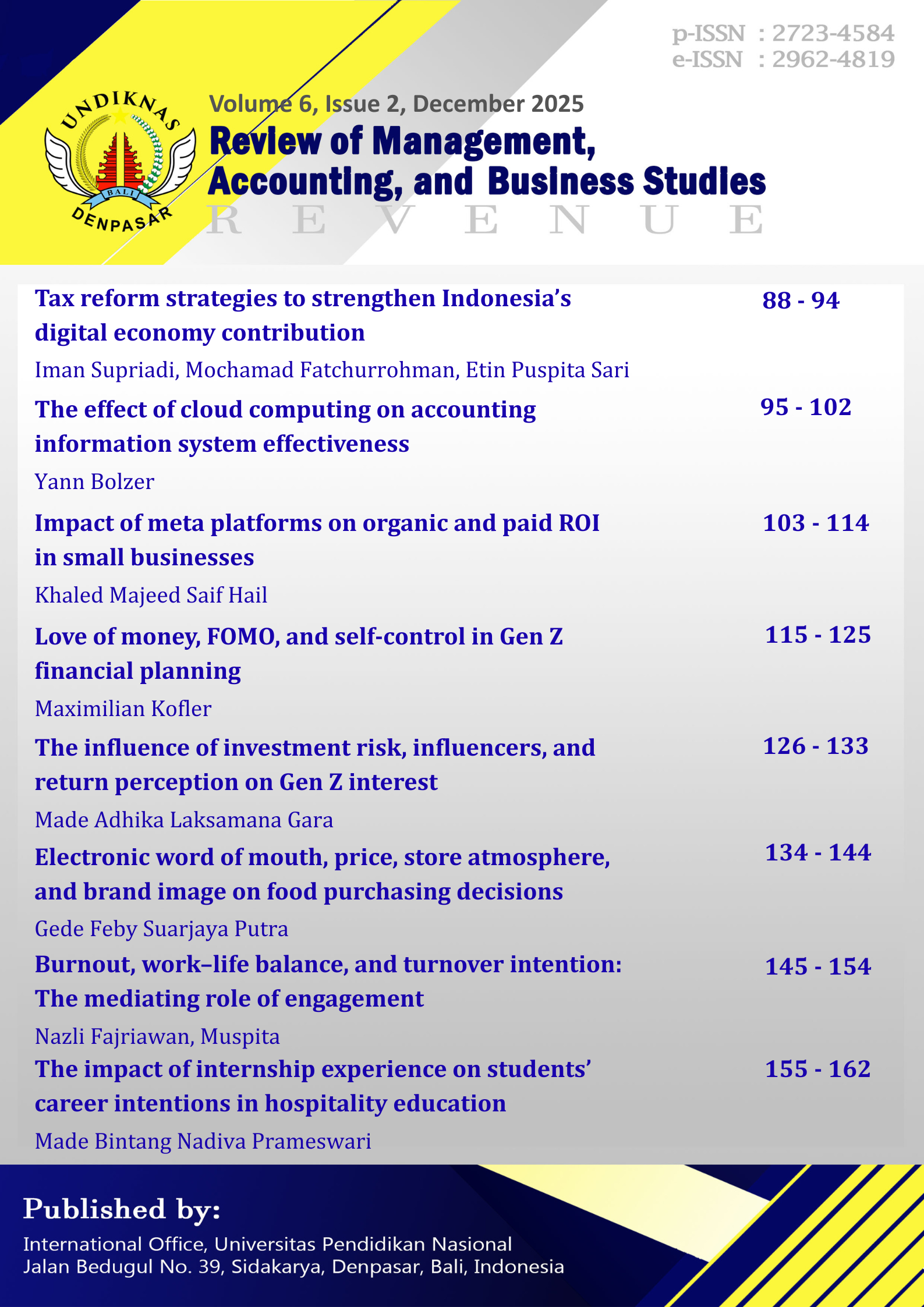
The influence of investment risk, influencers, and return perception on Gen Z interest
DOI:
https://doi.org/10.38043/revenue.v6i2.7353Keywords:
Investment Interest, Investment Risk, Social Media Influencers, Return Perception.Abstract
This research aims to the investment interest of Generation Z is considered essential because the current challenges for Generation Z relate to financial issues. Generation Z tends to spend their money on new experiences rather than saving for long-term needs. This research aims to examine the influence of Investment Risk, Social Media Influencers, and Return Perception on the investment interest of Generation Z in Denpasar city using the Bibit application. The data analysis technique employed in this study utilizes IBM SPSS Statistics 23 software. The research was conducted in Denpasar city, and data was collected through questionnaires distributed to 170 respondents who were familiar with or had used the Bibit application. The research results indicate an influence of Investment Risk, Social Media Influencers, and Return Perception on investment interest, as confirmed by the hypothesis testing: 1) Investment Risk has a positive and significant impact on Investment Interest, 2) Social Media Influencers have a positive and significant impact on Investment Interest, and 3) Return Perception has a positive and significant impact on Investment Interest.
References
Ajzen, I. (1991). The theory of planned behavior. Organizational Behavior and Human Decision Processes, 50(2), 179–211. https://doi.org/10.1016/0749-5978(91)90020-T
Ajzen, I. (2005). Attitudes, personality, and behavior (2nd ed.). Open University Press.
Ang, R. (1997). Buku pintar pasar modal Indonesia. Mediasoft Indonesia.
Atiqah Athi’ulhaq. (2023). Pengaruh pengetahuan, keamanan dan persepsi risiko investasi terhadap minat generasi Z dalam berinvestasi emas digital: Studi pada E-Mas BSI Mobile.
Azis, A. (2010). Manajemen investasi. Alfabeta.
Badan Pusat Statistik. (2021). Hasil sensus penduduk 2020. BPS Indonesia.
Cahya, B. T., & Kusuma, N. W. A. (2019). Pengaruh motivasi dan kemajuan teknologi terhadap minat investasi saham. Jurnal Ilmu Ekonomi dan Keislaman, 7, 192–207.
Dharmmesta, B. S. (1998). Manajemen pemasaran: Analisis perilaku konsumen. BPFE.
Djaali. (2013). Psikologi pendidikan. Bumi Aksara.
Featherman, M. S., & Pavlou, P. A. (2003). Predicting e-services adoption: A perceived risk facets perspective. International Journal of Human-Computer Studies, 59(4), 451–474. https://doi.org/10.1016/S1071-5819(03)00111-3
Fishbein, M., & Ajzen, I. (1975). Belief, attitude, intention, and behavior: An introduction to theory and research. Addison-Wesley.
Fauzianti, A. (2022). Pengaruh modal awal investasi, pengetahuan investasi, dan sosial media influencer terhadap minat investasi mahasiswa akuntansi Universitas Tidar. Universitas Tidar.
Hair, J. F., Hult, G. T. M., Ringle, C. M., & Sarstedt, M. (2017). A primer on partial least squares structural equation modeling (PLS-SEM) (2nd ed.). Sage Publications.
Hartono, J. (2015). Teori portofolio dan analisis investasi (10th ed.). BPFE.
Isnaini, M., & Rikumahu, B. (2023). Pengaruh literasi keuangan, motivasi investasi dan risiko investasi terhadap minat berinvestasi pada pengguna aplikasi Bibit. Jurnal Mirai Management, 8(1), 80–92.
Kejarmimpi. (2018). Perilaku keuangan generasi muda di Indonesia.
Kusmawati. (2011). Perilaku investor dan minat investasi.
Kustodian Sentral Efek Indonesia. (2022). Statistik investor pasar modal Indonesia. KSEI.
Lestary Kusnandar, D., Sari, D. P., & Sahroni, N. (2022). Pengaruh literasi digital dan persepsi return dan risiko dalam meningkatkan minat investasi generasi Z di pasar modal pada era new normal. Valid Jurnal Ilmiah, 20(1), 97–104. https://doi.org/10.53512/Valid.V20i1.266
Majalah Jendela Pendidikan dan Kebudayaan. (2019). Sekilas pandang revolusi industri 4.0. Kementerian Pendidikan dan Kebudayaan Republik Indonesia. https://jendela.kemdikbud.go.id
Mawarni. (2022). The effect of ease of use technology, perception of return, and perception of risk on students’ investment intention in the capital market with financial literacy as moderating variable. Jurnal Manajemen Update. https://jurnal.untan.ac.id/index.php/ejmfe/article/view/57592
Muzzahid, M., & Kartawinata, B. R. (2020). Persepsi risiko dalam pengambilan keputusan investasi. Jurnal Manajemen.
Nurman, D. P. (2021). Pengaruh persepsi return terhadap minat investasi mahasiswa.
Otoritas Jasa Keuangan. (2017). Pengelolaan investasi pasar modal. https://www.ojk.go.id
Otoritas Jasa Keuangan. (2022). Survei nasional literasi dan inklusi keuangan. OJK.
Pratiwi, D. T. (2020). Pengaruh pengetahuan investasi, modal awal investasi dan social media influencer terhadap minat mahasiswa berinvestasi di pasar modal. Universitas Islam Indonesia.
Putri, G. H., & Patria, B. (2018). Pengaruh endorsement selebriti Instagram terhadap minat beli remaja putri. Gadjah Mada Journal of Professional Psychology, 4(1), 33–41. https://doi.org/10.22146/gamajpp.45347
Senft, T. M. (2013). Microcelebrity and the branded self. In J. Hartley, J. Burgess, & A. Bruns (Eds.), A companion to new media dynamics (pp. 346–354). Wiley-Blackwell.
Tandio, T., & Putra, I. M. P. D. (2016). Pengaruh persepsi return dan risiko terhadap minat investasi mahasiswa. Jurnal Manajemen.
Vroom, V. H. (1964). Work and motivation. Wiley.
Widodo. (2018). Pengaruh celebrity endorsement terhadap minat beli mahasiswa.
Downloads
Published
How to Cite
Issue
Section
License
Copyright (c) 2025 Made Adhika Laksamana Gara

This work is licensed under a Creative Commons Attribution-ShareAlike 4.0 International License.