Explaining Green Skincare Purchase Intention: The Role of Attitudes and Usage Barriers
DOI:
https://doi.org/10.38043/jimb.v11i1.7633Keywords:
Consumer attitude, Green skincare, Purchase intention, Usage barriers, Generation ZAbstract
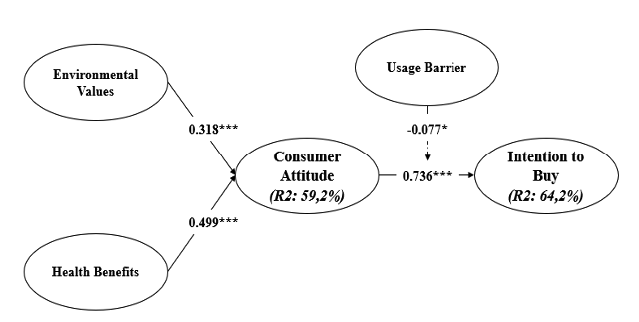
This study aims to explain the formation of green skincare purchase intention among Generation Z consumers in Indonesia by examining the roles of environmental values and perceived health benefits in shaping consumer attitudes, and the moderating effect of usage barriers on the attitude–intention relationship. This study adopted a quantitative approach and surveyed 263 Indonesian Generation Z consumers with prior experience using green skincare products. The collected data were analyzed using Partial Least Squares Structural Equation Modeling (PLS-SEM) to test the proposed hypotheses. The results indicate that both environmental values and perceived health benefits significantly and positively influence consumer attitudes toward green skincare, with health benefits exerting a stronger effect. Consumer attitudes are strong determinants of purchase intention. Crucially, the structural model exhibits high explanatory and predictive power, explaining a substantial proportion of purchase intention (R² = 0.642) and demonstrating high predictive relevance (Q²_predict = 0.598). Moreover, usage barriers significantly and negatively moderate the relationship between attitude and purchase intention, weakening the translation of positive attitudes into buying intentions. This study contributes to the green consumption literature by integrating the Theory of Planned Behavior (TPB) and Innovation Resistance Theory (IRT) to demonstrate that usage barriers function as a boundary condition rather than a direct predictor, thereby offering a nuanced explanation of the attitude–intention gap in high-involvement green products. Therefore, the findings suggest that managers should prioritize the credible communication of health benefits while simultaneously reducing functional barriers to use. Policymakers are advised to strengthen standards and transparency for green skincare claims to support informed and confident consumer decision-making.
Downloads
References
Ajzen, I. (1991). The theory of planned behavior. Organizational Behavior and Human Decision Processes, 50(2), 179211. https://doi.org/10.1016/0749-5978(91)90020-T
Alyahya, R. S., AlHasson, M. A., & Alhsaon, M. A. A. (2025). Assessing the Adverse Effects and Safety Concerns Related to Cosmetic and Skincare Products: A Systematic Review. Cureus, 17(4). https://doi.org/10.7759/cureus.81759
Anand, A., & Sharma, M. (2023). Unveiling the Impact of Environmental Factors on Consumer Purchase Intention for Sustainable Products. International Journal of Environmental Sciences(IND), 9(2), 88101.
Andika, A., Ernestivita, G., Anisah, T. N., Hidayati, L., & Joshi, M. C. (2025). The Role of Social Media in Sustainable Fashion Adoption: Examining Psychological Mechanisms and Financial Constraints. Journal of Sustainable Marketing, 6(1), 114143. https://doi.org/10.51300/JSM-2025-144
Andika, Luthfiana, D. N., Nadia, & Kartinah. (2023). Green purchase behavior: The role of green advertising, green awareness, and eco-literacy. IOP Conference Series: Earth and Environmental Science, 1181(1). https://doi.org/10.1088/1755-1315/1181/1/012025
Andika, Nadia, Najmudin, M., & Hasibuan, A. B. (2023). Green Cosmetics In Indonesia: Unraveling Attitude-Behavior Gap And Gender Moderation. Jurnal Aplikasi Bisnis, 21(4), 11341152. https://doi.org/http://dx.doi.org/10.21776/ub.jam. 2023.021.04.20.
Aprilia, S. P., Anggraeni, A., Ramadhan, A. S., & Putra, S. (2022). Perceived Value of Consumers Towards Buying "Green" Skincare Products. ACM International Conference Proceeding Series, February, 116121. https://doi.org/10.1145/3556089.3556098
Baltac, D. ., Durmaz, Y., & Baltac, F. (2025). The mediating role of attitudes in the effect of human and environment-centered value orientation on green cosmetic product purchasing behavior: comparison of different countries. Environment, Development and Sustainability. https://doi.org/10.1007/s10668-025-06173-9
Brislin, R. W. (1986). The Wording and Translation of Research Instruments. In Cross-Cultural Research and Methodology Series, Vol. 8 (pp. 137164). Sage publications.
CG, M. K., & G, A. (2025). A study on environmental prosocial attitudes to green consumption values, openness to green communication, and its relationship with buying behavior. Cogent Business and Management, 12(1). https://doi.org/10.1080/23311975.2024.2443050
Chin, J., Jiang, B. C., Mufidah, I., Persada, S. F., & Noer, B. A. (2018). The investigation of consumers' behavior intention in using green skincare products: A pro- environmental behavior model approach. Sustainability (Switzerland), 10(11). https://doi.org/10.3390/su10113922
Chu, K. W. K. (2020). The green gap of high-involvement purchasing decisions: an exploratory study. Asian Journal of Business Ethics, 9(2), 371394. https://doi.org/10.1007/s13520-020-00115-6
Cohen, J. (1988). Statistical power analysis for the behavioral sciences (2nd ed.). Lawrence Erlbaum.
Couceiro, B., Hameed, H., Vieira, A. C. F., Singh, S. K., Dua, K., Veiga, F., Pires, P. C., Ferreira, L., & Paiva-Santos, A. C. (2025). Promoting health and sustainability: exploring safer alternatives in cosmetics and regulatory perspectives. Sustainable Chemistry and Pharmacy, 43(January). https://doi.org/10.1016/j.scp.2024.101901
Davis, F. D. (1989). Perceived Usefulness, Perceived Ease of Use, and User Acceptance of Information Technology. MIS Quarterly, 13(3), 319340. https://doi.org/http://www.jstor.org/stable/249008
Dawes, J. (2008). Do data characteristics change according to the number of scale points used? An experiment using 5-point, 7-point and 10-point scales. International Journal of Market Research, 50(1), 6177. https://doi.org/10.1177/147078530805000106
Dewi, W. W. A., Avicenna, F., & Meideline, M. M. (2020). Purchase intention of green products following an environmentally friendly marketing campaign: Results of a survey of instagram followers of innisfreeindonesia. Asian Journal for Public Opinion Research, 8(2), 160177. https://doi.org/10.15206/ajpor.2020.8.2.160
Dini, I., & Laneri, S. (2021). The new challenge of green cosmetics: Natural food ingredients for cosmetic formulations. Molecules, 26(13). https://doi.org/10.3390/molecules26133921
Dlamini, S., & Mahowa, V. (2024). Investigating factors that influence the purchase behaviour of green cosmetic products. Cleaner and Responsible Consumption, 13(May), 100190. https://doi.org/10.1016/j.clrc.2024.100190
Fishbein, M., & Ajzen, I. (1975). Belief, Attitude, Intention, and Behavior: An Introduction to Theory and Research (Social Psy). MA: Addison-Wesley. https://people.umass.edu/aizen/f&a1975.html
FMI. (2026). Natural Cosmetics Market Forecast and Outlook 2026 to 2036. Https://Www.Futuremarketinsights.Com/. https://www.futuremarketinsights.com/reports/natural-cosmetics-market
Ghazali, E., Soon, P. C., Mutum, D. S., & Nguyen, B. (2017). Health and cosmetics: Investigating consumers' values for buying organic personal care products. Journal of Retailing and Consumer Services, 39, 154163. https://doi.org/10.1016/j.jretconser.2017.08.002
Hair, Hult, Ringle, & Sarstedt. (2017). A Primer on Partial Least Squares Structural Equation Modeling (PLS-SEM). In Asia-Pacific Pte. Ltd (Second). SAGE Publications, Inc. http://lccn.loc.gov/2016005380
Hair, J. F. J., Black, W. C., Babin, B. J., & Anderson, R. E. (2010). Multivariate Data Analysis (7th Ed). Pearson Prentice Hall.
Hair, J. F. J., Hult, G. T. M., Ringle, C. M., & Sarstedt, M. (2022). A Primer on Partial Least Squares Structural Equation Modeling (PLS-SEM) Third Edition. In L. Fargotstein, K. Offley, N. Tiwari, & G. Mahindra (Eds.), Sage (Third edit). SAGE Publications, Inc.
Hair, J. F., Risher, J. J., Sarstedt, M., & Ringle, C. M. (2019). When to use and how to report the results of PLS-SEM. European Business Review, 31(1), 224. https://doi.org/10.1108/EBR-11-2018-0203
Hair Jr., J. F., Matthews, L. M., Matthews, R. L., & Sarstedt, M. (2017). PLS-SEM or CB-SEM: updated guidelines on which method to use. International Journal of Multivariate Data Analysis, 1(2), 107. https://doi.org/10.1504/IJMDA.2017.10008574
Henseler, J., Dijkstra, T. K., Sarstedt, M., Ringle, C. M., Diamantopoulos, A., Straub, D. W., Ketchen, D. J., Hair, J. F., Hult, G. T. M., & Calantone, R. J. (2014). Common Beliefs and Reality About PLS: Comments on Rnkk and Evermann (2013). Organizational Research Methods, 17(2), 182209. https://doi.org/10.1177/1094428114526928
Henseler, J., Ringle, C. M., & Sarstedt, M. (2015). A new criterion for assessing discriminant validity in variance-based structural equation modeling. Journal of the Academy of Marketing Science, 43(1), 115135. https://doi.org/10.1007/s11747-014-0403-8
Hsu, C. L., Chang, C. Y., & Yansritakul, C. (2017). Exploring purchase intention of green skincare products using the theory of planned behavior: Testing the moderating effects of country of origin and price sensitivity. Journal of Retailing and Consumer Services, 34(October 2016), 145152. https://doi.org/10.1016/j.jretconser.2016.10.006
Inkwood Research. (2025). Indonesia Skin Care Market Forecast 2025-2032. Https://Www.Marketresearch.Com. https://www.marketresearch.com/Inkwood-Research-v4104/Indonesia-Skin-Care-Forecast-42109123/
Kim, B., & Kim, D. (2025). Understanding the Drivers of Sustainable Consumption in China: Role of Green Self-Identity, Subjective Norm, and Demographics. SAGE Open, 15(4), 116. https://doi.org/10.1177/21582440251390627
Koay, K. Y., & Ahmed, H. I. (2025). Understanding consumers' purchase intentions for green cosmetic products: an integrated perspective. Social Responsibility Journal, June. https://doi.org/10.1108/SRJ-04-2025-0382
Kock, N. (2015). Common method bias in PLS-SEM: A full collinearity assessment approach. 110.
Kurnia, S. N., & Mayangsari, L. (2020). Barriers in Purchasing Green Cosmetic Products Among Indonesian Women. Malaysian Journal of Social Sciences and Humanities (MJSSH), 5(8), 7284. https://doi.org/10.47405/mjssh.v5i8.465
Laheri, V. K., Lim, W. M., Arya, P. K., & Kumar, S. (2024). A multidimensional lens of environmental consciousness: towards an environmentally conscious theory of planned behavior. Journal of Consumer Marketing, 41(3), 281297. https://doi.org/10.1108/JCM-03-2023-5875
Luthfiana, D. N., Andika, A., & Bidayati, U. (2024). Unraveling the complexity of the organic food market: Indonesian consumer perspective on price and product knowledge. Asian Management and Business Review, 4(1), 7389. https://doi.org/10.20885/AMBR.vol4.iss1.art5
Luthra, C., Deshwal, P., Kushwah, S., & Gokarn, S. (2025). Exploring barriers towards green personal care products purchase: an integrated ISM-MICMAC approach. International Journal of Pharmaceutical and Healthcare Marketing, 19(3), 618646. https://doi.org/10.1108/IJPHM-05-2024-0045
Mamun, A. Al, Nawi, N. C., Hayat, N., & Zainol, N. R. B. (2020). Predicting the purchase intention and behaviour towards green skincare products among Malaysian consumers. Sustainability (Switzerland), 12(24), 118. https://doi.org/10.3390/su122410663
Mansoor, M., Saeed, A., Rustandi Kartawinata, B., & Naqi Khan, M. K. (2022). Derivers of green buying behavior for organic skincare products through an interplay of green brand evaluation and green advertisement. Journal of Global Fashion Marketing, 13(4), 328343. https://doi.org/10.1080/20932685.2022.2085597
Margariti, K., Hatzithomas, L., & Boutsouki, C. (2024). Elucidating the Gap between Green Attitudes, Intentions, and Behavior through the Prism of Greenwashing Concerns. Sustainability (Switzerland) , 16(12), 113. https://doi.org/10.3390/su16125108
Maslikhah, Andika, Tampubolon, N. K. T., Harahap, J. B., & Luthfiana, D. N. (2024). Stay or Switch: How Usage Barriers Influence Consumer Transition to Green Skincare Products in Indonesia Using Push-Pull-Mooring Framework. International Journal of Environmental Impacts, 7(4), 603614. https://doi.org/10.18280/ijei.070401
Nemchenko, A., Mishchenko, V., Nazarkina, V., Sliptsova, N., & Mashtaler, V. (2024). Analysis and Main Trends of the World and Ukrainian Organic and Natural Cosmetics Market. Pharmakeftiki, 36(4), 4858. https://doi.org/10.60988/p.v36i4.87
Ngo-Thi-Ngoc, H., Nguyen-Viet, B., & Hong-Thach, H. (2024). Purchase Intention for Vegan Cosmetics: Applying an Extended Theory of Planned Behavior Model. SAGE Open, 14(1), 111. https://doi.org/10.1177/21582440241240548
Oliveira, Z., Teixeira, S., Teixeira, S., & Teixeira, S. F. (2023). The Attitude of Portuguese Consumers of Green Cosmetics. In M. M. Carvalho & M. Rodrigues (Eds.), Sustainable Consumption Experience and Business Models in the Modern World (pp. 165189). IGI Global Scientific Publishing. https://doi.org/10.4018/978-1-6684-9277-2.ch008
Ram, S., & Sheth, J. N. (1989). Consumer resistance to innovations: The marketing problem and its solutions. Journal of Consumer Marketing, 6(2), 5. https://doi.org/10.1108/EUM0000000002542
Ringle, C. M., Wende, S., & Becker, J.-M. (2024). SmartPLS 4. SmartPLS. https://www.smartpls.com/
Setiawan, M., Widjojo, R., & Purnama Alamsyah, D. (2023). Consumers' reasonings for intention to purchase natural personal care products in Indonesian market. Cogent Business and Management, 11(1). https://doi.org/10.1080/23311975.2023.2289205
Shanbhag, P. R., Pai, Y. P., Kidiyoor, G., & Prabhu, N. (2023). Development and initial validation of a theory of planned behavior questionnaire: Assessment of purchase intentions towards products associated with CRM campaigns. Cogent Business and Management, 10(2). https://doi.org/10.1080/23311975.2023.2229528
Singhal, A., & Malik, G. (2018). The attitude and purchasing of female consumers towards green marketing related to cosmetic industry. Journal of Science and Technology Policy Management, 12(3), 514531. https://doi.org/10.1108/JSTPM-11-2017-0063
Sonkar, S., Singh, P., & Singh Dubey, R. (2025). Examining the Consumer Behavior and Preferences of Generation Y and Generation Z Toward Green Cosmetics in the Indian Market. Journal of Global Marketing, 122. https://doi.org/10.1080/08911762.2025.2518091
Szaban, M., Szymkowiak, A., & Canils, M. C. J. (2024). Unraveling green personal care: Exploring the shift in consumer values and stages of change toward green consumption. Global Business and Organizational Excellence, 43(4), 4564. https://doi.org/10.1002/joe.22244
Testa, R., Vella, F., Rizzo, G., Schifani, G., & Migliore, G. (2024). What drives and obstacles the intention to purchase green skincare products? A study of the Italian market of green skincare products. Journal of Cleaner Production, 484(November), 144358. https://doi.org/10.1016/j.jclepro.2024.144358
The Business Research Company. (2026a). Natural Cosmetics Market Report 2026. Https://Www.Thebusinessresearchcompany.Com/. https://www.thebusinessresearchcompany.com/report/natural-cosmetics-global-market-report#:~:text= Natural Cosmetics market size,Collagen Boosting And Radiant Skin
The Business Research Company. (2026b). Skincare Market Report 2026. Https://Www.Thebusinessresearchcompany.Com. https://www.thebusinessresearchcompany.com/report/skincare-global-market-report
Wang, D., Weisstein, F. L., Duan, S., & Choi, P. (2022). Impact of ambivalent attitudes on green purchase intentions: The role of negative moods. International Journal of Consumer Studies, 46(1), 182199. https://doi.org/10.1111/ijcs.12663
Widodo, A., Rubiyanti, N., & Madiawati, P. N. (2025). Investigating the influence of eco-labels on consumer behavior in Indonesia's developing green market. Management & Sustainability: An Arab Review. https://doi.org/10.1108/MSAR-02-2025-0054
Wijekoon, R., & Sabri, M. F. (2021). Determinants that influence green product purchase intention and behavior: A literature review and guiding framework. Sustainability (Switzerland), 13(11), 140. https://doi.org/10.3390/su13116219
Yu, A., & Han, S. (2021). Social exclusion and effectiveness of self-benefit versus other-benefit marketing appeals for eco-friendly products. Sustainability (Switzerland), 13(9). https://doi.org/10.3390/su13095034
Zahan, I., Kaium, M. A., & Rahman, M. S. (2024). Accept or Reject? Investigating Customers' Attitudes Toward Green Cosmetics in Bangladesh. Journal of Sustainability Research, 6(2), e240025. https://doi.org/10.20900/jsr20240025
Zollo, L., Carranza, R., Faraoni, M., Daz, E., & Martn-Consuegra, D. (2021). What influences consumers' intention to purchase organic personal care products? The role of social reassurance. Journal of Retailing and Consumer Services, 60(December 2020). https://doi.org/10.1016/j.jretconser.2020.102432
Downloads
Published
How to Cite
Issue
Section
License
Copyright (c) 2026 Ita Nurcholifah, Heny Hidayati, Muhammad Rafiuddin, Hesham Saleem Al Naggar

This work is licensed under a Creative Commons Attribution-ShareAlike 4.0 International License.