From Adoption to Productivity: The Central Role of Optimal Technology Use in The Informal Economy
DOI:
https://doi.org/10.38043/jimb.v11i1.7610Keywords:
Informal Economy, Technology Adoption, Optimal Technology UseAbstract
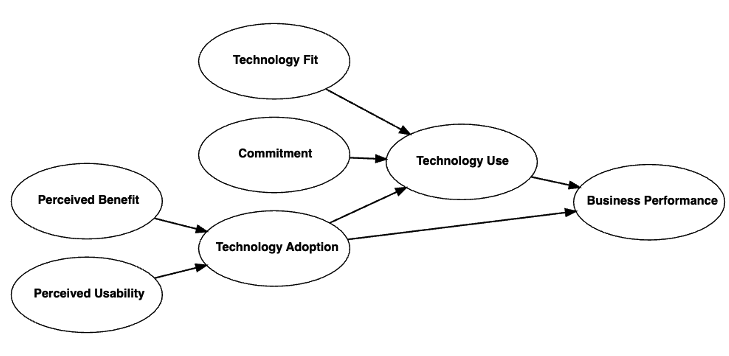
This study examines factors influencing optimal technology use and its relationship with technology adoption and business performance in the informal economy. It highlights the need to explore ways in which technology can maximize productivity and performance. Most studies have documented the discourse on technology adoption and its drivers, while the drivers or factors that facilitate optimal technology use remain comparatively underexplored. Thus, this study fills the gap. This study addresses the question: What factors influence optimal technology use, and how does it mediate the relationship between technology adoption and business performance? It also emphasizes that directly eradicating or formalizing the informal economy is not an ideal solution. Mixed methods were employed in this study. PLS-SEM analysis was conducted using SEMinR in RStudio, based on data from 221 completed questionnaires, providing reliable empirical evidence. Thematic analysis was also applied to qualitative responses to provide additional insights. Quantitative and qualitative evidence confirms significant relationships among technology adoption, technology use, and business performance. All indicators significantly impact their respective constructs, supporting the hypothesized relationships. Optimal use of technology partially mediates the positive and significant impact of adoption on business performance. Key factors, such as technology adoption and user commitment to continuous learning, are essential to optimizing technology use. Practical strategies include allocating adequate resources for ongoing training and skill development and ensuring the technology aligns with operational needs to enhance efficiency.
Downloads
References
Ajao, B. F., Oyebisi, T. O., & Aderemi, H. O. (2018). Factors influencing the implementation of e-commerce innovations: The case of the Nigerian informal sector. African Journal of Science, Technology, Innovation and Development, 10(4), 473481. https://doi.org/10.1080/20421338.2018.1475541
Al-Emran, M., & Griffy-Brown, C. (2023). The role of technology adoption in sustainable development: Overview, opportunities, challenges, and future research agendas. Technology in Society, 73, 102240. https://doi.org/10.1016/j.techsoc.2023.102240
Allioui, H., & Mourdi, Y. (2023). Exploring the Full Potentials of IoT for Better Financial Growth and Stability: A Comprehensive Survey. Sensors, 23(19), 8015. https://doi.org/10.3390/s23198015
Andrews, D., Snchez, A. C., & Johansson, . (2011). Towards a Better Understanding of the Informal Economy.
Attaran, M., & Celik, B. G. (2023). Digital Twin: Benefits, use cases, challenges, and opportunities. Decision Analytics Journal, 6, 100165. https://doi.org/10.1016/j.dajour.2023.100165
Badan Pusat Statistik. (2026). Keadaan Ketenagakerjaan Indonesia November 2025.
Benjamin, N., Beegle, K., Recanatini, F., & Santini, M. (2014). Informal Economy and the World Bank (6888; Policy Research Working Paper).
Bhattacharya, R. (2019). ICT solutions for the informal sector in developing economies: What can one expect? The Electronic Journal of Information Systems in Developing Countries, 85(3). https://doi.org/10.1002/isd2.12075
Blades, D., Ferreira, F. H. G., & Lugo, M. A. (2011). The Informal Economy in Developing Countries: An Introduction. Review of Income and Wealth, 57(s1). https://doi.org/10.1111/j.1475-4991.2011.00457.x
Blut, M., & Wang, C. (2020). Technology readiness: a meta-analysis of conceptualizations of the construct and its impact on technology usage. Journal of the Academy of Marketing Science, 48(4), 649669. https://doi.org/10.1007/s11747-019-00680-8
Braun, V., & Clarke, V. (2021). Can I use TA? Should I use TA? Should I not use TA? Comparing reflexive thematic analysis and other pattern-based qualitative analytic approaches. Counselling and Psychotherapy Research, 21(1), 3747. https://doi.org/10.1002/capr.12360
Chen, M. A. (2012). The Informal Economy: Definitions, Theories and Policies.
Chen, M., & Carr, F. (2020). The Informal Economy Revisited. Routledge. https://doi.org/10.4324/9780429200724
Chueh, H.-E., & Huang, D.-H. (2023). Usage intention model of digital assessment systems. Journal of Business Research, 156, 113469. https://doi.org/10.1016/j.jbusres.2022.113469
Chuttur, M. Y. (2009). Overview of the Technology Acceptance Model: Origins, Developments, and Future Directions. Sprouts: Working Papers on Information Systems, 9(37). http://sprouts.aisnet.org/9-37
Danquah, M., & Owusu, S. (2021). Digital technology and productivity of informal enterprises: Empirical evidence from Nigeria. https://doi.org/10.35188/UNU-WIDER/2021/054-2
Delchat, C., & Medina, L. (2021). The Global Informal Workforce: Priorities for Inclusive Growth. International Monetary Fund.
DellAnno, R. (2022). Theories and definitions of the informal economy: A survey. Journal of Economic Surveys, 36(5), 16101643. https://doi.org/10.1111/joes.12487
Douglas, E. (2017). Beyond the Interpretive: Finding Meaning in Qualitative Data. ASEE Annual Conference & Exposition Proceedings. https://doi.org/10.18260/1-2--27658
Ebrahim, A. Q., & van den Berg, C. L. (2024). The barriers to technology adoption among businesses in the informal economy in Cape Town. South African Journal of Information Management, 26(1). https://doi.org/10.4102/sajim.v26i1.1872
Elvis, N. T., Cheng, H., & Providence, B. I. (2022). The Illustrative Understanding on the Informal Sector and Its Influence in Firm Productivity in Sub-Saharan Africa (SSA): Evidence from Cameroon. Sustainability, 14(15), 9789. https://doi.org/10.3390/su14159789
Etim, E., & Daramola, O. (2023). Investigating the E-Readiness of Informal Sector Operators to Utilize Web Technology Portal. Sustainability, 15(4), 3449. https://doi.org/10.3390/su15043449
FakhrHosseini, S., Chan, K., Lee, C., Jeon, M., Son, H., Rudnik, J., & Coughlin, J. (2024). User Adoption of Intelligent Environments: A Review of Technology Adoption Models, Challenges, and Prospects. International Journal of HumanComputer Interaction, 40(4), 986998. https://doi.org/10.1080/10447318.2022.2118851
Felzensztein, C., Venter, R., & Salloum, C. (2025). Resilient informality and the role of family support in township entrepreneurship. International Journal of Entrepreneurial Behavior & Research, 122. https://doi.org/10.1108/IJEBR-03-2025-0266
Garcia-Murillo, M., & Velez-Ospina, J. A. (2014). The impact of ICTs on the informal economy. https://EconPapers.repec.org/RePEc:zbw:itsb14:106841
Grxhani, K., & Cichocki, S. (2023). Formal and informal institutions: understanding the shadow economy in transition countries. Journal of Institutional Economics, 19(5), 656672. https://doi.org/10.1017/S1744137422000522
Ghobakhloo, M., Hong, T. S., Sabouri, M. S., & Zulkifli, N. (2012). Strategies for Successful Information Technology Adoption in Small and Medium-sized Enterprises. Information, 3(1), 3667. https://doi.org/10.3390/info3010036
Giannakos, M. N., Mikalef, P., & Pappas, I. O. (2022). Systematic Literature Review of E-Learning Capabilities to Enhance Organizational Learning. Information Systems Frontiers, 24(2), 619635. https://doi.org/10.1007/s10796-020-10097-2
Gunawan, A., Jufrizen, & Pulungan, D. R. (2023). Improving MSME performance through financial literacy, financial technology, and financial inclusion. International Journal of Applied Economics, Finance and Accounting, 15(1), 3952. https://doi.org/10.33094/ijaefa.v15i1.761
Hagspiel, V., Huisman, K. J. M., & Nunes, C. (2015). Optimal technology adoption when the arrival rate of new technologies changes. European Journal of Operational Research, 243(3), 897911. https://doi.org/10.1016/j.ejor.2014.12.024
Hair, J. F., Hult, G. T. M., Ringle, C. M., Sarstedt, M., Danks, N. P., & Ray, S. (2021). Partial Least Squares Structural Equation Modeling (PLS-SEM) Using R. Springer International Publishing. https://doi.org/10.1007/978-3-030-80519-7
Hair, J. F., Risher, J. J., Sarstedt, M., & Ringle, C. M. (2019). When to use and how to report the results of PLS-SEM. European Business Review, 31(1), 224. https://doi.org/10.1108/EBR-11-2018-0203
Handayani, F., Raja, H. S., Nurliana, N., Musyarof, Z., Wiratama, B. F., Damara, D., Assadiqi, G. S., & Hamdani, H. (2025). Analisis Isu Terkini Provinsi Kalimantan Selatan 2025 (F. Handayani & H. Hamdani, Eds.; Vol. 7). Badan Pusat Statistik Provinsi Kalimantan Selatan.
Hapsari, I. M., Yu, S., Pape, U. J., & Mansour, W. (2023). Informality in Indonesia: Levels, Trends, and Features (10586). The World Bank. https://doi.org/10.1596/1813-9450-10586
Henseler, J., Ringle, C. M., & Sarstedt, M. (2015). A new criterion for assessing discriminant validity in variance-based structural equation modeling. Journal of the Academy of Marketing Science, 43(1), 115135. https://doi.org/10.1007/s11747-014-0403-8
Hoang, H. (2024). Navigating the Digital Landscape: An Exploration of the Relationship Between Technology-Organization-Environment Factors and Digital Transformation Adoption in SMEs. Sage Open, 14(4). https://doi.org/10.1177/21582440241276198
Hooks, D., Davis, Z., Agrawal, V., & Li, Z. (2022). Exploring factors influencing technology adoption rate at the macro level: A predictive model. Technology in Society, 68, 101826. https://doi.org/10.1016/j.techsoc.2021.101826
Hsieh, M.-C., Pan, H.-C., & Chou, S.-W. (2025). Exploring E-Learners IT Mindfulness and Its Impact on Post-Adoption Behavior: A Dedication-Constraint Relationship of Commitment in Live Streaming Learning Environments. International Journal of HumanComputer Interaction, 41(17), 1105511076. https://doi.org/10.1080/10447318.2024.2440637
Hyde-Clarke, N. (2013). The Impact of Mobile Technology on Economic Growth amongst Survivalists in the Informal Sector in the Johannesburg CBD, South Africa. International Journal of Business and Social Science, 4(16). www.ijbssnet.com
Ibidunni, A. S., Kolawole, A. I., Olokundun, M. A., & Ogbari, M. E. (2020). Knowledge transfer and innovation performance of small and medium enterprises (SMEs): An informal economy analysis. Heliyon, 6(8), e04740. https://doi.org/10.1016/j.heliyon.2020.e04740
Jacolin, L., Keneck Massil, J., & Noah, A. (2021). Informal sector and mobile financial services in emerging and developing countries: Does financial innovation matter? The World Economy, 44(9), 27032737. https://doi.org/10.1111/twec.13093
Khin, S., & Ho, T. C. (2019). Digital technology, digital capability and organizational performance. International Journal of Innovation Science, 11(2), 177195. https://doi.org/10.1108/IJIS-08-2018-0083
Kinkel, S., Baumgartner, M., & Cherubini, E. (2022). Prerequisites for the adoption of AI technologies in manufacturing Evidence from a worldwide sample of manufacturing companies. Technovation, 110, 102375. https://doi.org/10.1016/j.technovation.2021.102375
Kraemer-Mbula, E., & Wunsch-Vincent, S. (2016). The Informal Economy in Developing Nations (E. Kraemer-Mbula & S. Wunsch-Vincent, Eds.). Cambridge University Press. https://doi.org/10.1017/CBO9781316662076
Kwarteng, M. A., Ntsiful, A., Diego, L. F. P., & Novk, P. (2024). Extending UTAUT with competitive pressure for SMEs digitalization adoption in two European nations: a multi-group analysis. Aslib Journal of Information Management, 76(5), 842868. https://doi.org/10.1108/AJIM-11-2022-0482
Lai, P. (2017). The literature review of technology adoption models and theories for the novelty technology. Journal of Information Systems and Technology Management, 14(1), 2138. https://doi.org/10.4301/S1807-17752017000100002
Li, L., Zhu, W., Wei, L., & Yang, S. (2022). How can digital collaboration capability boost service innovation? Evidence from the information technology industry. Technological Forecasting and Social Change, 182, 121830. https://doi.org/10.1016/j.techfore.2022.121830
Li, Y., Dai, J., & Cui, L. (2020). The impact of digital technologies on economic and environmental performance in the context of industry 4.0: A moderated mediation model. International Journal of Production Economics, 229, 107777. https://doi.org/10.1016/j.ijpe.2020.107777
Luque, A. (2021). Analysis of the concept of informal economy through 102 definitions: legality or necessity. Open Research Europe, 1, 134. https://doi.org/10.12688/openreseurope.13990.1
Lynn, T., Rosati, P., Conway, E., Curran, D., Fox, G., & OGorman, C. (2022). Infrastructure for digital connectivity. In Digital towns: Accelerating and measuring the digital transformation of rural societies and economies (pp. 109132). Springer.
Manyati, T. K., & Mutsau, M. (2019). Exploring technological adaptation in the informal economy: A case study of innovations in small and medium enterprises (SMEs) in Zimbabwe. African Journal of Science, Technology, Innovation and Development, 11(2), 253259. https://doi.org/10.1080/20421338.2018.1552650
Maranguni, N., & Grani, A. (2015). Technology acceptance model: a literature review from 1986 to 2013. Universal Access in the Information Society, 14(1), 8195. https://doi.org/10.1007/s10209-014-0348-1
Martnez-Caro, E., Cegarra-Navarro, J. G., & Alfonso-Ruiz, F. J. (2020). Digital technologies and firm performance: The role of digital organisational culture. Technological Forecasting and Social Change, 154, 119962. https://doi.org/10.1016/j.techfore.2020.119962
Martnez-Pelez, R., Ochoa-Brust, A., Rivera, S., Flix, V. G., Ostos, R., Brito, H., Flix, R. A., & Mena, L. J. (2023). Role of Digital Transformation for Achieving Sustainability: Mediated Role of Stakeholders, Key Capabilities, and Technology. Sustainability, 15(14), 11221. https://doi.org/10.3390/su151411221
Muchenje, G., & Seppnen, M. (2023). Unpacking task-technology fit to explore the business value of big data analytics. International Journal of Information Management, 69, 102619. https://doi.org/10.1016/j.ijinfomgt.2022.102619
Naeem, M., Ozuem, W., Howell, K., & Ranfagni, S. (2023). A Step-by-Step Process of Thematic Analysis to Develop a Conceptual Model in Qualitative Research. International Journal of Qualitative Methods, 22. https://doi.org/10.1177/16094069231205789
Naushad, M., & Sulphey, M. M. (2020). Prioritizing Technology Adoption Dynamics among SMEs. TEM Journal, 983991. https://doi.org/10.18421/TEM93-21
Nayyar, A., Naved, M., & Rameshwar, R. (2023). New horizons for industry 4.0 in modern business. Springer.
Nguimkeu, P., & Okou, C. (2021). Leveraging digital technologies to boost productivity in the informal sector in SubSaharan Africa. Review of Policy Research, 38(6), 707731. https://doi.org/10.1111/ropr.12441
Noerman, T., Riyadi, Yuliaji, E. S., & Natasha, C. A. M. (2025). The impacts of social influence and hedonic motivation on experience and continuance intention of using AI in SMEs HRM. Cogent Business & Management, 12(1). https://doi.org/10.1080/23311975.2025.2542422
Pankomera, R., & van Greunen, D. (2019). Opportunities, barriers, and adoption factors of mobile commerce for the informal sector in developing countries in Africa: A systematic review. The Electronic Journal of Information Systems in Developing Countries, 85(5). https://doi.org/10.1002/isd2.12096
Prokopenko, O., Jrvis, M., Bielialov, T., Omelyanenko, V., & Malheiro, T. (2024). The Future of Entrepreneurship: Bridging the Innovation Skills Gap Through Digital Learning (pp. 206230). https://doi.org/10.1007/978-3-031-61582-5_18
Rahi, S., Khan, M. M., & Alghizzawi, M. (2020). Extension of technology continuance theory (TCT) with task technology fit (TTF) in the context of Internet banking user continuance intention. International Journal of Quality & Reliability Management, 38(4), 9861004. https://doi.org/10.1108/IJQRM-03-2020-0074
Rangaswamy, N. (2019). A note on informal economy and ICT. The Electronic Journal of Information Systems in Developing Countries, 85(3). https://doi.org/10.1002/isd2.12083
Rauniar, R., Rawski, G., Cao, Q. R., & Shah, S. (2024). Mediating effect of industry dynamics, absorptive capacity and resource commitment in new digital technology adoption and effective implementation processes. Journal of Enterprise Information Management, 37(3), 928958. https://doi.org/10.1108/JEIM-06-2022-0190
Rieg, R. (2025). Exploring the determinants and performance effects of digital dashboard use by management accountants. Journal of Management Control. https://doi.org/10.1007/s00187-025-00400-0
Sagala, G. H., & ri, D. (2024). Toward SMEs digital transformation success: a systematic literature review. Information Systems and E-Business Management, 22(4), 667719. https://doi.org/10.1007/s10257-024-00682-2
Saghafian, M., Laumann, K., & Skogstad, M. R. (2021). Stagewise Overview of Issues Influencing Organizational Technology Adoption and Use. Frontiers in Psychology, 12. https://doi.org/10.3389/fpsyg.2021.630145
Sarker, M., & AL-Muaalemi, M. A. (2022). Sampling techniques for quantitative research. In Principles of social research methodology (pp. 221234). Springer.
Schultz, C. D., & Kaiser, S. (2025). Consumer value dimensions in conversational and mobile commerce. Journal of Marketing Analytics, 13(3), 587605. https://doi.org/10.1057/s41270-025-00383-w
Seetharaman, P., Cunha, M. A., & Effah, J. (2019). IT for the informal sector in developing countries: A broader perspective. THE ELECTRONIC JOURNAL OF INFORMATION SYSTEMS IN DEVELOPING COUNTRIES, 85(3). https://doi.org/10.1002/isd2.12093
Selim, H. M. (2007). Critical success factors for e-learning acceptance: Confirmatory factor models. Computers & Education, 49(2), 396413. https://doi.org/10.1016/j.compedu.2005.09.004
Shahadat, M. M. H., Nekmahmud, Md., Ebrahimi, P., & Fekete-Farkas, M. (2023). Digital Technology Adoption in SMEs: What Technological, Environmental and Organizational Factors Influence in Emerging Countries? Global Business Review. https://doi.org/10.1177/09721509221137199
Shankar, V., Kalyanam, K., Setia, P., Golmohammadi, A., Tirunillai, S., Douglass, T., Hennessey, J., Bull, J. S., & Waddoups, R. (2021). How Technology is Changing Retail. Journal of Retailing, 97(1), 1327. https://doi.org/10.1016/j.jretai.2020.10.006
Sharma, B. P., & Adhikari, D. B. (2020). Informal Economy and Poverty Dynamics: A Review. Quest Journal of Management and Social Sciences, 2(1), 130140. https://doi.org/10.3126/qjmss.v2i1.29028
Shen, L., Zhang, X., & Liu, H. (2022). Digital technology adoption, digital dynamic capability, and digital transformation performance of textile industry: Moderating role of digital innovation orientation. Managerial and Decision Economics, 43(6), 20382054. https://doi.org/10.1002/mde.3507
Shmueli, G., Sarstedt, M., Hair, J. F., Cheah, J.-H., Ting, H., Vaithilingam, S., & Ringle, C. M. (2019). Predictive model assessment in PLS-SEM: guidelines for using PLSpredict. European Journal of Marketing, 53(11), 23222347. https://doi.org/10.1108/EJM-02-2019-0189
Sibagariang, F. A., Mauboy, L. M., Erviana, R., & Kartiasih, F. (2023). Gambaran Pekerja Informal dan Faktor-Faktor yang Memengaruhinya di Indonesia Tahun 2022. Seminar Nasional Official Statistics, 2023(1), 151160. https://doi.org/10.34123/semnasoffstat.v2023i1.1892
Stewart, J. (2007). Local Experts in the Domestication of Information and Communication Technologies. Information, Communication & Society, 10(4), 547569. https://doi.org/10.1080/13691180701560093
Straub, E. T. (2009). Understanding Technology Adoption: Theory and Future Directions for Informal Learning. Review of Educational Research, 79(2), 625649. https://doi.org/10.3102/0034654308325896
Surya, B., Menne, F., Sabhan, H., Suriani, S., Abubakar, H., & Idris, M. (2021). Economic Growth, Increasing Productivity of SMEs, and Open Innovation. Journal of Open Innovation: Technology, Market, and Complexity, 7(1), 20. https://doi.org/10.3390/joitmc7010020
Tabrizi, B., Lam, E., Girard, K., & Irvin, V. (2019). Digital transformation is not about technology. Harvard Business Review, 13(March), 16.
Takyi, G., Okeniyi, J. O., & Samuel, S. E. (2022). Factors and remedies for productivity and efficiency among smallscale informal enterprises: A theoretical perspective. International Social Science Journal, 72(245), 719735. https://doi.org/10.1111/issj.12359
Tang, W., Wang, T., & Xu, W. (2022). Sooner or Later? The Role of Adoption Timing in New Technology Introduction. Production and Operations Management, 31(4), 16631678. https://doi.org/10.1111/poms.13637
Teo, T., & van Schaik, P. (2012). Understanding the Intention to Use Technology by Preservice Teachers: An Empirical Test of Competing Theoretical Models. International Journal of Human-Computer Interaction, 28(3), 178188. https://doi.org/10.1080/10447318.2011.581892
Ulyssea, G. (2020). Informality: Causes and Consequences for Development. Annual Review of Economics, 12(1), 525546. https://doi.org/10.1146/annurev-economics-082119-121914
Verhoef, P. C., Broekhuizen, T., Bart, Y., Bhattacharya, A., Qi Dong, J., Fabian, N., & Haenlein, M. (2021). Digital transformation: A multidisciplinary reflection and research agenda. Journal of Business Research, 122, 889901. https://doi.org/10.1016/j.jbusres.2019.09.022
Williams, C. (2023). A Modern Guide to the Informal Economy. Edward Elgar Publishing. https://doi.org/10.4337/9781788975612
Williams, C. C. (2007). Small business and the informal economy: evidence from the UK. International Journal of Entrepreneurial Behavior & Research, 13(6), 349366. https://doi.org/10.1108/13552550710829160
Yadegari, M., Mohammadi, S., & Masoumi, A. H. (2024). Technology adoption: an analysis of the major models and theories. Technology Analysis & Strategic Management, 36(6), 10961110. https://doi.org/10.1080/09537325.2022.2071255
Zhang, L., Shao, Z., Zhao, T., & Chen, K. (KC). (2025). The influences of four dimensions of perceived fit on individuals utilisation of SPOCs: an extension of the task-technology fit model. Behaviour & Information Technology, 44(3), 611629. https://doi.org/10.1080/0144929X.2024.2332449
Zolas, N., Kroff, Z., Brynjolfsson, E., McElheran, K., Beede, D., Buffington, C., Goldschlag, N., Foster, L., & Dinlersoz, E. (2020). Advanced Technologies Adoption and Use by U.S. Firms: Evidence from the Annual Business Survey. https://doi.org/10.3386/w28290
Downloads
Published
How to Cite
Issue
Section
License
Copyright (c) 2026 Mizan Ikhlasul Rahman, Chairul Sa'roni, Sri Hidayah, Muhammad Fathur Reza

This work is licensed under a Creative Commons Attribution-ShareAlike 4.0 International License.