Does Business Intelligence Reverse the Negative Impact of ESG on Firm Value?
DOI:
https://doi.org/10.38043/jimb.v11i1.7552Keywords:
Business Intelligence, Environmental Social Governance, Firm Value, Legitimacy Theory, Signalling TheoryAbstract
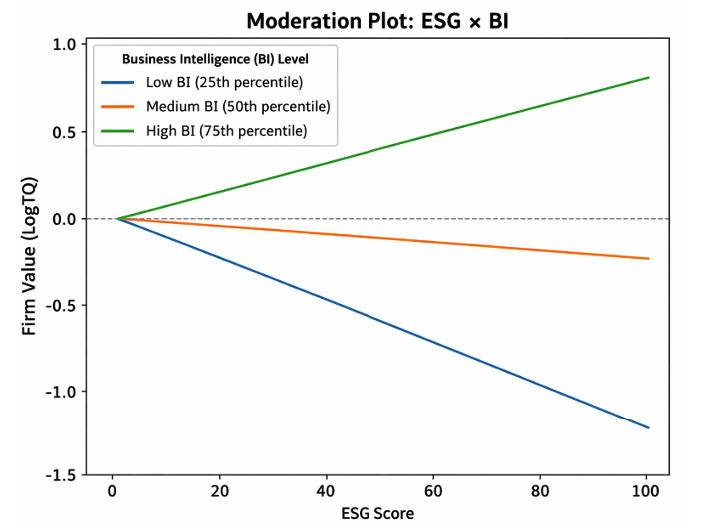
Environmental degradation in Indonesia has increased significantly in recent decades, thereby increasing the importance of Environmental, Social, and Governance (ESG) factors in corporate decision-making. This study aims to analyse the impact of ESG implementation on company value and investigate the moderating effect of business intelligence (BI) on this relationship. This research uses data panels from 35 listed non-financial companies on the Indonesia Stock Exchange, covering the period from 2018 to 2023. A total of 201 observations were collected through purposive sampling. We used descriptive statistics and Fixed Effects regression methods to analyse the data using a data panel approach. The findings show that ESG implementation is associated with a decrease in firm value. This suggests that such initiatives were still perceived primarily as symbolic activities that imposed additional costs and responded to external pressures rather than being fully embedded in corporate strategy. BI, when considered independently, also exhibits a negative relationship with firm value. Nevertheless, the correlation between ESG and BI yields a positive impact, implying that effective BI governance enhanced the credibility and strategic relevance of ESG information. The combined effect appeared to strengthen market perceptions and supports long-term formation firm value. This study provides empirical insights regarding literature that discusses the inconsistent link on the relationship of ESG and firm value in developing countries and emphasizes the strategic role of BI as an information governance mechanism that can increase the relevance of ESG for investors.
Downloads
References
Aboud, A., & Diab, A. (2018a). The impact of social, environmental and corporate governance disclosures on firm value. Journal of Accounting in Emerging Economies, 8(4), 442458. https://doi.org/10.1108/JAEE-08-2017-0079
Aboud, A., & Diab, A. (2018b). The impact of social, environmental and corporate governance disclosures on firm valueEvidence from Egypt. Journal of Accounting in Emerging Economies, 8(4), 442458. https://doi.org/10.1108/JAEE-08-2017-0079
Adeneye, Y. B., Kammoun, I., & Ab Wahab, S. N. A. (2023). Capital structure and speed of adjustment: the impact of environmental, social and governance (ESG) performance. Sustainability Accounting, Management and Policy Journal, 14(5), 945977. https://doi.org/10.1108/SAMPJ-01-2022-0060
Ahmad, H., Yaqub, M., & Lee, S. H. (2023). Environmental-, social-, and governance-related factors for business investment and sustainability: a scientometric review of global trends. Environment, Development and Sustainability, 26(2), 29652987. https://doi.org/10.1007/s10668-023-02921-x
Angir, P., & Weli, W. (2024). The Influence of Environmental, Social, and Governance (ESG) Disclosure on Firm Value: An Asymmetric Information Perspective in Indonesian Listed Companies. Binus Business Review, 15(1), 2940. https://doi.org/10.21512/bbr.v15i1.10460
Aydomu, M., Glay, G., & Ergun, K. (2022). Impact of ESG performance on firm value and profitability. Borsa Istanbul Review, 22, S119S127. https://doi.org/10.1016/J.BIR.2022.11.006
Azimli, A., & Cek, K. (2024). Can sustainability performance mitigate the negative effect of policy uncertainty on the firm valuation? Sustainability Accounting, Management and Policy Journal, 15(3), 752775. https://doi.org/10.1108/SAMPJ-09-2022-0464
Bagh, T., Fuwei, J., & Khan, M. A. (2024). From risk to resilience: Climate change risk, ESG investments engagement and Firms value. Heliyon, 10(5), e26757. https://doi.org/10.1016/j.heliyon.2024.e26757
Bahrami, M., & Shokouhyar, S. (2022a). The role of big data analytics capabilities in bolstering supply chain resilience and firm performance: a dynamic capability view. Information Technology & People, 35(5), 16211651. https://doi.org/10.1108/ITP-01-2021-0048
Bahrami, M., & Shokouhyar, S. (2022b). The role of big data analytics capabilities in bolstering supply chain resilience and firm performance: a dynamic capability view. Information Technology & People, 35(5), 16211651. https://doi.org/10.1108/ITP-01-2021-0048
Balachandran, B. M., & Prasad, S. (2017). Challenges and Benefits of Deploying Big Data Analytics in the Cloud for Business Intelligence. Procedia Computer Science, 112, 11121122. https://doi.org/10.1016/J.PROCS.2017.08.138
Chen, R., & Zhang, T. (2025). Artificial intelligence applications implication for ESG performance: can digital transformation of enterprises promote sustainable development? Chinese Management Studies, 19(3), 676701. https://doi.org/10.1108/CMS-11-2023-0653
Eliwa, Y., Aboud, A., & Saleh, A. (2021). ESG practices and the cost of debt: Evidence from EU countries. Critical Perspectives on Accounting, 79, 102097. https://doi.org/10.1016/j.cpa.2019.102097
Fan, H., & Chen, L. (2023). Political connections, business strategy and tax aggressiveness: evidence from China. China Accounting and Finance Review, 25(2), 125144. https://doi.org/10.1108/CAFR-07-2022-0086
Fatemi, A., Glaum, M., & Kaiser, S. (2018). ESG performance and firm value: The moderating role of disclosure. Global Finance Journal, 38, 4564. https://doi.org/10.1016/j.gfj.2017.03.001
Firmansyah, E. A., Umar, U. H., & Jibril, R. S. (2023). Investigating the effect of ESG disclosure on firm performance: The case of Saudi Arabian listed firms. Cogent Economics & Finance, 11(2). https://doi.org/10.1080/23322039.2023.2287923
Han, G.-R., & Lee, J.-E. (2024). The Moderating Effect of ESG Level in the Relationship between Digital Transformation Capability and Financial Performance: Evidence from Foreign Subsidiaries of Korean Firms. Sustainability, 16(9), 3764. https://doi.org/10.3390/su16093764
Heredia, J., Castillo-Vergara, M., Geldes, C., Carbajal Gamarra, F. M., Flores, A., & Heredia, W. (2022). How do digital capabilities affect firm performance? The mediating role of technological capabilities in the new normal. Journal of Innovation & Knowledge, 7(2), 100171. https://doi.org/10.1016/j.jik.2022.100171
Interactive Data Access | Worldwide Governance Indicators. (n.d.). Retrieved September 23, 2025, from https://www.worldbank.org/en/publication/worldwide-governance-indicators/interactive-data-access
Johnson, O. P., & Neyman, J. (1936). Tests of certain linear hypotheses and their application to some educational problems. Statistical Research Memoirs, 1, 5793.
Kim, S., & Kim, K. (2024). The compounding effect of mandatory GHG emissions disclosure and voluntary ESG disclosure on firm value in Korea. Journal of Asian Business and Economic Studies, 31(5), 378391. https://doi.org/10.1108/JABES-12-2023-0519
Kuzey, C., Al-Shaer, H., Karaman, A. S., & Uyar, A. (2023a). Public governance, corporate governance and excessive ESG. Corporate Governance: The International Journal of Business in Society, 23(7), 17481777. https://doi.org/10.1108/CG-01-2023-0028
Kuzey, C., Al-Shaer, H., Karaman, A. S., & Uyar, A. (2023b). Public governance, corporate governance and excessive ESG. Corporate Governance, 23(7), 17481777. https://doi.org/10.1108/CG-01-2023-0028
Lim, Y. Y., & Teoh, A. P. (2020). Realizing the strategic impact of business intelligence utilization. Strategic Direction, 36(4), 79. https://doi.org/10.1108/SD-09-2019-0184
Liu, Y., Song, J., Zhou, B., & Liu, J. (2025). Artificial intelligence applications and corporate ESG performance. International Review of Economics & Finance, 104, 104559. https://doi.org/10.1016/j.iref.2025.104559
Madison, N., & Schiehll, E. (2021). The Effect of Financial Materiality on ESG Performance Assessment. Sustainability, 13(7), 3652. https://doi.org/10.3390/su13073652
Maji, S. G., & Lohia, P. (2023). Environmental, social and governance (ESG) performance and firm performance in India. Society and Business Review, 18(1), 175194. https://doi.org/10.1108/SBR-06-2022-0162
Meini, Z., & Setijaningsih, H. T. (2024). The Impact of ESG on Firm Value: Empirical Study on Indonesia and Singapore Companies. Jurnal EQUITY, 27(2), 128141. https://doi.org/10.34209/equ.v27i2.9183
Melinda, A., & Wardhani, R. (2020). The Effect of Environmental, Social, Governance, and Controversies on Firms Value: Evidence from Asia (pp. 147173). https://doi.org/10.1108/S1571-038620200000027011
Ningtyas, A. I. R., Mualim, W., & Nusron, A. (2026). Artificial Intelligence in The Application of ESG to Improve Company Reputation: The Moderating Role of Financial Performance. Journal of Accounting Science/, 10(1), 6080.
OECD. (2024). OECD Economic Surveys: Indonesia 2024 (Vol. 2024). OECD Publishing. https://doi.org/10.1787/de87555a-en
Pardamean, R. J., & Gunawan, Y. (2025). Environmental, Social, and Governance to Firm Value: Profitability as a Moderating Variable. Jurnal Akuntansi, 17(2), 283296. https://doi.org/10.28932/jam.v17i2.11825
Prabawati, P. I., & Rahmawati, I. P. (2022). The effects of Environmental, Social, and Governance (ESG) scores on firm values in ASEAN member countries. Jurnal Akuntansi & Auditing Indonesia, 119129. https://doi.org/10.20885/jaai.vol26.iss2.art2
Prasetyo, R. A., Rissa Anandita, & Nur Amaliyatun Anisa Br Ginting. (2025). Assesing the Role of ESG on Firm Value in Indonesia: Signaling or Symbolism? GOVERNORS, 4(2), 298306. https://doi.org/10.47709/governors.v4i2.6757
Qaffas, A. A., Ilmudeen, A., Almazmomi, N. K., & Alharbi, I. M. (2023). The impact of big data analytics talent capability on business intelligence infrastructure to achieve firm performance. Foresight, 25(3), 448464. https://doi.org/10.1108/FS-01-2021-0002
Rana, N. P., Chatterjee, S., Dwivedi, Y. K., & Akter, S. (2022). Understanding dark side of artificial intelligence (AI) integrated business analytics: assessing firms operational inefficiency and competitiveness. European Journal of Information Systems, 31(3), 364387. https://doi.org/10.1080/0960085X.2021.1955628
Renaldo, N., Suyono, Andi, Putri, N. Y., & Cecilia. (2023). How Business Intelligence, Intellectual Capital, and Company Performance Increase Company Value? Leverage as Moderation. Journal of Applied Business and Technology, 4(1), 9399. https://doi.org/10.35145/jabt.v4i1.123
Seok, J., Kim, Y., & Oh, Y. K. (2024). How ESG shapes firm value: The mediating role of customer satisfaction. Technological Forecasting and Social Change, 208, 123714. https://doi.org/10.1016/j.techfore.2024.123714
Siva Anindhita Yori, N., & Putri Rahmawati, I. (2025). Environmental, Social, Governance (ESG) performance and company value on Indonesia non-financial firms. IOP Conference Series: Earth and Environmental Science, 1438(1), 012032. https://doi.org/10.1088/1755-1315/1438/1/012032
Spence, M. (1973). Job Market Signaling. The Quarterly Journal of Economics, 87(3), 355. https://doi.org/10.2307/1882010
Subhani, B. H., Zunhuan, S., & Khan, M. A. (2025). Finance for a Greener future: Evolving the financial sector for ESG and sustainable corporate debt management. Borsa Istanbul Review, 25(2), 337349. https://doi.org/10.1016/j.bir.2025.01.011
Suchman, M. C. (1995). Managing Legitimacy: Strategic and Institutional Approaches. The Academy of Management Review, 20(3), 571. https://doi.org/10.2307/258788
Sumarno, D. C., Andayani, W., & Prihatiningtyas, Y. W. (2023). The Effect of Environmental, Social and Governance (ESG) Assessment on Firm Value with Profitability as a Mediating Variable. Asia Pacific Management and Business Application, 12(1), 5564. https://doi.org/10.21776/ub.apmba.2023.012.01.4
Truong, T. H. D. (2025). Environmental, social and governance performance and firm value: does ownership concentration matter? Management Decision, 63(2), 488511. https://doi.org/10.1108/MD-10-2023-1993
Wahua, L., & Yonney Ahlijah. (2020). Business intelligence costs and firm performance: Evidence from selected top ECOWASbanks. Journal of Economics and Trade, 5(1), 117.
Wang, D., & Xia, X. (2024a). The impact of digital transformation on firms value: examining the role of ESG performance and the effect of information interaction. Business Process Management Journal, 30(4), 12361265. https://doi.org/10.1108/BPMJ-06-2023-0469
Wang, D., & Xia, X. (2024b). The impact of digital transformation on firms value: examining the role of ESG performance and the effect of information interaction. Business Process Management Journal, 30(4), 12361265. https://doi.org/10.1108/BPMJ-06-2023-0469
Wasiuzzaman, S., Ibrahim, S. A., & Kawi, F. (2023a). Environmental, social and governance (ESG) disclosure and firm performance: does national culture matter? Meditari Accountancy Research, 31(5), 12391265. https://doi.org/10.1108/MEDAR-06-2021-1356
Wasiuzzaman, S., Ibrahim, S. A., & Kawi, F. (2023b). Environmental, social and governance (ESG) disclosure and firm performance: does national culture matter? Meditari Accountancy Research, 31(5), 12391265. https://doi.org/10.1108/MEDAR-06-2021-1356
Wong, W. C., Batten, J. A., Ahmad, A. H., Mohamed-Arshad, S. B., Nordin, S., & Adzis, A. A. (2021). Does ESG certification add firm value? Finance Research Letters, 39, 101593. https://doi.org/10.1016/j.frl.2020.101593
Ye, Y., Yeung, A. C. L., & Huo, B. (2020). Maintaining stability while boosting growth? The long-term impact of environmental accreditations on firms financial risk and sales growth. International Journal of Operations and Production Management, 40(12), 18291856. https://doi.org/10.1108/IJOPM-05-2019-0407
Yiu, L. M. D., Yeung, A. C. L., & Cheng, T. C. E. (2021). The impact of business intelligence systems on profitability and risks of firms. International Journal of Production Research, 59(13), 39513974. https://doi.org/10.1080/00207543.2020.1756506
Downloads
Published
How to Cite
Issue
Section
License
Copyright (c) 2026 Oviliani Yenty Yuliana, yenni mangoting, Audrie Jessalyne Tankilisan, Eugunia Evanthe Yenardi , Desi Arisandi

This work is licensed under a Creative Commons Attribution-ShareAlike 4.0 International License.