Building a Nation Branding Image through Social Media Strategy: What does Gen Z say?
DOI:
https://doi.org/10.38043/jimb.v10i2.7447Keywords:
Digital Diplomacy, Social Media Campaign, Cultural Curiosity, Nation Brand Image, Gen ZAbstract
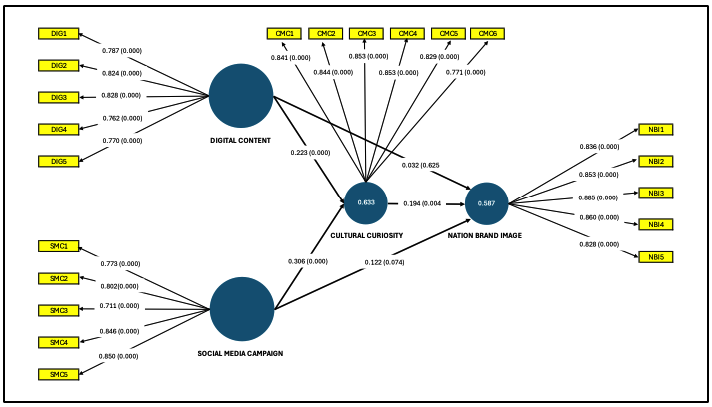
This study explores how digital diplomacy, particularly through digital content and social media campaigns, impacts Indonesia’s nation brand image in Pakistan, with cultural curiosity among Pakistani Gen Z acting as a mediating factor. Using a quantitative research approach, data were gathered from 545 respondents selected via purposive sampling and analyzed with Structural Equation Modelling. The results show that digital content and social media campaigns do not directly improve Indonesia’s nation brand image. Instead, both significantly increase cultural curiosity among Gen Z audiences. An important insight is that cultural curiosity effectively mediates the relationship between social media campaigns and the nation's brand image, while digital content has no significant effect. This indicates that successful digital nation branding relies on culturally engaging social media campaigns that foster familiarity and meaningful cognitive connections. Theoretically, the study advances the literature on nation branding and digital diplomacy by identifying cultural curiosity as a key psychological mechanism linking diplomatic stimuli to brand outcomes, supporting the Stimulus–Organism–Response (S–O–R) framework and consumer multiculturation theory. Future research should incorporate mixed and experimental methods, expand to broader contexts, and use applied behavioral and participatory data to capture genuine digital diplomacy engagement better. Overall, the study highlights the strategic importance of digital diplomacy in sparking curiosity and shaping positive international perceptions among younger audiences.
Downloads
References
Anholt, S. (2007). The theory of competitive identity. Palgrave Macmillan. https://doi.org/10.1057/9780230627727_2.
Anholt, S. (2010). Places: Identity, image, and reputation. Palgrave Macmillan.
Ayalew, H. (2017). Digital Diplomacy for Image Building and Nation Branding: The Ethiopian Context (Master's thesis). Addis Ababa University.
Baltezarevi, R. (2021). The role of digital diplomacy in creating the image of the nation. Megatrend Revija, 18(4), 8196. https://doi.org/10.5937/megrev2104081b
Bandura, A. (1977). Social learning theory. Prentice Hall.
Ben Aicha, A. & Bouzaabia, R. (2023). "The effects of video storytelling advertising on consumers' online reactions on Facebook: a cross-cultural study", Qualitative Market Research, Vol. 26 No. 3, pp. 247268. https://doi.org/10.1108/QMR-06-2022-0101
Bjola, C., & Holmes, M. (2015). Digital diplomacy: Theory and practice. Routledge.
Blumler, J. G., & Katz, E. (1974). The uses of mass communications: Current perspectives on gratifications research. Sage Publications.
Cain, M. K., Zhang, Z., & Yuan, K.-H. (2017). Univariate and multivariate skewness and kurtosis for measuring nonnormality: Prevalence, influence, and estimation. Behavior Research Methods, 49(5), 17161735. https://doi.org/10.3758/s13428-016-0814-1
Carson, N. (2010). Born digital: Understanding the first generation of digital natives [Review of the book Born digital: Understanding the first generation of digital natives, by J. Palfrey & U. Gasser]. Journal of the American Academy of Child & Adolescent Psychiatry, 49(7), 718720. https://doi.org/10.1016/j.jaac.2010.05.001
Chen, X., Shen, X., Huang, X., & Li, Y. (2021). Research on Social Media Content Marketing: An Empirical Analysis Based on Chinas 10 Metropolises for Korean Brands. SAGE Open, 11(4), Article 21582440211052951. https://doi.org/10.1177/21582440211052951
Cheung, C. M., & Thadani, D. R. (2012). The impact of electronic word-of-mouth communication. Decision Support Systems, 54(1), 461470.
Cull, N. J. (2019). Public diplomacy: Foundations for global engagement in the digital age. Polity.
Duffett, R. G. (2017). Influence of social media marketing communications on young consumers attitudes. Young Consumers: Insight and Ideas for Responsible Marketers, 18(1), 1939. https://doi.org/10.1108/YC-07-2016-00622
Gilboa, E. (2016). Digital diplomacy: A new era in international relations. Journal of International Relations and Development, 19(2), 147164.
Green, M. C., & Brock, T. C. (2000). The role of transportation in the persuasiveness of fiction. Journal of Personality and Social Psychology, 79(5), 701721.
Hair, J. F., Hult, G. T. M., Ringle, C. M., & Sarstedt, M. (2017). A primer on partial least squares structural equation modelling (PLSSEM) (2nd ed.). SAGE.
Hocking, B., & Melissen, J. (2015). Diplomacy in the digital age. Clingendael Institute. https://www.clingendael.org/sites/default/files/pdfs/Digital_Diplomacy_in_the_Digital%20Age_Clingendael_July2015.pdf
Holt, D. B. (2004). How brands become icons: The principles of cultural branding. Harvard Business Press.
Hurn, B. J. (2016). The role of cultural diplomacy in nation branding. Industrial and Commercial Training, 48(2), 6266.
Ibarra-Cantu, C., & Cheetham, F. (2021). Consumer multiculturation in multicultural marketplaces: Mexican immigrants responses to the global consumer culture construction of Tex-Mex as Mexican food. Journal of Business Research, 134, 7077. https://doi.org/10.1016/j.jbusres.2021.05.012
Ishii, K., & Watanabe, T. (2015). A cross-national comparison of country brand strength: Lessons from the East and West. Journal of Brand Management, 22(2), 89101.
Jenkins, H., Clinton, K., Purushotma, R., Robison, A.J., & Weigel, M. (2006). Confronting the challenges of participatory culture: Media education for the 21st century. MIT Press.
Jung, H., & Lee, Y.A. (2024). Exploring direct and indirect cultural experiences: A study of global consumers Hanbok experience and engagement mediated via YouTube. Fashion and Textiles, 11(15). https://doi.org/10.1186/s40691-024-00385-9
Kalsn, . (2023). Digital diplomacy and nation branding: A study of Turkey's digital diplomacy efforts. Journal of Public Diplomacy, 10(1), 1-15.
Kim, Y. (2020). The role of cultural diplomacy in enhancing a nation's brand image: A case study of South Korea. International Journal of Cultural Policy, 26(3), 345360.
Kipnis, E., Broderick, A., & Demangeot, C. (2014). Consumer Multi-Cultural Identity Orientation Matrix: Understanding Cross-Cultural Identity Negotiation. Journal of Consumer Research.
Kipnis, E., Broderick, A., & Demangeot, C. (2019). Consumer Multicultural Identity Affiliation and Its Impact on Brand Perception. Marketing Theory & Practice.
Kotler, P., & Gertner, D. (2002). Country as brand, product, and beyond: A place marketing and brand management perspective. Journal of Brand Management, 9(45), 249261. https://doi.org/10.1057/palgrave.bm.2540076
Kumar, N., & Steenkamp, J.-B. E. M. (2007). Brand versus brand. International Commerce Review, 7(1), 4653. https://doi.org/10.1007/s12146-007-0008-y
Litman, J. A. (2005). Curiosity and the pleasures of learning: Wanting and liking new information. Cognition and Emotion, 19(6), 793814.
Litvin, S. W., Goldsmith, R. E., & Pan, B. (2008). Electronic wordofmouth in hospitality and tourism management. Tourism Management, 29(3), 458468. https://doi.org/10.1016/j.tourman.2007.05.011
Loewenstein, G. (1994). The psychology of curiosity: A review and reinterpretation. Psychological Bulletin, 116(1), 7598. https://doi.org/10.1037/0033-2909.116.1.75
Lund, N. F., Cohen, S. A., & Scarles, C. (2018). The power of social media storytelling in destination branding. Journal of Destination Marketing & Management, 8, 271280. https://doi.org/10.1016/j.jdmm.2017.05.003
Lopez-Mugica, J., Whyke, T. W., White, A., & Dean, L. (2024). The fluidity of soft power in YouTubes broadcast of the Beijing 2022 Winter Olympic Games. Global Media and Communication, 20(3), 311328. https://doi.org/10.1177/17427665241289741
Manor, I., & Huang, Z. A. (2022). Digitalization of public diplomacy: Concepts, trends, and challenges. Communication and the Public, 7(4), Article 20570473221138401. https://doi.org/10.1177/20570473221138401
Masadeh, R., Al-Haddad, S., Abed, D., Khalil, H., AlMomani, L., & Khirfan, T. (2021). The impact of social media activities on brand equity. Information, 12(11), 477. https://doi.org/10.3390/info12110477
Stojanovic, I., Andreu, L., & Prez, R. (2018). Effects of the intensity of use of social media on brand equity: An empirical study in a tourist destination. European Journal of Management and Business Economics, 27(3), 245262. https://doi.org/10.1108/EJMBE-11-2017-0049
McLuhan, M. (1964). Understanding media: The extensions of man. New York: McGraw-Hill.
Mehrabian, A. & Russell, J.A. (1974). An Approach to Environmental Psychology. The MIT Press, Cambridge.
Nye, J. S., Jr. (2004). Soft power: The means to success in world politics. PublicAffairs.
Pamment, J., & Cassinger, C. (2018). Nation branding and the social imaginary of participation: An exploratory study of the Swedish Number campaign. European Journal of Cultural Studies, 21(5), 561574. https://doi.org/10.1177/1367549417751152
Perera, C. H., Nayak, R., & Nguyen, L. T. V. (2022). The impact of social media marketing and brand credibility on higher education institutes brand equity in emerging countries. Journal of Marketing Communications, 29(8), 770795. https://doi.org/10.1080/13527266.2022.2086284
Prensky, M. (2001). "Digital Natives, Digital Immigrants Part 1". On the Horizon, Vol. 9 No. 5 pp. 16, doi: https://doi.org/10.1108/10748120110424816
Rainu, H.K., & Baskaran, K. (2025). Examining the influence of social media marketing strategies on indigenous consumer behavior in the UAE. In I. Ghosal, S. Gupta, S. Rana, & D. Saha (Eds.), Indigenous empowerment through humanmachine interactions: The challenges and strategies from business lenses (pp.118). Emerald Publishing Limited. https://doi.org/10.1108/978-1-83608-068-820251001
Dubiv, N.V., & Nelaeva, G.A. (2017). [Review of the book Public diplomacy and the implementation of foreign policy in the US, Sweden, and Turkey, by E. Sevin]. Diplomacy & Statecraft, 28(4), 733734. https://doi.org/10.1080/09592296.2017.1386471
Seo, Y., & Gao, H. (2015). Towards a valuebased perspective of consumer multicultural orientation. European Management Journal, 33(1), 3036. https://doi.org/10.1016/j.emj.2014.06.001
Sheldon, P., & Bryant, K. (2016). Instagram: Motives for its use and relationship to narcissism and contextual age. Computers in Human Behavior, 58, 8997. https://doi.org/10.1016/j.chb.2015.12.059
Smith, L. (2024). Digital diplomacy: How social media influences international relations in the 21st century. Edu Journal of International Affairs and Research, 3(2), 4047. https://edupublications.com/index.php/ejiar/article/view/88
Song, L., Li, R. Y. M., & Wareewanich, T. (2023). The cultivation effect of architectural heritage YouTube videos on perceived destination image. Buildings, 13(2), 508. https://doi.org/10.3390/buildings13020508
Straubhaar, J. D. (1991). Beyond media imperialism: Asymmetrical interdependence and cultural proximity. Critical Studies in Mass Communication, 8(1), 3959. https://doi.org/10.1080/15295039109366779
Steenkamp, J. B. E. M., Batra, R., & Alden, D. L. (2003). How perceived brand globalness creates brand value. Journal of International Business Studies, 34(1), 5365. https://doi.org/10.1057/palgrave.jibs.8400002
Steenkamp, J. B. E. M. (2020). Global brand building and management in the digital age. Journal of International Marketing, 28(1), 1327. https://doi.org/10.1177/1069031X19894946
Wijaya, C.O., Wijaya, S. and Jaolis, F. (2025). "The influence of social media content on attitude, destination image and intention of female Muslim travelers to visit halal destinations: comparison between UGC and FGC", Journal of Islamic Marketing, Vol. 16 No. 2, pp. 402427. https://doi.org/10.1108/JIMA-08-2023-0235
Yousaf, S., Fan, X., & Laber, M. (2020). Branding China through the internationalization of the higher education sector: An international students perspective from China. Journal of Marketing for Higher Education, 30(1), 119. https://doi.org/10.1080/08841241.2019.1710890
Yazdanparast, A., Naderi, I., Spears, N., & Fabrize, R. (2018). Advertising and pseudo-culture: An analysis of the changing portrayal of women in print advertisements. Journal of Macromarketing, 38(4), 494506. https://doi.org/10.1177/027614671876247
Downloads
Published
How to Cite
Issue
Section
License
Copyright (c) 2025 Ade Pranajaya, Sara Rashid

This work is licensed under a Creative Commons Attribution-ShareAlike 4.0 International License.