Scrolling Toward Simplicity: Social Media Use, Fear of Missing Out, and Minimalist Consumption Among Generation Z In Indonesia
DOI:
https://doi.org/10.38043/jimb.v10i2.7232Keywords:
social media use, fear of missing out, minimalist consumption, social media, young generationAbstract
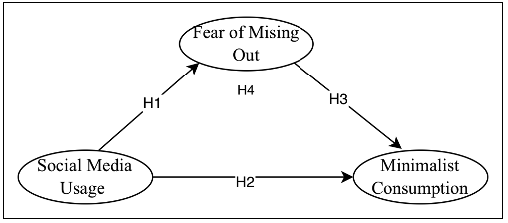
This study examines how social media use and fear of missing out (FoMO) relate to minimalist consumption tendencies among young people in Indonesia. The study examines whether intense social media use merely stimulates overconsumption or can also support a more focused and sustainable minimalist lifestyle. A cross-sectional quantitative survey was conducted with 275 young Indonesian users who actively use Instagram and TikTok. Data were collected through an online questionnaire and analyzed using partial least squares structural equation modeling (PLS-SEM) to test for direct and indirect effects. Results indicate that social media use has a positive and significant effect on FoMO and a positive and significant effect on minimalist consumption. Conversely, FoMO does not significantly predict minimalist consumption; therefore, FoMO does not mediate the relationship between social media use and minimalist consumption. These findings suggest that social media can serve as a supportive space for minimalist practices when users are exposed to content and communities that promote simple and sustainable living. Practically, despite the insignificant role of FoMO, this study informs sustainable marketing and consumption initiatives by suggesting that brands and their supporters integrate buy less but better messaging into Instagram/TikTok campaigns, encourage mindful reordering and purchasing routines, and build community based engagement rather than relying on promotional cues driven by urgency or FoMO. Overall, this study highlights the ambivalent role of social media in youth consumption behavior and suggests opportunities to promote minimalist lifestyles in developing countries.
Downloads
References
Alyani, J., Putri, L. I., Zidhan, R. E., & Arthaditama, D. I. (2025). The Influence Of Social Media On Generation Z Consumption Patterns In Indonesia. Interkoneksi: Journal of Computer Science and Digital Business, 3(1), 2630. https://doi.org/10.61166/interkoneksi.v3i1.33
Ayyasy, M. Z., Belinda, K. I., & Dirgantara, I. M. B. (2025). FOMO Related Impulse Buying on Social Commerce: A Literature Review. Economic and Business Horizon, 4(2), 365374. https://doi.org/10.54518/ebh.4.2.2025.680
Bardey, A., Booth, M., Heger, G., & Larsson, J. (2022). Finding yourself in your wardrobe: An exploratory study of lived experiences with a capsule wardrobe. International Journal of Market Research, 64(1), 113131. https://doi.org/10.1177/1470785321993743
Blse, R., Filser, M., Kraus, S., Puumalainen, K., & Moog, P. (2023). Non-sustainable buying behavior: How the fear of missing out drives purchase intentions in the fast fashion industry. Business Strategy and the Environment. https://doi.org/10.1002/bse.3509
Blse, R., Filser, M., Kraus, S., Puumalainen, K., & Moog, P. (2024). Nonsustainable buying behavior: How the fear of missing out drives purchase intentions in the fast fashion industry. Business Strategy and the Environment, 33(2), 626641. https://doi.org/10.1002/bse.3509
Chen, S., Kou, S., & Lv, L. (2024). Stand out or fit in: Understanding consumer minimalism from a social comparison perspective. Journal of Business Research, 170, 114307. https://doi.org/10.1016/j.jbusres.2023.114307
Creswell, J. W. (2007). Qualitative Inquiry and Research Design: Choosing among Five Approaches, 2nd edition (2nd ed.).
Dempsey, A. E., OBrien, K. D., Tiamiyu, M. F., & Elhai, J. D. (2019). Fear of missing out (FoMO) and rumination mediate relations between social anxiety and problematic Facebook use. Addictive Behaviors Reports, 9, 100150. https://doi.org/10.1016/j.abrep.2018.100150
DenegriKnott, J., & Molesworth, M. (2010). Concepts and practices of digital virtual consumption. Consumption Markets & Culture, 13(2), 109132. https://doi.org/10.1080/10253860903562130
Deveci, F. G., & Yldz, T. (2025). The Effect of Consumer Minimalism on Sustainable Consumption: The Mediator Role of Perceived Consumer Effectiveness. In Journal of Yasar University (Vol. 20).
Dewantoro, R., Sariani, S., & Suriono, H. (2025). Transformation of Generation Zs consumption behavior in the digital ecosystem: A theoretical review of social media-based marketing strategies. Priviet Social Sciences Journal, 5(5), 102110. https://doi.org/10.55942/pssj.v5i5.619
Dinh, T. C. T., & Lee, Y. (2022a). I want to be as trendy as influencers how fear of missing out leads to buying intention for products endorsed by social media influencers. Journal of Research in Interactive Marketing, 16(3), 346364. https://doi.org/10.1108/JRIM-04-2021-0127
Dinh, T. C. T., & Lee, Y. (2022b). I want to be as trendy as influencers how fear of missing out leads to buying intention for products endorsed by social media influencers. Journal of Research in Interactive Marketing, 16(3), 346364. https://doi.org/10.1108/JRIM-04-2021-0127
Djafarova, E., & Bowes, T. (2021). Instagram made Me buy it: Generation Z impulse purchases in fashion industry. Journal of Retailing and Consumer Services, 59, 102345. https://doi.org/10.1016/j.jretconser.2020.102345
F. Hair Jr, J., Sarstedt, M., Hopkins, L., & G. Kuppelwieser, V. (2014). Partial least squares structural equation modeling (PLS-SEM). European Business Review, 26(2), 106121. https://doi.org/10.1108/EBR-10-2013-0128
Fornell, C., & Larcker, D. F. (1981). Evaluating Structural Equation Models with Unobservable Variables and Measurement Error. Journal of Marketing Research, 18(1), 3950. https://doi.org/10.1177/002224378101800104
Good, M. C., & Hyman, M. R. (2020). Fear of missing out: antecedents and influence on purchase likelihood. Journal of Marketing Theory and Practice, 28(3), 330341. https://doi.org/10.1080/10696679.2020.1766359
GWI. (2023). GWI Core Q3 2023 Dataset. London. Data Diakses Melalui Laporan Digital 2024 Indonesia.
Hair, J. F., Ringle, C. M., Sarstedt, M., & Hult, G. T. M. (2021). Partial Least Squares Structural Equation Modeling (PLS-SEM) Using R. Springer.
Hair, J. F., Risher, J. J., Sarstedt, M., & Ringle, C. M. (2019). When to use and how to report the results of PLS-SEM. European Business Review, 31(1), 224. https://doi.org/10.1108/EBR-11-2018-0203/FULL/XML
Hussain, S., Raza, A., Haider, A., Ishaq, M. I., & Talpur, Q. (2023). Fear of missing out and compulsive buying behavior: The moderating role of mindfulness. Journal of Retailing and Consumer Services, 75, 103512. https://doi.org/10.1016/j.jretconser.2023.103512
Huwaida, L. A., Yusuf, A., Satria, A. N., Darmawan, M. A., Ammar, M. F., Yanuar, M. W., Hidayanto, A. N., & Yaiprasert, C. (2024). Generation Z and Indonesian Social Commerce: Unraveling key drivers of their shopping decisions. Journal of Open Innovation: Technology, Market, and Complexity, 10(2), 100256. https://doi.org/10.1016/j.joitmc.2024.100256
Kang, J., Martinez, C. M. J., & Johnson, C. (2021a). Minimalism as a sustainable lifestyle: Its behavioral representations and contributions to emotional well-being. Sustainable Production and Consumption, 27, 802813. https://doi.org/10.1016/j.spc.2021.02.001
Kang, J., Martinez, C. M. J., & Johnson, C. (2021b). Minimalism as a sustainable lifestyle: Its behavioral representations and contributions to emotional well-being. Sustainable Production and Consumption, 27, 802813. https://doi.org/10.1016/j.spc.2021.02.001
Keinan, A., & Kivetz, R. (2008). Remedying Hyperopia: The Effects of Self-Control Regret on Consumer Behavior. Journal of Marketing Research, 45(6), 676689. https://doi.org/10.1509/jmkr.45.6.676
Kemp, S. (2024). Digital 2024 Indonesia. DataReportal, We Are Social, Dan Meltwater.
Kemp, S. (2025). Digital 2025 Global Overview Report. DataReportal.
Kozinets, R., Patterson, A., & Ashman, R. (2017). Networks of Desire: How Technology Increases Our Passion to Consume. Journal of Consumer Research, 43(5), 659682. https://doi.org/10.1093/jcr/ucw061
Lai, C., Altavilla, D., Ronconi, A., & Aceto, P. (2016). Fear of missing out (FOMO) is associated with activation of the right middle temporal gyrus during inclusion social cue. Computers in Human Behavior, 61, 516521. https://doi.org/10.1016/j.chb.2016.03.072
Le, T.-M. H., & Ngoc, B. M. (2024). Consumption-related social media peer communication and online shopping intention among Gen Z consumers: A moderated-serial mediation model. Computers in Human Behavior, 153, 108100. https://doi.org/10.1016/j.chb.2023.108100
Lee, J., & Kwon, K. H. (2023). Promoting Sustainable Learning in the Post-Pandemic Era: Focused on the Role of Motivation, Growth Mindset, Self-Regulated Learning, Well-Being, and Smart Device Utilization. In Sustainability (Switzerland) (Vol. 15, Issue 17). Multidisciplinary Digital Publishing Institute (MDPI). https://doi.org/10.3390/su151713247
Li, J., Qi, J., Wu, L., Shi, N., Li, X., Zhang, Y., & Zheng, Y. (2021). The continued use of social commerce platforms and psychological anxietythe roles of influencers, informational incentives and fomo. International Journal of Environmental Research and Public Health, 18(22). https://doi.org/10.3390/ijerph182212254
Lu, F. C., & Sinha, J. (2024). How social media usage and the fear of missing out impact minimalistic consumption. European Journal of Marketing, 58(4), 10831114. https://doi.org/10.1108/EJM-08-2022-0641
Lu, Y., Zhang, T., & Xu, Z. (2024a). Exploring Chinese Millennials Minimalist Consumption Behavior in the Context of Global Economic Downturn: A PLS-SEM Analysis Based on Symbolic and Simulacrum Consumption Perception. Behavioral Sciences, 14(12), 1175. https://doi.org/10.3390/bs14121175
Lu, Y., Zhang, T., & Xu, Z. (2024b). Exploring Chinese Millennials Minimalist Consumption Behavior in the Context of Global Economic Downturn: A PLS-SEM Analysis Based on Symbolic and Simulacrum Consumption Perception. Behavioral Sciences, 14(12), 1175. https://doi.org/10.3390/bs14121175
Majeed, M., Chaudhary, A., & Chadha, R. (2024). Digital Transformation in the Customer Experience. Apple Academic Press. https://doi.org/10.1201/9781003560449
Martin-Woodhead, A. (2022). Limited, considered and sustainable consumption: The (non)consumption practices of UK minimalists. Journal of Consumer Culture, 22(4), 10121031. https://doi.org/10.1177/14695405211039608
Mazaheri Habibi, M. R., Abadi, F. M., Tabesh, H., Vakiliarki, H., AbuHanna, A., Ghaddaripouri, K., & Eslami, S. (2024). Evaluation of noshow rate in outpatient clinics with open access scheduling system: A systematic review. Health Science Reports, 7(7). https://doi.org/10.1002/hsr2.2160
Milyavskaya, M., Saffran, M., Hope, N., & Koestner, R. (2018). Fear of missing out: prevalence, dynamics, and consequences of experiencing FOMO. Motivation and Emotion, 42(5), 725737. https://doi.org/10.1007/s11031-018-9683-5
Mutiarasari, N. A. G. (2025). Celebrity Characteristics and Purchase Intentions: A Structural Equation Modeling Analysis of YouTube Culinary Content. Journal of Applied Data Sciences, 6(2), 11541168. https://doi.org/10.47738/jads.v6i2.634
Nekmahmud, Md., Naz, F., Ramkissoon, H., & Fekete-Farkas, M. (2022). Transforming consumers intention to purchase green products: Role of social media. Technological Forecasting and Social Change, 185, 122067. https://doi.org/10.1016/j.techfore.2022.122067
Ngoc Nguyen, D., & Nguyen, D. Van. (2025). FOMO and the Impulsive Purchasing Behavior of Young People. European Journal of Business and Management Research, 10(3), 4147. https://doi.org/10.24018/ejbmr.2025.10.3.2638
Przybylski, A. K., Murayama, K., Dehaan, C. R., & Gladwell, V. (2013). Motivational, emotional, and behavioral correlates of fear of missing out. Computers in Human Behavior, 29, 18411848. https://doi.org/10.1016/j.chb.2013.02.014
Richard P. Bagozzi, & Youjae Yi. (1988). On the evaluation of structural equation models. Journal of the Academy of Marketing Science, 16, 7494.
Rosen, L. D., Whaling, K., Rab, S., Carrier, L. M., & Cheever, N. A. (2013). Is Facebook creating iDisorders? The link between clinical symptoms of psychiatric disorders and technology use, attitudes and anxiety. Computers in Human Behavior, 29(3), 12431254. https://doi.org/10.1016/j.chb.2012.11.012
Santos Corrada, M. D. L. M., MndezTejeda, R., FlechaOrtiz, J. A., & Lopez, E. (2024). An analysis of sustainable consumption practices through the role of the consumer behavior in the circular economy. Journal of Consumer Behaviour, 23(1), 229242. https://doi.org/10.1002/cb.2183
Servidio, R., Soraci, P., Griffiths, M. D., Boca, S., & Demetrovics, Z. (2024). Fear of missing out and problematic social media use: A serial mediation model of social comparison and self-esteem. Addictive Behaviors Reports, 19, 100536. https://doi.org/10.1016/j.abrep.2024.100536
Sriwilai, K., & Charoensukmongkol, P. (2016). Face it, dont Facebook it: Impacts of Social Media Addiction on Mindfulness, Coping Strategies and the Consequence on Emotional Exhaustion. Stress and Health, 32(4), 427434. https://doi.org/10.1002/smi.2637
Tandon, A., Dhir, A., Almugren, I., AlNemer, G. N., & Mntymki, M. (2021). Fear of missing out (FoMO) among social media users: a systematic literature review, synthesis and framework for future research. Internet Research, 31(3), 782821. https://doi.org/10.1108/INTR-11-2019-0455
William G. Zikmund, Babin, B. J., & Jon C. Carr. (2010). Business Research Methods, 8th Edition (William G. Zikmund, Barry J. Babin, Jon C. Carr etc.) (z-lib.org).
Wilson, A. V, & Bellezza, S. (2022). Consumer Minimalism. Journal of Consumer Research, 48(5), 796816. https://doi.org/10.1093/jcr/ucab038
Xanidis, N., & Brignell, C. M. (2016). The association between the use of social network sites, sleep quality and cognitive function during the day. Computers in Human Behavior, 55, 121126. https://doi.org/10.1016/j.chb.2015.09.004
Yasin Abbas, M., Ilham Pratama, F., Romdonny, J., & Maulana, Y. (2025). The Influence of Scarcity Perception and FOMO .. 9715 THE INFLUENCE OF SCARCITY PERCEPTION AND FOMO ON GEN Z IMPULSE BUYING IN CIREBON CITY. In Indonesian Interdisciplinary Journal of Sharia Economics (IIJSE) (Vol. 8, Issue 3).
Zafar, S. (2022). How minimalism and sustainability go hand in hand. Www.Ecomena.Org/Minimalism-and-Sustainability.
Zhang, Q., & Abdullah, F. (2025). The psychological mechanisms through which digital content marketing by online influencers affects customer loyalty: evidence from multiple countries. Frontiers in Communication, 10. https://doi.org/10.3389/fcomm.2025.1702657
Downloads
Published
How to Cite
Issue
Section
License
Copyright (c) 2025 N. Azizia Gia Mutiarasari, Wahyu Eka kiswardhani, Krisnayanti Aditasari

This work is licensed under a Creative Commons Attribution-ShareAlike 4.0 International License.