Perceived Value as a Mediator: How Customer Experience Outweighs E-Service Quality in Driving Digital Repurchase Intention in Quick-Service Restaurants
DOI:
https://doi.org/10.38043/jimb.v10i2.7170Keywords:
E-Service Quality, Customer Experience, Perceived Value, Repurchase Intention, Quick-service restaurants, Digital food services, SEM-PLSAbstract
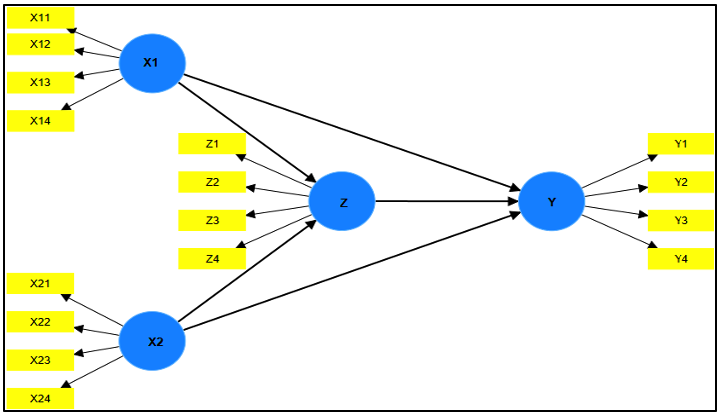
This study explores the different impacts of e-service quality and customer experience on repurchase intention, with perceived value as a mediator, among digital consumers of Yoshinoya quick-service restaurants in Surabaya, Indonesia. Using Structural Equation Modeling–Partial Least Squares (SEM-PLS) on data from 148 respondents, the results show that e-service quality does not significantly affect repurchase intention (coefficient = 0.166, p = 0.120), while customer experience has a strong direct effect (coefficient = 0.405, p < 0.001). Perceived value mediates the relationship between customer experience and repurchase intention (coefficient = 0.497, p < 0.001), but not between e-service quality and repurchase intention (coefficient = 0.074, p = 0.217). This study contributes to digital service and consumer behavior literature by showing that perceived value acts as a selective mediator, enhancing the impact of customer experience while reducing the role of e-service quality in technology-based QSR environments. Practically, the findings suggest that QSR managers should view e-service quality as a basic requirement and focus on experiential strategies, such as emotional engagement, personalization, and omnichannel consistency, to improve perceived value and maintain customer loyalty in competitive digital food service markets.
Downloads
References
Anshu, K., & Gaur, L. (2022). Impact of customer experience on attitude and repurchase intention in online grocery retailing: A moderation mechanism of value co-creation. Journal of Retailing and Consumer Services, 64. https://doi.org/10.1016/j.jretconser.2021.102798
Armstrong, J. S., & Overton, T. S. (1977). Estimating Nonresponse Bias in Mail Surveys. Journal of Marketing Research, 14(3).
Barney, J. (1991). Firm Resources and Sustained Competitive Advantage. Journal of Management, 17(1), 99–120. https://doi.org/10.1177/014920639101700108
Belarmino, A., Raab, C., Tang, J., & Qian, X. (2023b). Exploring the motivations to use online food delivery services: Before and during the pandemic. International Journal of Contemporary Hospitality Management, 35(1), 45–64. https://doi.org/10.1108/IJCHM-04-2022-0511
Bethlehem, J. (2010). Selection Bias in Web Surveys. International Statistical Review, 78(2), 161–188. https://doi.org/0.1111/j.1751-5823.2010.00112.x
Blut, M., Chowdhry, N., Mittal, V., & Brock, C. (2024b). E-service quality: A meta-analytic review. Journal of Retailing, 100(1), 135–159. https://doi.org/10.1016/j.jretai.2024.01.003
BMI Research. (2024). Indonesia food and drink report. Fitch Solutions.
Brislin, R. W. (1970). Back-translation for cross-cultural research. Journal of Cross-Cultural Psychology, 1(3), 185–216. https://doi.org/10.1177/135910457000100301
Chen, Y., Li, M., & Zhang, L. (2024). Omnichannel customer experience and loyalty in the restaurant industry: The moderating role of technology readiness. International Journal of Hospitality Management, 118. https://doi.org/10.1016/j.ijhm.2024.103678
Creswell, J. W., & Creswell, J. D. (2018). Research design: Qualitative, quantitative, and mixed methods approaches (5th ed.). SAGE Publications.
Davis, F. D. (1989). Perceived usefulness, perceived ease of use, and user acceptance of information technology. MIS Quarterly, 13(3), 319–340. https://doi.org/10.2307/249008
Dhar, R., & Wertenbroch, K. (2000). Consumer choice between hedonic and utilitarian goods. Journal of Marketing Research, 37(1), 60–71. https://doi.org/10.1509/jmkr.37.1.60.18718
Ellitan, L., Sugiyanto, S. A., & Risdwiyanto, A. (2023). Increasing repurchase intention through experiential marketing, service quality, and customer satisfaction: Korean restaurants in Surabaya. Jurnal Maksipreneur: Manajemen, Koperasi, Dan Entrepreneurship, 12(1), 67–84. https://doi.org/10.30588/jmp.v12i1.1022
Etikan, I., Musa, S. A., & Alkassim, R. S. (2009). Comparison of convenience sampling and purposive sampling. American Journal of Theoretical and Applied Statistics, 5(1), 1–4. https://doi.org/10.11648/j.ajtas.20160501.11
Faul, F., Erdfelder, E., Buchner, A., & Lang, A. G. (2009). Statistical power analyses using G*Power 3.1: Tests for correlation and regression analyses. Behavior Research Methods, 41(4), 1149–1160. https://doi.org/10.3758/BRM.41.4.1149
Fishbein, M., & Ajzen, I. (1975). Belief, attitude, intention, and behavior: An introduction to theory and research. Addison-Wesley.
Fornell, C., & Larcker, D. F. (1981). Evaluating structural equation models with unobservable variables and measurement error. Journal of Marketing Research, 18(1), 39–50. https://doi.org/10.1177/002224378101800104
Gefen, D., Karahanna, E., & Straub, D. W. (2003). Trust and TAM in Online Shopping: An Integrated Model. MIS Quarterly, 27(1), 51–90.
GSMA, G. (2024). The Mobile Economy Asia Pacific 2024 [Industry report]. GSM Association. https://www.gsma.com/solutions-and-impact/connectivity-for-good/mobile-economy/
Gutman, J. (1982). A means-end chain model based on consumer categorization processes. Journal of Marketing, 46(2), 60–72. https://doi.org/10.1177/002224298204600207
Hair, J. F., Hult, G. T. H., Ringle, C. M., & Sarstedt, M. (2021). A primer on partial least squares structural equation modeling (PLS-SEM) (3rd ed.). SAGE Publications.
Hair, J. F., Risher, J. J., Sarstedt, M., & Ringle, C.M. (2019). When to use and how to report the results of PLS-SEM. European Business Review, 31(1), 2–24. https://doi.org/10.1108/EBR-11-2018-0203
Handoyo, A. T., & Fikriah, N. L. (2024). The influence of perceived value and repurchase intention: Study of Generation Z GoSend consumers in Malang. Jurnal Ekonomi, Bisnis & Entrepreneurship, 18(2), 569–580. https://doi.org/10.26418/jebikan.v18i2.68542
Heckman, J. J. (1979). Sample Selection Bias as a Specification Error. Econometrica, 47(1), 153–161. https://doi.org/10.2307/1912352
Herzberg, F. (1966). Work and the nature of man. World Publishing.
Ipsos Indonesia. (2023). Indonesian food delivery market report 2023. Ipsos Business Consulting.
Kahneman, D. (2011). Thinking, fast and slow. Farrar, Straus and Giroux.
Kahneman, D., & Tversky, A. (1979). Prospect theory: An analysis of decision under risk. Econometrica, 47(2), 263–291. https://doi.org/10.2307/1914185
Ken, R. (2024). Indonesia Delivery Market Outlook to 2028. https://www.marketresearch.com/Ken-Research-v3771/Indonesia-Delivery-Outlook-40698766/
Kotler, P., & Keller, K. L. (2016). Marketing management (15th ed.). Pearson Education Limited.
Kumari, A., Gaur, L., & Singh, G. (2022). Optimizing customer repurchase intention through cognitive and affective experience towards food-delivery applications. Sustainability, 14(19). https://doi.org/10.3390/su141912936
Lazarus, R. S. (1991). Emotion and adaptation. Oxford University Press.
Lemon, K. N., & Verhoef, P. C. (2016). Understanding customer experience throughout the customer journey. Journal of Marketing, 80(6), 69–96. https://doi.org/10.1509/jm.15.0420
Limayem, M., Hirt, S. G., & Cheung, C. M. K. (2007). Habit in the Context of IS Continuance: Theory Extension and Scale Development. MIS Quarterly, 31(4).
Luu, T. M. N., Hoang, D. L. T., & Nguyen, P. M. (2023). The influence of e-service quality on food online purchase intention in Vietnam. Journal of Economic Development, 48(3), 131–155. https://doi.org/10.35866/caujed.2023.48.3.006
Mandala, T. E., & Ellitan, L. (2024). The influence of food quality and service quality on repurchase intention through customer satisfaction. Journal of Entrepreneurship & Business, 5(2), 510–526. https://doi.org/10.24123/jeb.v5i2.6302
Mehrabian, A., & Russell, J. A. (1974). An approach to environmental psychology. MIT Press.
Nunnally, J. C., & Bernstein, I. H. (1994). Psychometric theory (3rd ed.). McGraw-Hill.
Okumus, B., & Bilgihan, A. (2024). Experiential marketing in restaurants: The role of sensory, affective, and cognitive experiences on revisit intention. Journal of Hospitality Marketing & Management, 33(2), 201–224. https://doi.org/10.1080/19368623.2023.2289456
Palinkas, L. A., Horwitz, S. M., Green, C. A., Wisdom, J. P., Duan, N., & Hoagwood, K. (2015). Purposeful sampling for qualitative data collection and analysis in mixed method implementation research. Administration and Policy in Mental Health, 42(5), 533–544. https://doi.org/10.1007/s10488-013-0528-y
Podsakoff, P. M., MacKenzie, S. B., & Podsakoff, N. P. (2012). Sources of method bias in social science research and recommendations on how to control it. Annual Review of Psychology, 63, 539–569. https://doi.org/10.1146/annurev-psych-120710-100452
Porter, M. E. (2008). Competitive advantage: Creating and sustaining superior performance. simon and schuster.
Rachbini, W., Anggraeni, D., & Wulanjani, H. (2021). The influence of electronic service quality and electronic word of mouth (eWOM) toward repurchase intention: Study on e-commerce in Indonesia. Jurnal Komunikasi (Malaysian Journal of Communication), 37(1), 42–58. https://doi.org/10.17576/JKMJC-2021-3701-03
Rindfleisch, A., Malter, A., Ganesan, S., & Moorman, C. (2008). Cross-sectional versus longitudinal survey research: Concepts, findings, and guidelines. Journal of Marketing Research, 45(3), 261–279. https://doi.org/10.1509/jmkr.45.3.261
Roy, S. K., Singh, G., Hope, M., Nguyen, B., & Harrigan, P. (2023). The role of e-service quality in online customer engagement and loyalty. Journal of Service Management, 34(3), 402–428. https://doi.org/10.1108/JOSM-03-2022-0098
Salem, O. T., & Kiss, M. (2022). The impact of perceived service quality on customers’ repurchase intention: Mediation effect of price perception. Innovative Marketing, 18(4), 1–12. https://doi.org/10.21511/im.18(4).2022.01
Sheth, J. N., Newman, B. I., & Gross, B. L. (1991). Why we buy what we buy: A theory of consumption values. Journal of Business Research, 22(2), 159–170. https://doi.org/10.1016/0148-2963(91)90050-8
Statista. (2024). Fast food market in Indonesia—Statistics & facts. Statista. https://www.statista.com/topics/9847/fast-food-market-in-indonesia/
Sweeney, J. C., & Soutar, G. N. (2001). Consumer perceived value: The development of a multiple item scale. Journal of Retailing, 77(2), 203–220. https://doi.org/10.1016/S0022-4359(01)00041-0
Troise, C., Corvello, V., Ghobadian, A., & O’Regan, N. (2023). How can SMEs successfully navigate the digital food delivery revolution? A dynamic capability perspective. Technological Forecasting and Social Change, 188. https://doi.org/10.1016/j.techfore.2023.122305
Venkatesh, V., & Davis, F. D. (2024). Unified theory of acceptance and use of technology: A synthesis and the road ahead. Journal of the Association for Information Systems, 25(1), 85–114. https://doi.org/114.%2520https://doi.org/10.17705/1jais.00850
Weiner, B. (2000). Attributional thoughts about consumer behavior. Journal of Consumer Research, 27(3), 382–387. https://doi.org/10.1086/317592
Xu, Y., Qiu, H., Lian, Q., & Zhang, M. (2023). Customer experience and repeat patronage intentions in mobile commerce: A cross-cultural comparison. International Journal of Consumer Studies, 47(5), 1895–1912. https://doi.org/10.1111/ijcs.12923
Yin, R. K. (2018). Case Study Research and Applications: Design and Methods (6th ed.). SAGE Publications.
Zeithaml, V. A. (1988). Consumer perceptions of price, quality, and value: A means-end model and synthesis of evidence. Journal of Marketing, 52(3), 2–22. https://doi.org/10.1177/002224298805200302
Zhao, X., Lynch, J. G., & Chen, Q. (2010). Reconsidering Baron and Kenny: Myths and truths about mediation analysis. Journal of Consumer Research, 37(2), 197–206. https://doi.org/10.1086/651257
Downloads
Published
How to Cite
Issue
Section
License
Copyright (c) 2025 Ardo Mohhanto, Muhadjir Anwar, Zainal Abidin Achmad, Thinzar Win

This work is licensed under a Creative Commons Attribution-ShareAlike 4.0 International License.