Analysis of Factors Strengthening Human Capital Competitiveness in Indonesia’s Industry through Workplace Learning Model based on Indonesian Qualification Framework
DOI:
https://doi.org/10.38043/jimb.v10i2.7035Keywords:
Workplace Learning, Indonesian Qualification Framework, Exploratory Factor Analysis, Human Resource Development, Experiential LearningAbstract
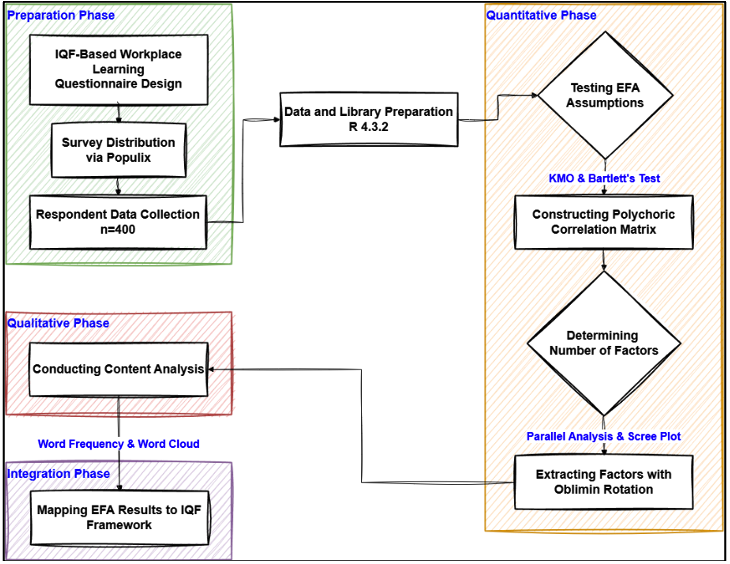
Strengthening workforce competitiveness in Indonesia requires workplace learning aligned with the Indonesian Qualifications Framework. This study aimed to identify and validate the latent structure of IQF based workplace learning and to outline an evaluation instrument and policy levers. We conducted an online cross-sectional survey of 400 workers across all provinces and applied exploratory factor analysis with polychoric correlations, oblimin rotation, parallel analysis, and a scree examination, complemented by content analysis of an open-ended question. Sampling adequacy was excellent with KMO 0.96 and Bartlett significance p under 0.001. Four coherent dimensions emerged that together explained about 65 percent of variance. Structured Competency Development captured structured training, standards, research, human resource planning, and certification. Performance Management and Workload gathered assignment, workload, remuneration, performance, and knowledge sharing. Experience Based Learning covered mentoring, internship, coaching, and job rotation. Educational Qualifications was defined chiefly by education level. Model fit was strong with RMSR 0.03 and moderate inter factor correlations, and qualitative keywords on work, skills, and experience converged with these factors. The study contributes a theoretically integrated IQF aligned model and a ready blueprint for measurement and auditing. Practically it informs policy and industry programs that link training with research and technology, formalise mentoring, reward knowledge sharing in performance systems, and map careers to qualification levels, and the instrument can audit learning ecosystems and guide resource allocation across priority sectors.
Downloads
References
Bappenas. (2025). Rencana Pembangunan Jangka Menengah Nasional Tahun 2025-2029.
Bui, T. T., Le, C. T., Le, T. T., Phan, Q. T., & Nguyen, T. Y. N. (2025). The relationship between online knowledge sharing and employee innovation: the role of task crafting and departmental support for innovation. European Journal of Management and Business Economics, 116. https://doi.org/10.1108/ejmbe-09-2024-0335
Cerya, E., & Mustika, J. (2018). Labor Competitiveness in Digital Economy: A Systematic Review of College Graduates.
Dellve, L., Jonsson, R., Arman, R., Gillberg, N., & Wikstrm, E. (2025). Organizational learning programs to fulfilling basic needs at work: significance for work attractiveness and turnover in strained sectors. Learning Organization, 32(1), 7592. https://doi.org/10.1108/TLO-12-2022-0165
Destek, G. (2023). Can the resource curse be reversed through financialization, human capital, and institutional quality? Evidence from Sustainable Development Index. Resources Policy, 86. https://doi.org/10.1016/j.resourpol.2023.104245
Ekuma, K. (2024). Artificial Intelligence and Automation in Human Resource Development: A Systematic Review. Human Resource Development Review, 23(2), 199229. https://doi.org/10.1177/15344843231224009
Erss, M., Loogma, K., & Jgi, A. L. (2024). The effect of teacher agency support, students personal perseverance and work experience on student agency in secondary schools with Estonian and Russian instructional language. Cogent Education, 11(1). https://doi.org/10.1080/2331186X.2024.2314515
Evers, A. T., Belgrave, I., Kreijns, K., & Alkan, M. F. (2025). Workplace learning of teacher educators: validation of a measurement instrument. Professional Development in Education, 115. https://doi.org/10.1080/19415257.2025.2503808
Howard, M. (2016). A Review of Exploratory Factor Analysis Decisions and Overview of Current Practices: What We Are Doing and How Can We Improve? International Journal of Human-Computer Interaction, 32(1), 5162. https://doi.org/10.1080/10447318.2015.1087664
Kaiser, H. F. (1974). An index of factorial simplicity. Psychometrika, 39(1), 3136.
Kebede, A., Asgedom, A., & Asfaw, A. (2024). Is linking technical and vocational training with industry a bridge to employability? Lessons from a literature review for Ethiopia. Cogent Education, 11(1). https://doi.org/10.1080/2331186X.2024.2406721
Kl, A. F. (2020). Exploratory factor analysis with R software. Anadolu niversitesi Eitim Fakltesi Dergisi, 4(3), 276293.
Lee, K. (2019). A functional model of workplace envy and job performance: When do employees capitalize on envy by learning from envied targets? Academy of Management Journal, 62(4), 10851110. https://doi.org/10.5465/amj.2016.1202
Monrouxe, L. V. (2017). Association of professional identity, gender, team understanding, anxiety and workplace learning alignment with burnout in junior doctors: A longitudinal cohort study. BMJ Open, 7(12). https://doi.org/10.1136/bmjopen-2017-017942
Palmquist, A. (2023). Stakeholders design preferences for instructional gamification. Behaviour and Information Technology. https://doi.org/10.1080/0144929X.2023.2255905
Peraturan Presiden Republik Indonesia Nomor 12 Tahun 2025 Tentang Rencana Pembangunan Jangka Menengah Nasional Tahun 2025 - 2029 (Lampiran I), Pub. L. No. 12, 1 (2025).
Peraturan Presiden Republik Indonesia Nomor 12 Tahun 2025 Tentang Rencana Pembangunan Jangka Menengah Nasional Tahun 2025 - 2029 (Lampiran III), Pub. L. No. 12, 1 (2025).
Populix. (2025). Expert Team Behind Populix Market Research Solutions. https://info.populix.co/about-us
Ranta, M. (2023). Board gender diversity and workplace diversity: a machine learning approach. Corporate Governance (Bingley), 23(5), 9951018. https://doi.org/10.1108/CG-01-2022-0048
Steiner, M. D., & Grieder, S. (2020). EFAtools: An R package with fast and flexible implementations of exploratory factor analysis tools. Journal of Open Source Software, 5(53), 2521.
Sulistiyono, S. T., Hattori, M., Rochwulaningsih, Y., Matsumoto, A., Masruroh, N. N., & Widisuseno, I. (2025). The dynamics of state-market relations in the quest for world-class universities in Indonesia. Discover Sustainability, 6(1). https://doi.org/10.1007/s43621-025-01635-6
Tnase, N. M. (2019). Appraisal of the regional competitiveness of the research-development sector in Romania by highlighting the correlations among clusters, workforce and expenses in CD. UPB Scientific Bulletin, Series D: Mechanical Engineering, 81(4), 341352. https://www.scopus.com/inward/record.uri?partnerID=HzOxMe3b&scp=85076487655&origin=inward
Vos, M., Petter-Mikx, E., & Collou, L. (2025). Development and validation of the learning culture scale for small- and medium-sized enterprises. Learning Organization, 32(7), 7493. https://doi.org/10.1108/TLO-09-2024-0279
Waaland, T. (2017). Mentoring and early years practitioners: Investigating the influence of higher education qualifications and social support. Cogent Education, 4(1), 1415630. https://doi.org/10.1080/2331186X.2017.1415630
Wardhana, M. A., Lestari, E., & Nikmah, M. (2024). Strengthening The Competitiveness of Indonesian Industry Human Resources Through IQF-Based Workplace Learning. Jurnal Ilmiah Manajemen Dan Bisnis, 9(2), 169184. https://doi.org/10.38043/jimb
Watkins, M. W. (2018). Exploratory factor analysis: A guide to best practice. Journal of Black Psychology. https://doi.org/10.1177/0095798418771807
Zamtinah. (2018). Developing the Indonesian Qualifications Frameworks descriptors for Electrical Engineering as the basis of the Recognition of Prior Learning (RPL). Journal of Physics: Conference Series, 1140(1). https://doi.org/10.1088/1742-6596/1140/1/012025
Downloads
Published
How to Cite
Issue
Section
License
Copyright (c) 2025 Mada Aditia Wardhana, Endah Lestari, Musilatin Nikmah

This work is licensed under a Creative Commons Attribution-ShareAlike 4.0 International License.